
Patent application US 2026/0370899A1 was filed by Google LLC on May 13, 2025, and published by the US Patent and Trademark Office on November 19, 2026 — the standard 18-month gap between filing and publication under US patent law. An examiner has issued a final rejection on all 20 claims, according to the patent tracker Patentlyze, which first flagged the filing and shared it with 404 Media. Google can still amend the claims or appeal; a final rejection is a checkpoint, not a verdict. The filing is titled “Creating a Channel of Video Experiences Tailored to a User,” and it describes, as 404 Media’s Jason Koebler reported, a continuous, auto-generated channel that casts the viewer as the lead character and inserts advertising into the finished clip.
The mechanism is three data streams feeding one prompt. The first is viewing preference: genres and titles already watched, presumably pulled from YouTube history. The second is contextual data: device IP address, language setting, GPS location. The third is demographic: age bracket, group affiliations. Patentlyze’s breakdown of the filing shows those three inputs assembled into a single prompt handed to a large language model, which in turn drives a video-generation model. The filing’s own sample prompt reads: “You are a customized video generating model. Generate a customized video for a user where the user will play the protagonist... The generated customized video follows the style and format of the top watches of the user... but the narrative for the generated customized video is customized.”
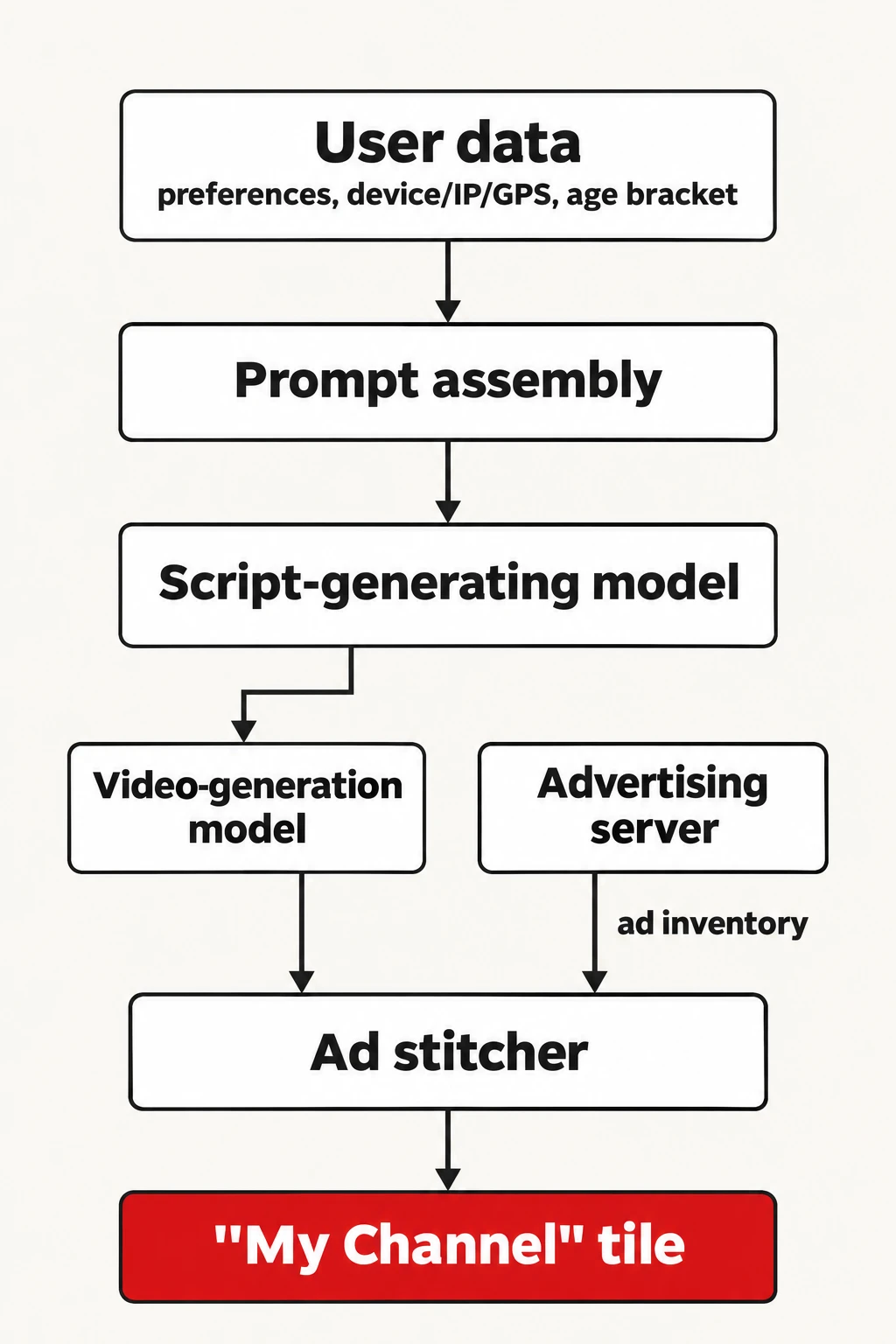
| From | To | How |
|---|---|---|
| User data (preferences, device/IP/GPS, age bracket) | Prompt assembly | |
| Prompt assembly | Script-generating model | |
| Script-generating model | Video-generation model | |
| Video-generation model | Ad stitcher | |
| Advertising server | Ad stitcher | ad inventory |
| Ad stitcher | "My Channel" tile |
Based on Google patent application US 2026/0370899A1, via Patentlyze
A fuller version of the system, per the filing, builds a personal avatar from uploaded photos and clones the user’s voice to read the lead character’s lines. One example ties generation to live events: a viewer who recently watched cricket highlights could get a video incorporating the Cricket World Cup and “cheering for India in the stands.” Generation can be triggered by a weekly, monthly or yearly timer, by direct request, or, the filing says, with no input from the user at all. Before playback, an “ad stitcher” component pulls from an advertising server and inserts commercials into the generated clip — the same insertion point a conventional streaming ad break uses, just downstream of a model instead of a studio.
A rough draft already shipped, without a patent
TCL built a cruder version of this two years earlier, and launched it. On December 12, 2024, TCL’s ad-supported streaming service TCL+ began airing five AI-generated shorts from what the company called its Film Machine, alongside the AI romcom “Next Stop Paris,” whose trailer had been widely mocked online. As 404 Media’s Koebler reported at the time, the films combined human-written scripts and voice acting with AI-generated visuals produced over 12 weeks by teams working across multiple countries using tools including Runway and ComfyUI, and they showed the usual AI tells: inconsistent character appearances, imperfect lip sync. TCL’s vice president of content services and partnerships, Catherine Zhang, described the business logic without euphemism:
Half of them don’t even change the channel.
That is the target state: passive, lean-back viewing that an algorithm fills in rather than a scheduler. Google’s patent automates the one step TCL still pays humans for — the script — and replaces it with a model prompt built from viewing history and device telemetry instead of a writers’ room.
The ad side is already industrial
The advertising half of the patent describes nothing Meta hasn’t already scaled. Meta told investors in its January 2025 earnings report that more than 4 million advertisers were using its generative AI ad tools, up from roughly 1 million six months earlier; by the first quarter of 2026 that figure had passed 8 million, Meta said on its earnings call, with those tools now generating more than 15 million AI-produced ad variants a month. A single product photo set can already yield 50-plus ad variations, matched to audiences by a targeting model rather than by a media buyer. Google’s patent proposes doing the same variant-generation trick to the twenty-two minutes of programming wrapped around the ad, not just to the ad itself.
A companion filing, personalizing what’s already live
Microsoft filed a related idea five months earlier. Application US 2026/0341309A1, filed April 29, 2025 by Microsoft Technology Licensing and published October 29, 2026, describes a system that rewrites spoken words in a live video feed — lectures, award shows, game shows, live sports — and redraws the speaker’s lips to match, on a delay of roughly one to ten seconds. As reported by tbreak, the system flags filler words, stutters, mispronounced or offensive terms and colloquialisms for replacement based on preset rules or on a viewer profile containing age, language, location, ethnicity, religion and education level — meaning two viewers of the same broadcast could hear two different scripts. The filing also covers live translation with matching lip movement. According to Patentlyze, that application was rejected too, at the same procedural stage as Google’s.
| Application | Filed | Published | Status | What it personalizes |
|---|---|---|---|---|
| Google, "My Channel" (US 2026/0370899A1) | May 13, 2025 | Nov 19, 2026 | Final rejection; Google may amend or appeal | The show itself: an AI-scripted video with the viewer as protagonist |
| Microsoft, live-event enhancement (US 2026/0341309A1) | Apr 29, 2025 | Oct 29, 2026 | Rejected; Microsoft may amend or appeal | The words and lip movements of a presenter in an existing live broadcast |
Source: USPTO filings, via Patentlyze
Neither filing is evidence of a shipping product. A rejected application with 20 claims and a named examiner — Omar S. Parra, Art Unit 2421, the USPTO division that handles television distribution systems — is a lawyer’s working document, not a roadmap. Patentlyze counts this as the 21st filing it has tracked in Google’s “AI simulation” category since May 2025, out of 193 such filings and 1,127 Google patents in its database overall: roughly one every three and a half weeks in that one category, for a company that was simultaneously building personalization into Android Auto through Gemini elsewhere in its product line. Whether any version of “My Channel” survives an appeal to the Patent Trial and Appeal Board is one open question. Whether Google, Microsoft or a rival ships a working version before the claims are settled — the way TCL shipped Next Stop Paris while the rest of the industry was still arguing about AI video quality — is the one worth watching.