
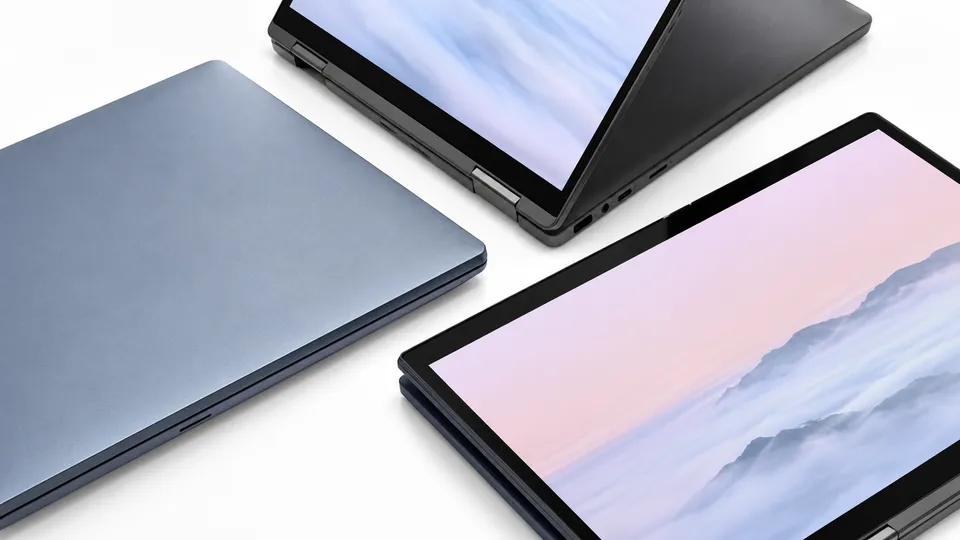
Google’s first Googlebooks go on sale in American stores on Sunday. The Android-based laptops are built around the company’s Gemini assistant and start at $899, and they arrive a week after Google told the schools that buy its cheaper Chromebooks that ChromeOS will stop receiving updates in mid-2034.
The date conflicts with a promise Google made in 2023: 10 years of updates for every Chromebook. Google’s own Auto Update policy page still lists recent classroom models, among them Lenovo’s 100e Gen 5 and 500e 2-in-1 Gen 5, Dell’s Chromebook 11 C1126M and Acer’s Chromebook 311, as supported until June 2036. For machines whose support runs past 2034, Google now says it will help them move to Googlebook OS and that “many” newer commercial Chromebooks will qualify. It has not said which ones.
Google’s support documents, its court filings and the coverage since point to a near-term risk for schools that is smaller than the headlines suggest, and a longer-term risk of a different kind. Nothing changes this year for the Chromebooks districts already own. What changes is the direction of the platform. The operating system Google built for its A.I. features is aimed at premium hardware. The tools schools need to manage it won’t arrive until the second half of 2027, the licenses it will require have no published price, and the cheap machines districts can still afford look like the least likely to make the move. The A.I. that Google is actually putting in front of students, meanwhile, runs through the web and needs none of that.
What Google told administrators
The guidance is on a help-center page for Chrome Enterprise and Education administrators titled “What the Googlebook announcement means for your ChromeOS devices.” 9to5Google reported it on Sept. 28. “ChromeOS devices will continue to receive regular updates and security patches through mid-2034,” the page says. Google also wrote that “Chromebooks you have today will continue to receive updates through their supported lifetime” and that Chromebooks “remain available for all school and enterprise deployments today.”
Most of the page is about what isn’t ready yet. This fall’s Googlebooks are consumer machines that can’t be enrolled in a school domain or managed as a fleet. Full management through Google’s Admin console, including zero-touch enrollment and reporting, starts rolling out in the second half of 2027. Existing Chrome Education Upgrade licenses stay with the Chromebooks they were bought for. Googlebooks, and any Chromebook moved to the new system, will use “a new licensing structure” whose terms Google says it will publish before commercial availability.
That gap matters more in a classroom than in an office. TechTimes noted that most American districts require student devices to be enrolled and managed so they comply with federal student-privacy laws such as FERPA and COPPA, which for now rules out an unmanaged consumer laptop. Ryan Whitwam wrote in Ars Technica that Google had publicly said only that Chromebooks would keep existing, but that its guidance suggested the platform was being wound down. He said that was a problem for schools used to getting “capable, easily managed PCs for dirt cheap.”
On Hacker News, The Register’s version of the story drew 147 comments. One reader argued that the operating system was the smaller issue.
I get that this is not 10 years support for ChromeOS. But it is 10 years of supported software upgrades for these devices. Perhaps the real issue is not the OS that runs on the devices themselves but support for the existing device management approach.
Google’s own timeline supports that reading. ChromeOS management is mature and will run until 2034. Googlebook management doesn’t exist yet. In court filings earlier this year, Google had put the new system’s full release for schools and businesses in 2028.
A date first seen in court
The 2034 date didn’t start with last month’s help page. In early February, documents from the Justice Department’s search antitrust case against Google, reported by The Verge and summarized by 9to5Google, said the “timeline to phase out ChromeOS is 2034.” They also said Google had to maintain ChromeOS “at least through 2033 to meet its ’10 year support commitment’ to existing users.” The same filings said the new system, then code-named Aluminium, would go to “commercial trusted testers” in 2026, with a “full release” for the “Enterprise and education sectors” in 2028.
Chromebooks had already mattered to Google in that case. On Sept. 2, 2025, Judge Amit P. Mehta of the U.S. District Court for the District of Columbia ruled that Google would not have to sell Chrome. According to Chrome Unboxed, Google’s lawyers had argued that a sale would make it “impossible to maintain the software support required for millions of students and businesses currently using Chromebooks.”
The plan to merge the two systems had been public for more than a year before that. In July 2025, Mishaal Rahman, then a reporter covering Android and now on Google’s Android team, posted that a Google executive had all but confirmed it.
💻 Google confirms it’s ‘combining’ Chrome OS and Android into a single platform
In November, I revealed that Google plans to unify its desktop OS efforts behind Android. Now, the President of the Android ecosystem essentially confirmed it.
Google introduced Googlebook on May 12 in its streamed Android Show, a week before its developer conference, and opened preorders on Sept. 21. Alexander Kuscher, Google’s senior director of Android tablets and laptops, told reporters that the A.I. features were “built in, but not in your face.”
Ten years, then eight
When Chromebooks arrived in 2011, Google planned on about three years of automatic updates, The Register reported. Schools bought them in bulk anyway. According to the U.S. PIRG Education Fund, 31 million Chromebooks were sold worldwide in the first year of the pandemic. The group’s April 2023 report, Chromebook Churn, written by Lucas Rockett Gutterman, argued that the machines’ built-in software expiration dates were sending working laptops to the scrap heap. It estimated that making them last longer could save American taxpayers $1.8 billion.
Google responded on Sept. 14 of that year. “All Chromebook platforms will get regular automatic updates for 10 years,” two ChromeOS engineering directors, Prajakta Gudadhe and Ashwini Varma, wrote on the company’s blog. District technology leaders treated it as relief for their budgets. “People should be happy that the expectation is that the device should be still in service in 10 years,” Jeannie Crowley of the Scarsdale, N.Y., school district told Education Week.
The 10 years are counted from the release of a hardware platform, not from the date a school buys the laptop. A platform released in mid-2024 runs out right around mid-2034, and anything newer runs past it. Google’s policy page lists dozens of models with dates in 2035 and 2036, including Asus’s CM14 and CL14 and Lenovo’s 100e Gen 5, at June 2036. A school that buys those models this fall was sold close to 10 years of updates. On ChromeOS it will get about eight.
Robby Payne of Chrome Unboxed argued that 2034 was “not an arbitrary shutdown date or a premature end of life,” because it gives devices built on 2024 boards their full decade. That holds for those devices. It doesn’t account for the 2035 and 2036 dates on Google’s own list. In May, a Google executive told Chrome Unboxed that “all Chromebooks will continue to receive support through their device’s existing date commitment.” The September page reconciles the two by moving those later years onto Googlebook OS.
That is where cheap classroom laptops run into trouble. Google hasn’t published an eligibility list. Mr. Payne predicted that “Clamshells built around entry-tier processors and 4GB of RAM will remain comfortably on ChromeOS” through their published dates. For a June 2036 model, though, ChromeOS ends two years before that date. Every Googlebook in the launch lineup has at least 16GB of memory, Android Authority reported. It was not clear what Google will offer a June 2036 machine that can’t migrate.
Budgets without a cushion
The math falls on districts that have already spent their pandemic money. The Upper Darby School District outside Philadelphia enrolls more than 12,500 students and replaces about 3,000 Chromebooks a year. There, the cost of a device has risen from about $400 per student to more than $600, the superintendent, Dan McGarry, told WHYY in August. The station traced the increase to a worldwide memory shortage driven by demand from A.I. data centers. Mr. McGarry put the district’s Chromebook spending at $2 million to $3 million a year.
I don’t think we’re going to be able to financially keep going one-to-one with our kids in the near future
In Beaumont, Texas, the school board approved a four-year, $11.19 million lease for 14,585 Apple devices, AppleInsider reported on Thursday. The district had spent nearly $470,000 on Chromebook repair and support over several reporting periods, and close to two-thirds of its devices were past their recommended life cycle. “There is not one environment in the workplace that uses a Chromebook,” said Rachel Harrah, the deputy superintendent.
Washington State has a statewide count. In the annual technology survey run by the Office of Superintendent of Public Instruction, with responses collected through June 22, districts estimated that 860,761 devices will need replacing within four years. That is about 79 percent of the devices they have deployed, and 227,520 of them are due in the 2026-27 school year.
Next to those numbers, the new hardware is priced for a different buyer. Fortune put a typical Chromebook at $300 to $400. The cheapest Googlebook, made by Acer, starts at $899, and the Dell, HP, Asus and Lenovo models start at $1,199 to $1,299, according to Android Authority. TechTimes estimated that about 38 million Chromebooks are in active use in American K-12 schools.
What A.I. readiness means
The push to bring A.I. into classrooms comes from Washington as well as from Google. President Trump’s executive order of April 23, 2025, called for A.I. instruction in K-12 schools and set up a White House task force on A.I. education. When the task force met in September 2025, Google committed to giving every American high school free access to Gemini for Education. Sundar Pichai, Google’s chief executive, announced the offer at the meeting.
It’s also why we’re offering Gemini for Education to every high school in America. That means every high school student and every teacher has access to our best AI tools, including Guided Learning
None of that requires a Googlebook. Gemini for Education reaches students through the web app and Google Classroom, and Google has since opened Gemini in Classroom to students of all ages. A.I. built into the device itself is another matter. Gemini in Chrome, the browser assistant, works on ChromeOS only on Chromebook Plus machines and only for users 18 or older, according to Google’s administrator documentation. Google’s own requirements for Chromebook Plus start at a 12th-generation Intel Core i3 or comparable chip, 8GB of memory and 128GB of storage. That is well above the 4GB entry-level machines Mr. Payne expects to stay on ChromeOS.
Googlebook goes further still. Google introduced it in May as a laptop designed for Gemini Intelligence, with features like Magic Pointer, a cursor that offers Gemini actions based on what’s on the screen. A day later, Google said Magic Pointer would also come to Gemini in Chrome, Android Authority reported. Some of the new A.I., in other words, will reach browsers before it reaches budget hardware.
Google’s preorder announcement in September put the pitch plainly.
Googlebook is available for preorder today. Built on the @Android technology stack and paired with desktop foundations from ChromeOS, it’s engineered to work with your phone right out of the box and is designed for Gemini Intelligence.
Districts say they are getting ready for A.I., but mostly on policy rather than hardware. CoSN surveyed 607 district technology leaders in 44 states for its 2026 report. According to GovTech’s account in May, 79 percent of districts had A.I. guidelines, up from 57 percent a year earlier, and 96 percent said A.I. could benefit education. In the same survey, 58 percent said they were understaffed for instructional technology, and 65 percent named insufficient budgets as the top barrier to cybersecurity.
Some schools are moving the other way. McPherson Middle School in Kansas took Chromebooks back from its 480 students in December 2025, Fortune reported, and districts in North Carolina, Virginia, Maryland and Michigan are reconsidering one laptop per student. “This technology can be a tool. It is not the answer to education,” said Inge Esping, the school’s principal.
The case against alarm
Plenty of readers thought the alarm was overdone. On Hacker News, one commenter argued that Google was keeping its word by moving the platform rather than abandoning the devices.
I don’t think any promises were broken here. Google said they would provide ten years of software updates. Now they’re saying existing ChromeOS devices will be upgraded to the new “GoogleOS” within that ten year window, they will continue to receive said updates.
Simon Batt of XDA Developers called it “pretty much all good news.” Mr. Payne’s point holds for the large fleets bought from 2021 through 2023, whose dates already fall before mid-2034 and don’t move. An expired update date has also never meant a dead laptop. In 2023 the education technology blogger Tony DePrato called the “death date” label misleading, arguing that a Chromebook still turns on and lets users log in after its last update.
Other readers pointed out that schools don’t buy laptops only once.
Large organisations don’t buy a single batch of machines then call it a day. If an organisation standardised on Chromebooks because of the support period, they will still need to buy new machines and those won’t get the support period they had expected.
That purchase is the one in front of districts now. A school that orders a June 2036 model this fall is buying into the gap between Google’s two documents. It is also buying before Google has said whether that model can migrate.
Another reader focused on one word in Google’s commitment.
The word “many” feels like it’s pretty much explicitly saying it’s not “all”. If it’s not “all” then I’d say the promises were broken.
Each side is partly right. Nothing in Google’s documents shortens support for a Chromebook already in a classroom with a date before mid-2034, and Googlebooks also come with a 10-year update pledge. But that pledge starts from the chip’s launch date, Gadget Review noted, citing Tom’s Hardware, and “many” is not a list of models. For the newest and cheapest classroom machines, Google has promised a transition it has not yet shown will work on their hardware.
A record schools remember
Districts have reason to read Google’s commitments closely. Jamboard was a $4,999 digital whiteboard Google introduced in 2016 for businesses and educators. It went view-only on Oct. 1, 2024, and boards that hadn’t been moved elsewhere were deleted after Dec. 31 that year, Android Police reported. Google sent users to third-party whiteboard tools.
In 2021, Google told schools and universities that their free unlimited storage would end and be replaced in 2022 by 100 terabytes pooled across each institution, The Register reported. Google said then that more than 99 percent of institutions would fit within the cap.
Thom Holwerda, who runs OSNews, saw the ChromeOS change in light of that history. Google’s offer to move newer Chromebooks to Googlebook OS, he wrote, was “just another promise.”
corporations are free to make and break whatever promises they want virtually free of consequences
The record has another side. So far Google has kept the 2023 pledge, and the 2034 date was in public court filings in February, more than seven months before the help page appeared. The fan-run tracker Killed by Google lists Jamboard and Stadia. ChromeOS isn’t on it.
What comes next
Googlebooks ship in the United States on Oct. 4 and in Canada, Britain, Ireland, France, Germany and Australia on Oct. 5. Google has said details on eligible Chromebooks and migration paths will be shared soon, and that licensing terms will come before commercial availability. Its education page for Googlebook still says “Chromebooks are still the best choice for classrooms.”
The management tools are due in the second half of 2027. Until they arrive, the newest laptop a district can manage on Google’s platform is a Chromebook that Google’s policy page lists as supported until June 2036, and that Google’s guidance to the administrators who buy it says will get ChromeOS updates only through mid-2034.