
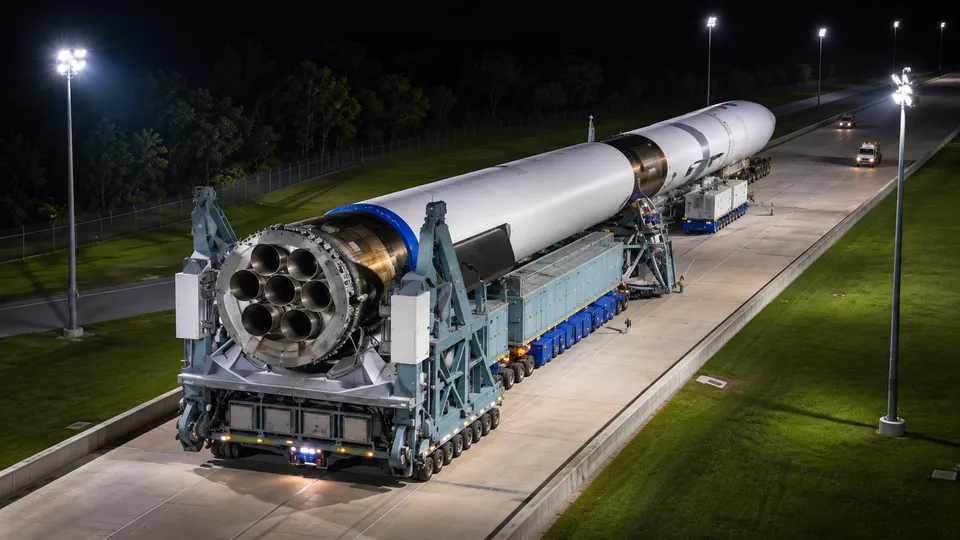
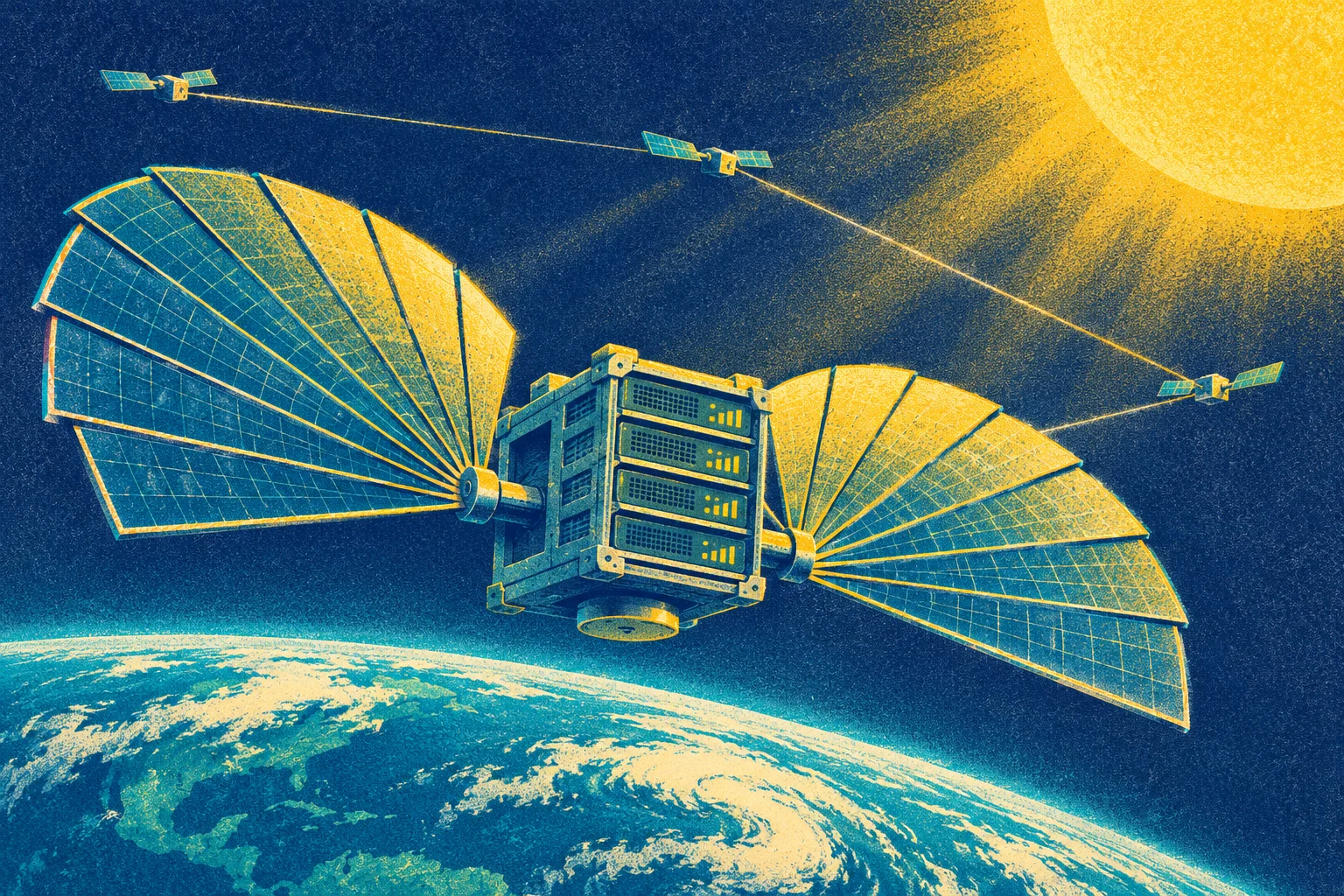
On Thursday, 19 November, Blue Origin announced that its New Glenn rocket will carry data center satellites for Google in 2029. Eric Berger reported in Ars Technica that the flight belongs to Project Suncatcher, a company effort to move computing off the planet. Each satellite will hold about as much computing capacity as one data center rack. They are bound for a sun-synchronous orbit, where the panels catch sunlight almost without a break.
The sunlight costs nothing. The trip up to it is expensive.
An orbit with almost no night
Google first described the project about a year ago and called it one of its research moonshots. According to Google’s own account, the plan is for constellations of solar-powered satellites carrying the company’s Tensor Processing Units, its AI chips, linked to one another by optical connections. On Earth, data centers compete for land, power and water. In a sun-synchronous orbit, the energy is close to continuous.
Travis Beals, Google’s senior director of Project Suncatcher, gave the company’s position in the news release. “Project Suncatcher is a long-term moonshot to scale AI infrastructure in space by tapping into the abundant solar power in orbit,” he said. “This dedicated launch with Blue Origin represents a crucial milestone on our roadmap as we expand the boundaries of what’s possible for the future of compute.”
The deal leaves a lot unsaid. Via Satellite reported that the launch is aimed at the first quarter of 2029 and that neither company would say how many satellites will fly or what the launch costs. For now the agreement covers one launch, though it could grow. The mission will use the 7×2 version of New Glenn, the smaller of the rocket’s two variants, which has flown three times so far. Google has not named the company building the satellites. They may weigh something on the order of several tons.
A demonstration before a constellation
The 2029 flight is probably a test. Its likely job is to show that solar-powered satellites carrying AI chips can be networked together and can run machine-learning work in orbit. Google is moving toward that point in stages. A first prototype, built with Planet, went up on a SpaceX rocket in October, and Google has said it is operating as expected. Planet has said it will build and operate two more prototypes for the project, with launch planned for 2027. Each step is bigger than the one before, and each one rides on somebody else’s rocket.

Renting the road
Google is booking now partly because seats are running out. US commercial heavy-lift rockets, New Glenn among them, are filling their schedules through 2030. Berger’s report puts the bigger question plainly: can a company really plan a large constellation of orbital data centers in the 2030s if it has no launch vehicle of its own?
A reflection, offered as such: an empire that depends on someone else’s ships has to accept that someone else’s timetable. Through history, the owner of the road has usually ended up with a share of whatever the travellers carried.
In this case the owners of the road are also rivals. A report carried by Yahoo Finance noted that Blue Origin is planning an orbital data center constellation of its own, called Project Sunrise. So Google may end up paying a competitor to carry its competing hardware. The same report said SpaceX, which flew Google’s first prototype, is also exploring data centers in orbit, as is the startup Starcloud. The two obvious carriers both want to sell the same product Google is testing.

Blue Origin gets something from the deal too. The report described the contract as a high-profile future mission for a launch business that has had delays and a launchpad explosion in May. The company has big plans, including a hundred Florida launches a year and a next engine it says will cost a quarter as much as the BE-4. A paying customer for 2029 gives those plans something to point to.
What a kilogram costs
Plenty of doubts remain about whether orbital data centers can ever pay their way, but on one point nearly everyone agrees. They cannot compete with data centers on the ground unless heavy launch becomes extremely cheap. Google said as much when it unveiled the project: its long-range timeline pointed to the mid-2030s, when it expected the cost of reaching orbit could drop to around $200 per kilogram.
How the economics turn out depends on that number. Neither company has said what Google will pay per kilogram for its 2029 ride.