
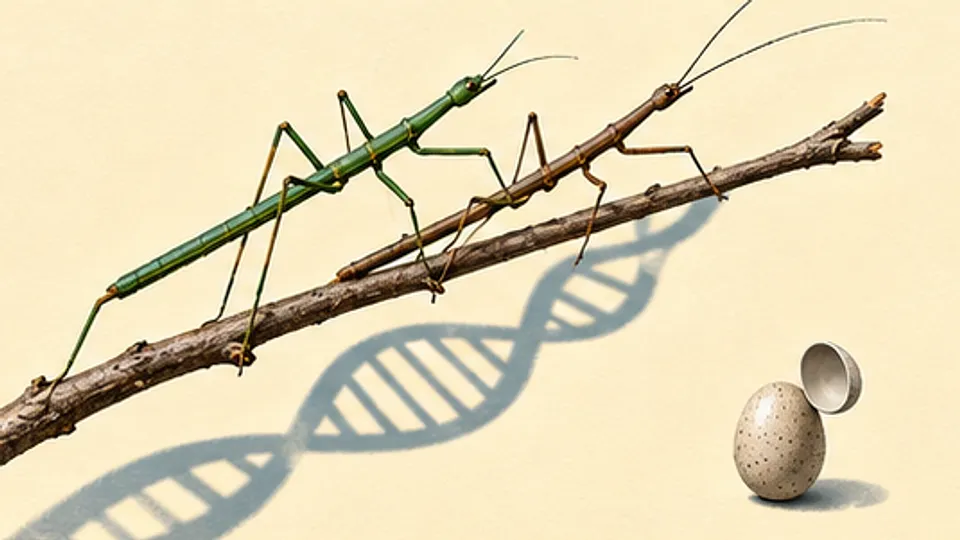
The walking stick is nature’s little confidence trick — an insect the size of a forearm that has bet its entire existence on looking like vegetation. The order’s very name is Phasmatodea, from the Greek for ghost, which tells you what farmers, bird-watchers and, it turns out, professional entomologists tend to see when they look straight at one: nothing. Australia has about 130 species of the things, out of some 3,000 creeping through the forests of the world; the biggest Australians stretch beyond two feet, the heaviest nudge the weight of a golf ball, and when the camouflage finally fails they can spray a foul or irritating liquid, play dead, detach a leg and grow it back, or simply deliver a thumping kick. And yet — here is the magnificent part — we are still only just learning their names.
Because now comes Braxton Jones, a postdoc at the University of Sydney, with a study in Austral Entomology (published September 21) announcing two brand-new species of stick insect and the resurrection of a third — all inside Anchiale, one of the most photographed, most-reported genera in the country. “Even among some of Australia’s most photographed and frequently reported insects, we’re still finding species that have escaped scientific recognition,” Jones says. “Taxonomy is often a bit like detective work.”
The detective’s kit, in this case: 35 Anchiale specimens from museum drawers and fresh field collecting — Anchiale being the big, heavy-bodied, winged twig-and-leaf mimics in their greenish-brown mufti. Thirty-two of them went through DNA analysis, with another 37 non-Anchiale insects run for comparison, and on top of that the team collated about 1,100 citizen-science observations from iNaturalist and the Atlas of Living Australia. Anatomy did its share of the talking too — the colour, length and shape of the wings, the habitats, and the eggs, which alone can identify a stick insect species.
Meet the Suspects
Suspect one: Anchiale robusta, a heavyset resident of Queensland’s coastal rainforests, notable for its size and mottled wings — and for the small matter that it had been photographed and ogled by insect enthusiasts for decades while being firmly misidentified as another species, Anchiale briareus. Seen constantly. Known not at all.
Suspect two: Anchiale mabiensis, from the critically endangered Mabi Rainforest of northern Queensland, and this one gave itself away at the very beginning of life. Other Australian Anchiale lay shiny, elongated eggs; mabiensis eggs come duller and shorter, with distinct concentric rings on the little lid that pops open at hatching — an arrangement, according to the researchers, with no recorded parallel among stick insects and their close relatives. One egg, one species, case closed.
And then the resurrection. The two reports of the study differ on the fine print, so let us give both. According to Nautilus, the revived species is A. spinicollis, the “spiny stick insect,” originally named in 1904, later cancelled, and now shown by the DNA to be distinct enough to deserve its name back. Smithsonian’s account has the reinstated insect as Anchiale albopunctata, bundled together with A. briareus back in 1908 and mistaken for it ever since — more than a century of filing error, corrected by chromosomes. Either way, the bureau of taxonomy has reopened a cold case and found the suspect was innocent all along.
In movies, they try to design all these crazy aliens. But all you have to do is just look at the insect world, because they already exist.
That was Jones again, talking to the Australian Broadcasting Corporation, and the man has a point — some female stick insects can even reproduce by parthenogenesis, producing female-only eggs that are clones of the mother, a trick Hollywood would kill for. He also told the Guardian there are “quite a lot of them” and they can hatch in huge numbers, and yet “there’s so much we don’t know about them.”
The conservation stakes ride along underneath the comedy of misidentification. The Mabi Forest where mabiensis lives has been cleared in large swaths for agriculture, as Terry Carmichael of the Wet Tropics Management Authority — not involved with the study — told the ABC. “Now we have a very rare stick insect living in that Mabi Forest,” he said. “It just makes it more and more special.” Without this work, nobody would have known the forest’s rare tenant was there at all.
Which is Jones’s closing argument, delivered with the quiet alarm of a man who has spent too long in museum drawers: the findings demonstrate the importance of protecting threatened ecosystems and of “documenting Australia’s extraordinary biodiversity before we lose species without us having even discovered them.” The ghosts are real. Some of them weigh nearly as much as a golf ball. And we have only just got around to asking their names.