
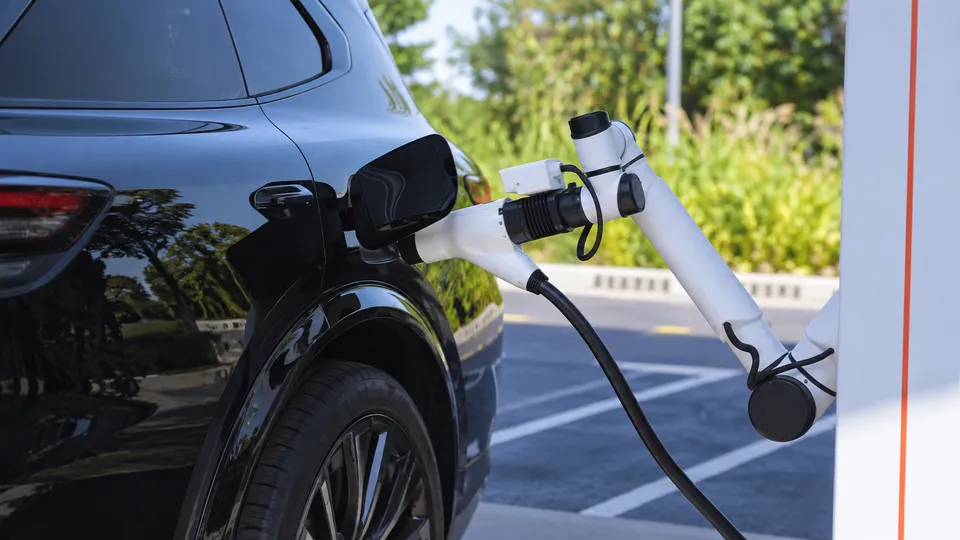
Four minutes and thirty seconds. That is the time Geely says its new battery takes, in real-world tests, to charge from 10 percent to 70 percent — the interval, roughly, of filling a tank with gasoline, which is precisely the habit of mind the figure is aimed at. China’s driving culture is younger than America’s or Europe’s, as Ars Technica notes, but it has been around long enough to teach its drivers what a fuel stop costs in minutes. The electric car has beaten internal combustion on efficiency, torque, noise and reliability; the stopwatch has been the last argument left. Geely is now arguing with it.
The numbers come from the company’s announcement of its ultra-fast, AI-managed Geely Smart Charging system. In tests using the battery in the Lynk & Co 10 and the Zeekr 001 — both Geely Auto Group brands — the pack went from 10 to 70 percent in 4 minutes 30 seconds, and from 10 to 97 percent in 8 minutes 40 seconds. (Ars Technica reported the deeper charge as 10 to 98 percent; Geely’s own release says 97.) Peak charging power reaches 2.2 megawatts. The battery uses lithium-iron-phosphate chemistry, according to Ars, and a “6C” version — the designation refers to how many times its capacity it can charge per hour — debuts in the new Geely Galaxy E5, per CarNewsChina, which frames the whole exercise as a direct challenge to BYD.
Sixty-five degrees, on purpose
Pushing 2.2 megawatts into a battery is, among other things, a thermal problem, and Geely’s answer is to run hot and know it. Thermal management is handled predictively by AI: the pack averages 55 degrees Celsius and peaks at 65 degrees during charging, the company said — temperatures that would once have been treated as a warning and are now treated as a setpoint.
The obvious objection is battery health: repeatedly forcing that much energy in, that fast, should shorten a pack’s life. Geely’s counterargument is also AI. The system applies micro pulses of current to “reactivate lithium ions accumulated at the negative electrodes during repeated fast charging,” which the company says extends battery life by 20 percent. Whether the claim survives independent testing is an open question; the mechanism, at least, is named.
Context matters here. Chinese manufacturers are in an open contest over who charges fastest, and Geely’s 2.2 megawatts is only the latest salvo, landing in a market where cars are also being sold as extensions of their owners’ digital lives, with phone-maker update cycles. Against that pace, Ars Technica’s assessment is blunt: China is making the United States look more than a little antiquated. The technology itself may eventually travel — Geely’s orbit includes Volvo and Lotus, and the pack has already been tested in the Zeekr 001 and Lynk & Co 10. Someday, the same battery could turn up in a car with a Swedish badge. For now, the only thing charging from 10 to 70 percent in under five minutes is on the other side of the world, keeping time with a gas pump.