
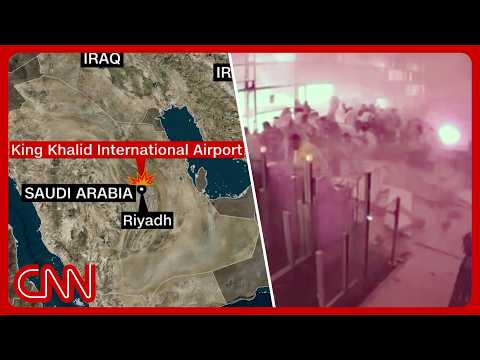
Four drones. That is what the Saudi-led coalition says its air defences shot down over Riyadh, the Eastern Province and southern Saudi Arabia on 17 October, the latest interception in a campaign that has put a Saudi airport out of commission twice in two weeks. The next day, the Gulf Cooperation Council’s foreign ministers, meeting in Manama, reached for language the six-member bloc rarely uses outside a crisis: an attack on any one GCC state, the council said in its statement, ‘would be considered an attack affecting all members.’ The bloc comprises Saudi Arabia, Bahrain, Kuwait, Oman, Qatar and the United Arab Emirates, none of which has been hit as hard this month as the kingdom itself.
The coalition spokesman, Major-General Turki al-Maliki, described the 17 October interceptions in characteristically flat terms.
We intercepted and destroyed four drones over the past few hours in the regions of Riyadh, the Eastern Province, and the South.
Al-Maliki’s own tally, given at a coalition press conference days earlier and reported by Arab News, puts the scale of the campaign in numbers: 20 attacks on Riyadh’s King Khalid International Airport alone since 1 October, using a mix of 10 drones, four ballistic missiles, four cruise missiles and two unidentified projectiles, killing 17 people and wounding 333 at that airport. Add Abha International (two killed, 28 wounded) and Jizan’s King Abdullah bin Abdulaziz Airport (three wounded), and five Saudi airports have taken fire since 5 October. Other counts run slightly higher: Wikipedia’s tally of the same ten days puts the toll at 20 dead and more than 370 wounded, a gap that reflects deaths reported after the coalition’s last briefing, including an Indian national and an Egyptian flight attendant who died of their injuries days after the 10 October strike that hit Terminals 3 and 4. Al-Maliki says the coalition has destroyed 127 Houthi warehouses built into the mountains around Sanaa, Saada and Amran, which he describes as the launch sites for the barrage.
Why the airports are burning now
The missile campaign is retaliation for a ground war. Houthi forces lost the Red Sea port of Mocha in early October to a government counteroffensive branded Operation Dawn of Yemen, and have pushed back hard around Taiz, the government-held city whose siege by Houthi forces Al Jazeera reports has left its 12 hospitals holding four days of fuel, no surgical supplies and a worsening cholera outbreak. Yemen’s UN envoy, briefing the Security Council, said the country has fallen back into full-scale civil war, its twelfth year of conflict reopened after a period of relative calm since the 2022 truce.
The displacement numbers moved fast through October and don’t fully agree with each other, because two UN agencies are counting the same war with different methods. OCHA reported on 12 October that 216,000 people had been displaced nationwide since the fighting escalated in August, with 172,000 of them from Taiz governorate. By 15 October the figure, now attributed to the International Organization for Migration, had risen to more than 230,000, as Middle East Monitor reported. By 18 October the national total had reached 233,000, but IOM’s Taiz subtotal had fallen to 121,000 — not because people returned, but because the two agencies’ registration counts for the same governorate differ by roughly 50,000. UNHCR separately counts more than 4,000 refugees who have crossed into East Africa, almost all of them to Djibouti, where its Markazi camp has recorded 31 cholera cases and one death.
What the statements actually commit anyone to
The GCC’s mutual-defence line has no treaty mechanism behind it comparable to NATO’s Article 5; it is a political statement, not a legal trigger for joint military action. What it does is escalate the diplomatic track. On 15 October the UN Security Council adopted presidential statement S/PRST/2026/4, condemning what it called the ‘reckless strikes’ of 10 and 11 October by name, affirming Saudi Arabia’s right to self-defence under international law, and calling for stricter enforcement of the arms embargo set out in Resolution 2216 of 2015. It stopped short of designating the Houthis a terrorist organisation outright, which the GCC had explicitly asked for. The United States already applies that label unilaterally: the State Department redesignated Ansarallah, the Houthis’ formal name, as a Foreign Terrorist Organisation on 4 March 2025, a status a UN Security Council sanctions listing would make binding on all 193 member states rather than just US persons and banks. No council member has moved to add that listing.
| From | To | How |
|---|---|---|
| Government ground offensive (Dawn of Yemen; Mocha retaken, Taiz besieged) | Houthi missile and drone campaign (Riyadh, Abha, Jizan airports; Aramco sites) | draws retaliation |
| Houthi missile and drone campaign (Riyadh, Abha, Jizan airports; Aramco sites) | Saudi-led coalition response (interceptions; strikes on warehouses in Sanaa, Saada, Amran) | forces response |
| Saudi-led coalition response (interceptions; strikes on warehouses in Sanaa, Saada, Amran) | Houthi missile and drone campaign (Riyadh, Abha, Jizan airports; Aramco sites) | strikes warehouses |
| Houthi missile and drone campaign (Riyadh, Abha, Jizan airports; Aramco sites) | GCC and UN Security Council statements (mutual-defence language; S/PRST/2026/4) | prompts condemnation |
| GCC and UN Security Council statements (mutual-defence language; S/PRST/2026/4) | Allied troop pledges (Pakistan-Turkey pact; Egypt's National Defence Council) | spurs commitments |
| Allied troop pledges (Pakistan-Turkey pact; Egypt's National Defence Council) | Government ground offensive (Dawn of Yemen; Mocha retaken, Taiz besieged) | reinforces government side |
Based on Compiled from Al Jazeera, UN and Reuters-wire reporting
The troops behind the rhetoric
Two commitments this month are more concrete than a council statement. Pakistan and Turkey agreed to send forces to Saudi Arabia under a mutual-defence pact, and Egypt has begun the domestic legal process to do the same. President Abdel Fattah al-Sisi told Egypt’s National Defence Council his country was ready to ‘carry out any measure to protect’ Saudi Arabia if Riyadh asked, adding it was ‘inconceivable’ for Cairo to stand by while the kingdom’s ‘security and stability’ were threatened, while stressing ‘I’m not talking about fighting anyone or attacking anyone... We are speaking only about defence,’ according to The National. Under Article 152 of Egypt’s constitution, Sisi cannot send troops abroad on a combat mission without a vote of two-thirds of parliament in an urgent closed session; an MP close to the state told reporters the council had already approved a ‘defensive mission.’ The Houthi-run parliament’s speaker wrote to his Egyptian counterpart warning that joining what he called ‘the same trench as the takfiri forces and the Israeli occupation entity’ would pose ‘a grave danger’ to Egypt’s own security — a threat aimed at a country that has so far pledged support without committing a single soldier.
Riyadh’s King Khalid Airport, closed and reopened twice already this month, was due to resume full operations on 17 October after its latest suspension. Whether it stays open past the next barrage, and whether the Security Council follows its presidential statement with an actual sanctions listing rather than a renewed call to enforce the one from 2015, are the two numbers worth watching next: one measured in days of normal flight schedules, the other in votes among 15 member states that have so far managed only unanimous condemnation.