
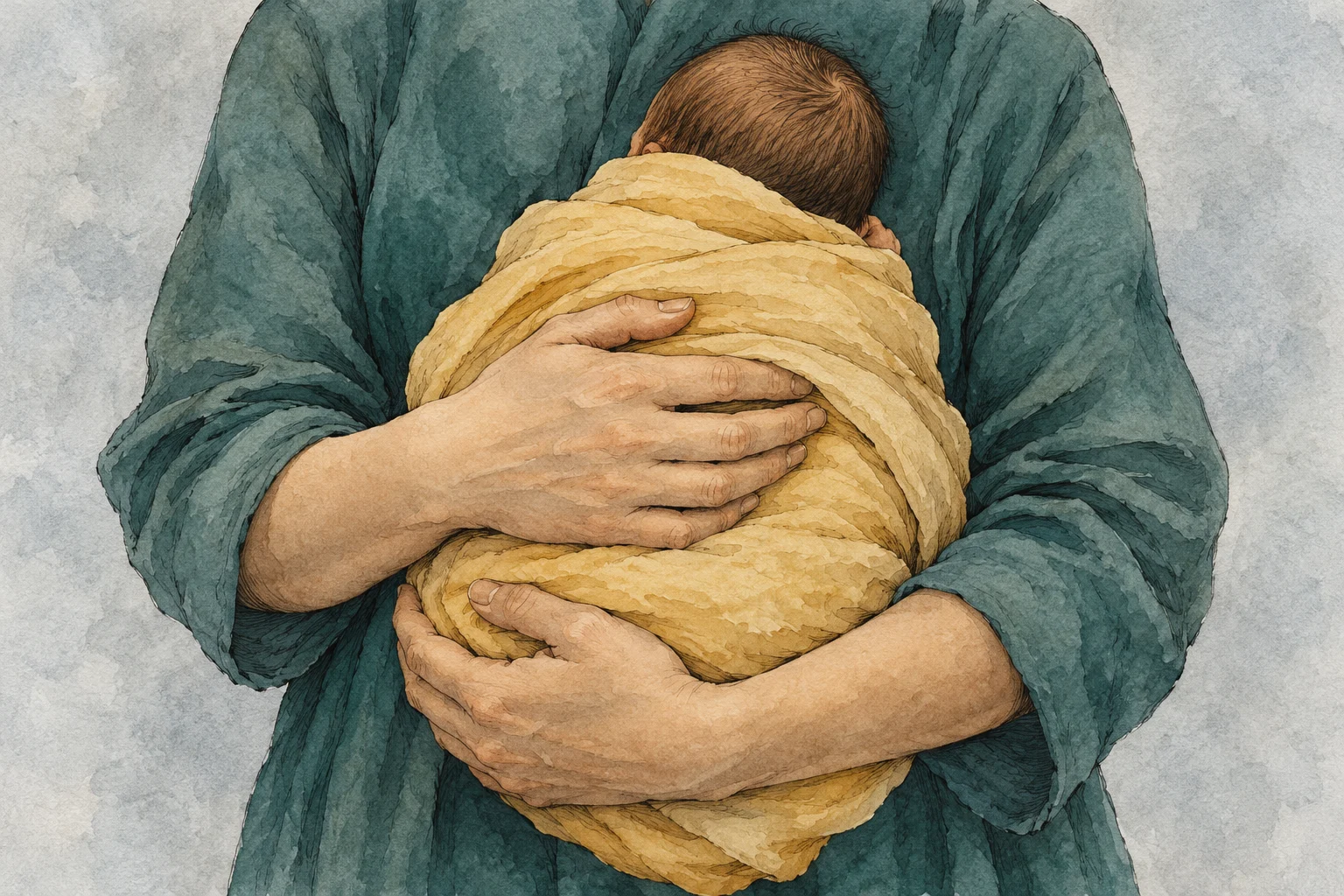
Kangaroo mother care is the clinical name for a specific protocol, not a metaphor: a premature or low-birth-weight newborn, dressed only in a diaper, held upright against a parent’s bare chest for continuous skin contact, combined with exclusive breastfeeding. The World Health Organization’s clinical guideline sets a floor of at least 8 hours a day, with 24 hours a day as the target, started as soon after birth as the infant can tolerate being moved (per the WHO guideline). At Nasser Hospital in Khan Younis, in southern Gaza, a pilot programme that WHO, UNICEF and UNFPA helped launch in September is starting at a quarter of that floor: an immediate target of 2 hours a day, as Al Jazeera reported.
The 8-hour figure traces back to a randomised trial of 3,211 infants published in 2021: among 1,609 babies assigned to immediate, continuous skin-to-skin contact, 191 (12.0%) died by 28 days, against 249 of 1,602 (15.7%) in a control group that got identical conventional care minus the contact — a relative risk of 0.75, a 25% reduction (NEJM). The intervention group averaged 16.9 hours of contact a day; controls got 1.5. WHO’s own briefing material, cited in Al Jazeera’s reporting, rounds this up to a 32% cut in overall neonatal mortality and a 25% cut in deaths by six months of age — different figures from different reviews (a separate Cochrane meta-analysis of stabilised low-birth-weight infants found a 40% mortality reduction). The numbers move with the population studied and the endpoint measured; what doesn’t move across any of the reviews is the direction, or the fact that it costs nothing.
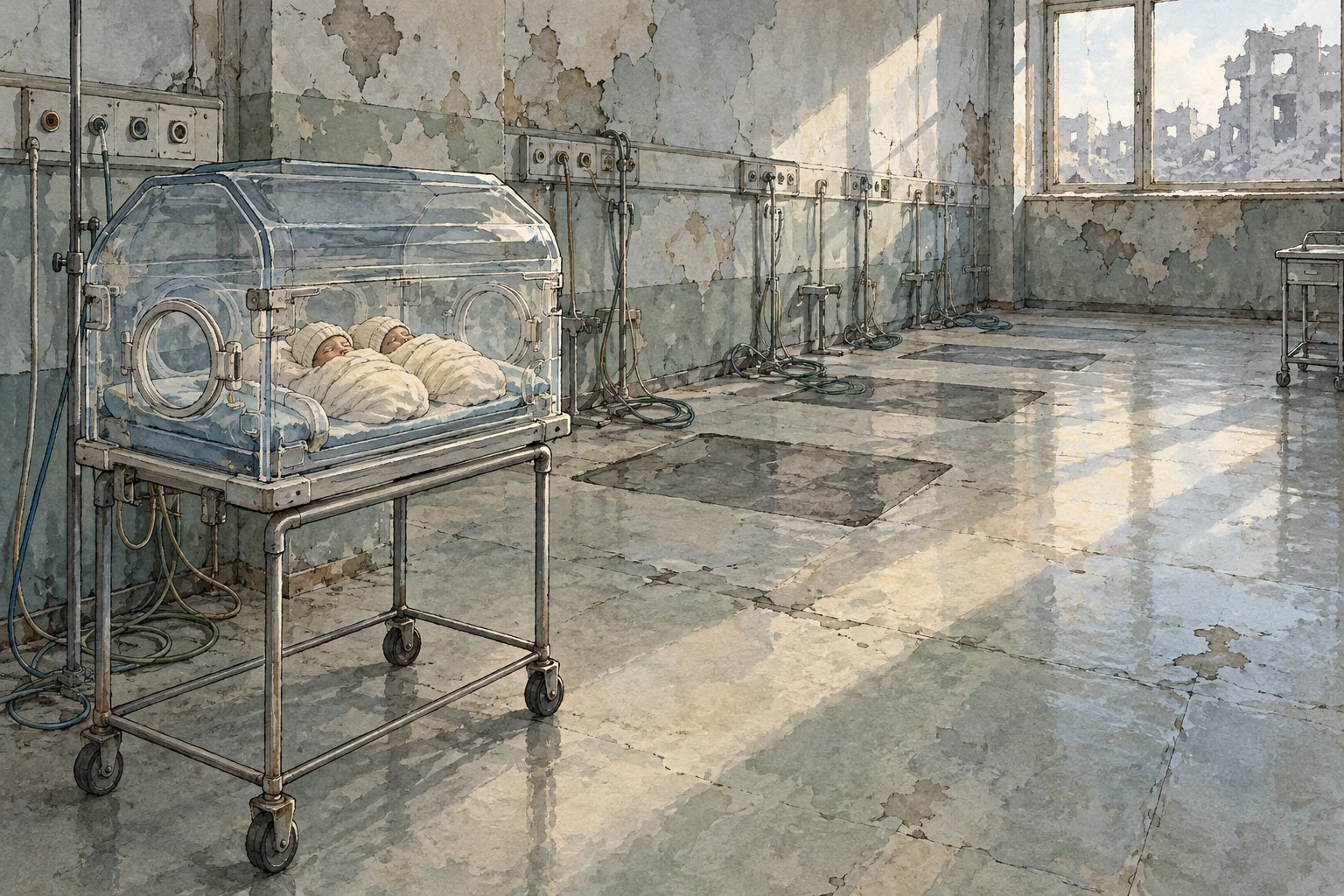
The appeal for Gaza isn’t the evidence, which has been settled since WHO updated its guidance in 2022; it’s the balance sheet. An incubator is capital Gaza can’t easily import under blockade; a parent’s chest isn’t. Before the war, Gaza had 8 neonatal intensive care units with 178 incubators between them. By November 2024, Israeli strikes had destroyed 3 of those units, all in the north, and cut the incubator count 70%, to about 54, according to a UNICEF statement issued that month (UNICEF). UNICEF has since delivered 93 incubators to six facilities, its Palestine advocacy chief Toby Fricker has said, but no agency has published an updated territory-wide count, and hospitals including Nasser still routinely place two or three newborns in a single incubator.
Hatem Dhahir, head of Nasser’s neonatal department, described the arithmetic to Al-Monitor: “there is no oxygen available for them, nor is there any spare incubators in the hospital.” Transfers to other wards, he said, “they’re always full and the situation is very bad.” The UN humanitarian agency OCHA’s 27 March 2026 situation report put a number on the strain: one in three pregnancies in Gaza classified as high-risk, and 70% of newborns premature or underweight, against a pre-war baseline the agency separately measured at roughly 9.5% premature and 9.1% underweight (OCHA). The same report counted about 15 births a week outside any health facility and without a skilled attendant, and found that of the 17 hospitals and 12 field hospitals offering obstetric and newborn care across the Strip, most were only partially functional.
The demand side has kept rising. A UNICEF briefing in December counted low-birth-weight births climbing from about 5% of all births in 2022, roughly 250 a month, to 10% in the first half of 2025, about 300 a month, to 15% in the third quarter of 2025 — an average of 460 babies a month, or 15 a day, nearly double the pre-war rate (UNICEF). Deaths on a baby’s first day of life rose over the same window from 27 a month to 47, a 75% increase that doctors partly attribute to a rise in congenital abnormalities. Maternal malnutrition is one driver: 38% of pregnant women screened by UNICEF and its partners in the third quarter of 2025 tested acutely malnourished, and 8,300 pregnant or breastfeeding women were admitted for malnutrition treatment in October 2025 alone, about 270 a day. UNFPA counted nearly 4,000 pregnancy losses in Gaza in the first half of 2026, more than three times the rate of the previous six months, with more than half of pregnant women anaemic (UNFPA).
| Low birth weight share (%) | |
|---|---|
| 2022 (pre-war) | 5 |
| H1 2025 | 10 |
| Q3 2025 | 15 |
Source: UNICEF. Q3 2025 equates to about 460 births a month, or 15 a day
A US-backed ceasefire took effect in October 2025. It has not stopped the damage to maternal and newborn care: Israeli strikes have continued since, even as one Gaza doctor has kept working out of a tent after losing three clinics to strikes in 13 months.
At Nasser, Khawla al-Madhoun, director of nursing for the maternity and neonatal departments, says the hospital is setting aside a dedicated room for kangaroo care and seeking more equipment. The method, she says, can’t substitute for an incubator in a baby who needs oxygen or other intensive support — for now it’s limited to infants judged medically stable and off respiratory support. “When we place a baby on the mother’s chest, it helps the baby grow,” she said. “We have seen babies who were unwell or underweight begin to grow faster with kangaroo care. This can help them leave the hospital sooner.” Rania Fadel, 24, gave birth to twin boys, Ilyas and Yahya, on 25 September; Ilyas was born at 1.4kg with blood and lung problems that required an incubator, and Fadel, recovering from a Caesarean, could not hold him for 11 days. She now holds him skin-to-skin for about 90 minutes a session. “I was so happy,” she said. “It was such a beautiful feeling.” Linda Abu Nasira, 23, holds her 3-day-old daughter for roughly 30 minutes every 2 hours, from a tent she shares with two other children, aged 2 and 3, in al-Mawasi. “As a mother,” she said, “it means a lot to me to feel that I am helping my daughter.”
The arithmetic the pilot can’t fix is the one behind its own 2-hour target. That’s a quarter of WHO’s 8-hour floor and a twelfth of its 24-hour ideal; the trial behind the 25% mortality figure ran at a median of 16.9 hours a day. Closing that gap depends on things no hospital controls: whether mothers recovering from surgery, raising other small children in tents, and themselves undernourished can spend most of a day skin-to-skin with an infant who may still need oxygen on and off, and whether the next incubator shipment arrives faster than the next spike in premature births.