
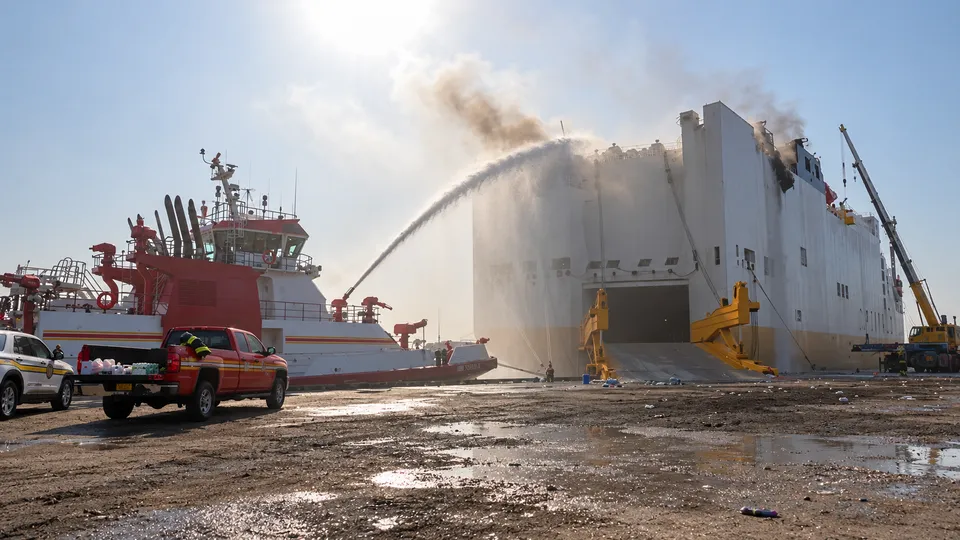
Gaps in training, coordination and emergency planning are still hampering the response to ship fires at U.S. ports, a federal watchdog said in a report released on Tuesday, three years after two Newark firefighters were killed battling a blaze aboard a cargo ship.
The Government Accountability Office counted 886 nearshore marine fires reported to the Coast Guard between 2015 and 2025. Of those, 206, nearly a quarter, caused a death, an injury, more than $200,000 in damage or the total loss of a vessel.
Unlike most emergencies on land, responsibility for a ship fire is divided: the Coast Guard generally coordinates the federal response while local departments do the firefighting, often alongside vessel operators, port authorities and commercial salvage firms. That structure, the G.A.O. said, can leave local firefighters facing unfamiliar vessels, confined spaces and hazardous cargo without enough shipboard experience.
The dangers came into focus in July 2023, when fire broke out aboard the Italian-flagged Grande Costa D’Avorio, a roll-on, roll-off cargo ship, at Port Newark. Firefighters became disoriented in smoke and the ship’s unfamiliar layout. Augusto Acabou and Wayne Brooks Jr. were killed and several others were injured. The fire burned for five days and caused an estimated $23 million in damage, according to the Coast Guard.
The last training exercise offered to the firefighters who responded had been held nine years before the accident, and only one of them had attended it, the G.A.O. noted. Coast Guard officials in six sectors told investigators that firefighters needed more hands-on preparation, including vessel tours and realistic shipboard drills. Fire chiefs said arranging access was hard: ships spend limited time in port, and firefighters cannot board without an owner’s approval.
The Coast Guard set up a National Salvage and Marine Firefighting Task Force in January 2024 and has developed online training and other tools. But as of September, the G.A.O. said, it had not produced guidance for a hands-on exercise program.
The report also faulted delays in activating vessel response plans, which summon commercial firefighting and salvage resources. In the Newark fire, the ship’s plan was not activated until about eight hours after the fire began, after land-based firefighters had already gone aboard; the Coast Guard’s investigation concluded that earlier activation might have limited the fire’s growth. Coast Guard officials and marine firefighting providers described a broader “wait and see” problem, the G.A.O. said, in which operators hesitate because of the cost of mobilizing.
A newer worry is alternative fuels. The worldwide fleet of battery-powered vessels grew from 142 ships in 2017 to 1,006 in 2024, with 1,584 more on order through 2027, according to data the G.A.O. cited. Lithium-ion batteries can enter thermal runaway, generating intense heat, toxic gases and fires that are hard to put out — a risk underscored by the 2025 fire and sinking of the car carrier Morning Midas in the North Pacific. Yet current law limits the Coast Guard’s ability to require some nontank vessels using alternative fuels, including battery-powered ferries, to keep response plans for hazardous-substance emergencies, provisions written before such ships were common.
The G.A.O. recommended that Congress consider changing the law to require response plans for worst-case hazardous-substance discharges from those vessels, and issued five recommendations to the Coast Guard, including assigning marine firefighting coordination duties to specific field personnel, arranging vessel tours and exercises with local departments, setting up a system for sharing lessons and clarifying when response plans should be activated. It also called for regulations requiring tank vessels to plan for worst-case hazardous-substance discharges, not just oil spills. The Department of Homeland Security agreed with all five recommendations.