
Members of Pulaku, a volunteer vigilante force led by Fulani herders, drilled with locally made firearms and machetes in the savanna outside Yola on a Tuesday in late September.
About 30 men in olive-green uniforms piled out of three Toyota Hilux trucks an hour’s drive from the city and rehearsed patrol tactics, several crouching on the reddish sand to aim at the open bush, Al Jazeera reported. Among them was Mahmud, a former cattle herder in his late 20s who gave only his first name and has yet to confront kidnappers himself. “We are ready to fight day in, day out,” he said.
The group’s leaders say Pulaku now has more than 500 members operating across Adamawa and neighboring Taraba State, manning a region where armed groups have abducted residents for ransom and stolen livestock for years, using mountains and forests as cover. SBM Intelligence, a Nigerian research firm, recorded 21 kidnapping incidents in Adamawa involving 77 people, and four in Taraba involving 14, between July 2025 and June 2026. In nearby Borno State, families have emptied their savings and sold livestock for ransoms.
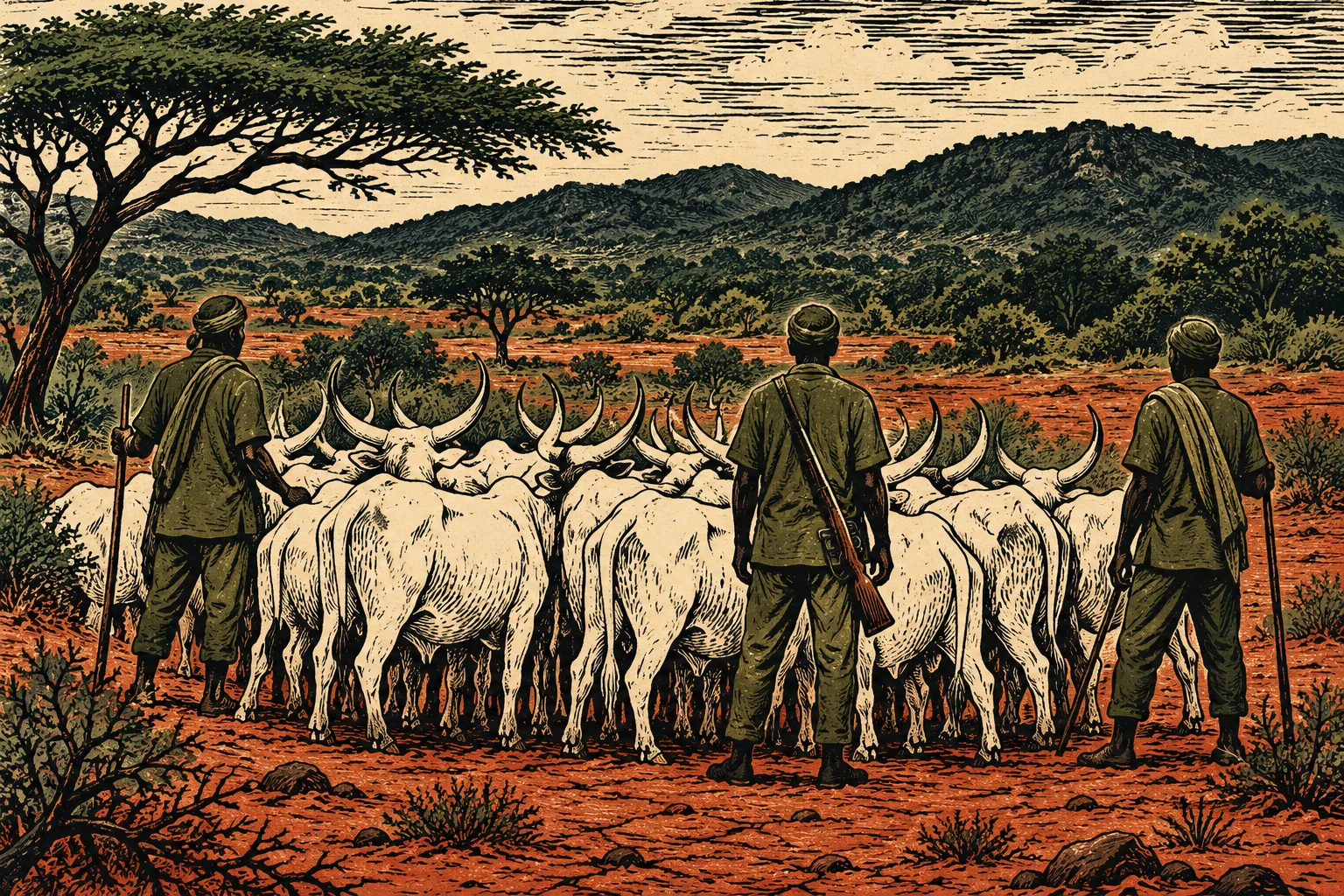
The cattle losses run deep. A 2024 study in the University of Jos Journal of Political Science estimated that 134,182 cattle were stolen in Taraba between 1999 and 2022, while more than 113,000 stolen cattle were recovered in Adamawa over the same period. At an estimated 700,000 naira ($525) a head, a 50-cow herd is worth about 35 million naira ($26,254) — a family’s livelihood.
Fulani leaders say they fight a second battle, against the way their ethnic identity is fused with kidnapping and banditry in parts of Nigeria’s media. A 2021 study in African Journalism Studies, examining 598 articles in three Nigerian newspapers, found reports that used “herdsmen” and “Fulani herdsmen” interchangeably alongside labels such as “Fulani terrorists.” “It’s painful to see an entire ethnic group being stereotyped,” said Alhaji Bello Ardo, a Fulani community leader in Adamawa. “If people are robbed, they say it’s Fulani without knowing who the perpetrators are.”
Pulaku took shape more than a decade ago in Malkohi, outside Yola, founded by the late Alhaji Abdu Bali and Musa Usman Malkohi, its current commander, among other community leaders. The name invokes pulaaku, the Fulani code of dignity, patience and courage. Professor Abubakar Abba Tahir, a spokesman for the Adamawa Emirate, called pulaaku “a living cultural concept” — and cautioned that “the mere use of pulaaku in an organisation’s name does not, by itself, establish that its activities fully reflect the broader cultural ideal.”
The force operates outside Nigeria’s formal security services. “The group is not on the government payroll,” said Mr. Malkohi, an older man with a short grey beard who declined to give his age. Members contribute their own resources; local government chairmen have given money for running costs, and the Adamawa State government has provided vehicles. One truck is painted: “Thank you Governor Ahmadu Umaru Fintiri.” Membership is voluntary, its ranks include men of the Verre and Chamba ethnic groups, and the leadership decides who may carry a firearm. For the police, the group’s value lies in its knowledge of the forests where kidnappers hide.
Al Jazeera reported that the organisation also faces allegations of torture, which shadow its work. Mr. Ardo, the community leader, insists the suspicion falls on the wrong people. “We are also not safe. Our cattle are being stolen, and we are also being killed,” he said. “People don’t understand that not all Fulani are terrorists.”