
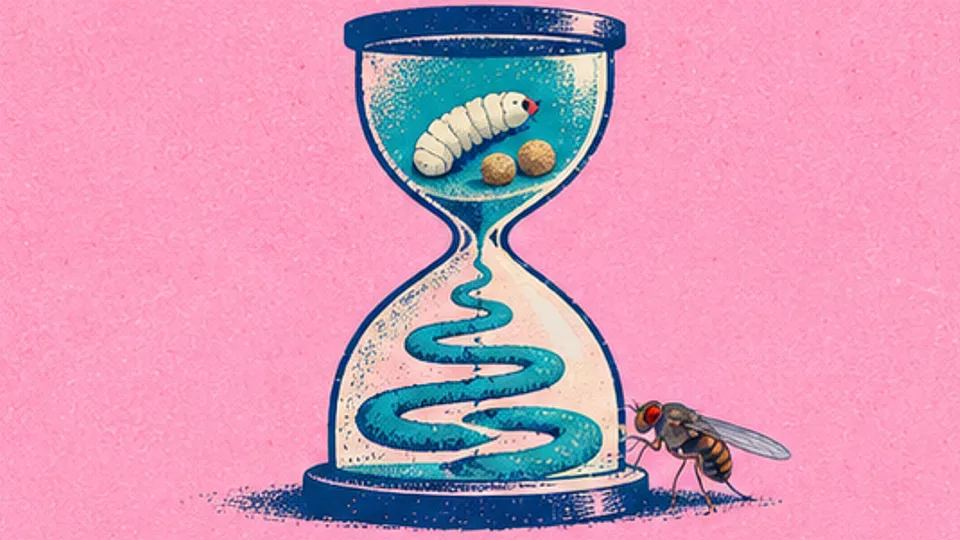
Fruit flies fed a low-protein diet as larvae live longer as adults, and researchers in Japan say they have identified the protein that records that early diet inside the body.
The finding, published in the journal Nature by a team led by Fumiaki Obata, a biologist at the RIKEN Center for Biosystems Dynamics Research in Kobe, offers a mechanism for an effect scientists first observed in the 1930s, when water fleas and rats fed restricted diets while young went on to live longer. The pattern has since appeared in fruit flies and mice.
Obata’s team cut only the yeast, the flies’ main protein source, from 8% of the larval diet to 1% or 2%, beginning roughly halfway through the larval period; once the flies emerged as adults, they returned to standard food. The protein-restricted flies, male and female, outlived their well-fed siblings, though they were paler, weighed as much as 28% less, and females laid fewer eggs.
“It’s very common, actually. Reproduction and lifespan are always in a trade-off relationship,” Obata said. But when amino acids, the building blocks of protein, were added back to the low-yeast larval food, the lifespan gain disappeared, evidence that the adult body retains what the team calls a nutritional memory of larval protein intake.
To find the memory, the researchers raised larvae on a synthetic diet in which the amino acids lysine and arginine were made with heavier isotopes of carbon and nitrogen, then fed the adults food tagged with lighter isotopes. Mass spectrometry on proteins from the flies’ heads showed whether each fragment had been built from larval or adult meals.
Three days into adulthood, nearly 64% of proteins in the flies’ heads were still built from amino acids eaten as larvae; by day six the figure was about 46%. Prominent among them were ribosomal proteins, part of the machinery that makes all other proteins; protein-restricted flies had fewer of them and produced new proteins more slowly during their first week of adulthood.
Because pupae do not eat during metamorphosis, the larval amino acids had to be stored in something sensitive to early protein intake. The team identified larval serum protein 2, or Lsp2, which larvae stockpile in quantity as reserves for metamorphosis. Restricted larvae made less of it — deliberately lowering specific amino acids lowered it further — and levels stayed low even after normal feeding resumed.
Genetically silencing Lsp2 in larvae produced adults with fewer ribosomal proteins, slower protein production and longer lives, mirroring the low-protein flies. Lsp2 is unusually rich in phenylalanine and tyrosine; removing tyrosine from larval food, or cutting phenylalanine to a quarter of its usual level, lowered Lsp2 and extended lifespan, while restricting isoleucine had no effect. “The low-tyrosine, low-phenylalanine flies cannot make enough [Lsp2],” Obata said. “It’s the same thing that happens under the low-protein diet condition.”
The chain the team reconstructed runs from less larval protein to less Lsp2 to fewer ribosomes and slower protein production in young adults, then to a longer life — an effect Obata attributes to improved proteostasis, the cell’s ability to keep its proteins in working order. Not every link is established. “What we have to find out is why this Lsp2 is preferably going to the ribosome,” he said. “This part is still kind of a mystery.” Manipulating ribosome levels directly is not technically possible because they comprise roughly 100 proteins that would all have to be adjusted at once, he said.
The work does not point to longevity diets for children: mammals, including humans, have no direct equivalent of Lsp2. Obata said the closest functional counterparts in people are albumin and globulins, which together make up about 90% of the protein in blood and, like Lsp2, are abundant, quick to turn over and sensitive to dietary protein.
Testing whether those proteins carry a similar memory would begin in mice, then perhaps primates, Obata said, while human studies would look for correlations between albumin levels and lifespan. Human albumin is not rich in tyrosine or phenylalanine, so a human mechanism could depend on different amino acids. “We have to find out which amino acids are key, which molecular carrier would be equivalent to Lsp2, and then whether there really is a connection between lifespan and the diet in people,” he said.