
Carrefour’s operating profit will come in €80 million to €200 million lower this year ($90 million to $225 million), the retailer said in its October 20 third-quarter results, pointing to looted and damaged stores and falling footfall tied to France’s unrest. Chief financial officer Matthieu Malige put the direct costs at “several tens of millions of euros” in stolen or destroyed merchandise, damaged stores and equipment, on top of stores closed outright; 50 Carrefour outlets were hit directly. Quarterly revenue still rose 3.9% to €22.7 billion, up 2.3% on a like-for-like basis, so the cut is not about underlying demand — it is about four weeks of broken windows and shuttered tills. Jefferies estimates the hit could absorb up to 60% of Carrefour’s fourth-quarter operating profit, the quarter that normally carries the end-of-year shopping season, as CNBC reported.
The market reaction outran the warning. Carrefour shares fell as much as 15% in Paris on October 21, their steepest intraday drop since 2017, and lost 17% over five trading days — more than €2 billion ($2.2 billion) of market value, roughly ten times the midpoint of the profit hit the company actually disclosed. Morgan Stanley cut Carrefour to Equal Weight from Overweight and trimmed its price target to €18.35 from €20.10, warning that 2026 French earnings before interest and tax could land 7% to 17% below prior estimates and group EBIT 3% to 9% lower. CEO Alexandre Bompard called the situation “unprecedented”; the France country manager who has to plan staffing around curfews and store closures has no comparable year to plan against.
That single company’s numbers are the clearest data point in a bigger mechanism: street violence raises a sovereign’s borrowing cost. France’s benchmark 10-year government bond, the OAT, traded at 5.05% on October 23, against 3.33% for the equivalent German Bund — a gap of 171.8 basis points, according to Ideal-investisseur.fr’s daily spread tracker. The OAT yield had already pushed above 5% on October 21 for the first time since 2002, as Macron faced down competing explanations for the unrest, and the Bund spread is now at its widest since the euro-zone debt crisis of November 2011 — a level last reached when markets were pricing in the possibility that Italy or Spain might need a bailout.
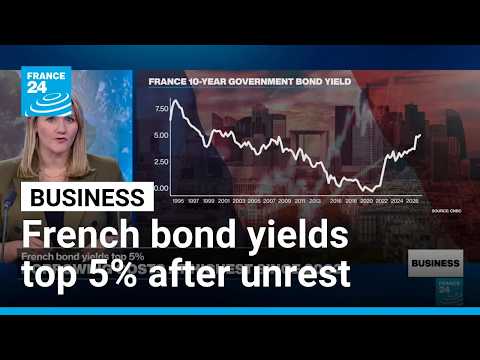
A wider spread is not an abstraction. France’s debt agency, Agence France Trésor, plans to sell a record €340 billion ($386 billion) of medium- and long-term bonds net of buybacks in 2027, Bloomberg reported — about 10% more than this year’s programme, and the largest AFT has ever run. Every basis point of extra yield on that stack compounds: the state’s budgeted debt-interest charge rises from €62.6 billion this year to €72.9 billion in 2027, according to the draft budget figures tracked by EU Debt Map. France’s public debt, measured at 119.0% of GDP at the end of the second quarter of 2026, according to INSEE, is on the finance ministry’s own projection headed for 121.7% of GDP in 2027 — a level the statistics agency says has never been recorded since it began compiling the series in 1978.
| From | To | How |
|---|---|---|
| Protests turn violent (~550,000 marchers Oct 17) | Stores looted, closed (50 Carrefour outlets hit) | |
| Stores looted, closed (50 Carrefour outlets hit) | Consumer spending pulls back | |
| Consumer spending pulls back | Corporate profit warnings (Carrefour: -€80m to -€200m) | |
| Corporate profit warnings (Carrefour: -€80m to -€200m) | Equity selloff (CAC 40 -4.5% in a month) | |
| Equity selloff (CAC 40 -4.5% in a month) | Bond portfolio outflows (Natixis: tactical, not buy-and-hold yet) | |
| Bond portfolio outflows (Natixis: tactical, not buy-and-hold yet) | OAT yield rises (5.05%, highest since 2002) | |
| OAT yield rises (5.05%, highest since 2002) | Bund spread widens (171.8bps, widest since 2011) | |
| Bund spread widens (171.8bps, widest since 2011) | Deficit target at risk (5% of GDP in 2027) | higher interest bill |
| Deficit target at risk (5% of GDP in 2027) | Negative outlook held (Moody's Aa3, review Dec 11) |
Based on CNBC, Agence France Trésor, Moody's
What Moody’s actually said
Moody’s kept France at Aa3 on Friday — seven notches above junk, on a par with the UK — defying some market expectations of a downgrade to A1, which would have matched Fitch and S&P’s A+ ratings. It kept the outlook negative. “The negative outlook reflects the increased risk that the fragmentation of France’s political landscape will continue to impair the functioning of the country’s legislative institutions,” the agency said, adding it would return the outlook to stable only if institutions can narrow the deficit — and would cut the rating if lawmakers’ capacity to prevent a prolonged deterioration in debt affordability weakens further. The next scheduled review is December 11, 2026, according to France’s debt agency.
That review falls after the National Assembly resumes debating the 2027 budget’s tax measures on October 27, with opposition lawmakers resisting the savings the government says it needs to cut the deficit from a projected 5.4% of GDP this year to 5% next year. Alain Durré, head of EMEA economic research at Natixis CIB, told CNBC the government could fall back on Article 49.3 — which pushes a bill through without a final vote unless lawmakers muster a no-confidence motion — or on executive ordinances, if it wants to hit that target without a parliamentary majority. Durré said the recent pressure on French debt has come mainly from tactical portfolio reallocation, with “buy-and-hold” investors still on the sidelines; if they stay there, the 5.05% yield has further room to move.
A further six months of political vacuum is a very long time for markets, the economy and entrepreneurs.
That is Kevin Thozet, portfolio advisor at Carmignac, on the gap between April’s scheduled presidential election and a budget that, even if it clears parliament, Ebury’s head of market strategy Matthew Ryan expects to be “so riddled with concessions to both the left and the right that the deficit problem is left insufficiently addressed.”
The growth arithmetic
ING had already forecast French GDP growth of just 0.3% in 2026 and 0.6% in 2027 before the unrest, senior economist Charlotte de Montpellier told CNBC — and warned growth could come in weaker still if confidence keeps deteriorating. The precedents are small but consistent: the 2018 Yellow Vest protests cut fourth-quarter GDP growth by about 0.1 percentage point, per an INSEE estimate; the spring 2023 pension protests cut first-quarter growth by a similar 0.1 point, according to the Banque de France. Those are point estimates from single quarters of disruption, not a multi-week pattern of weekend rioting plus a second wave of strikes the CGT and other unions have called for November 5 — alongside Yellow Vest groups calling for their own rallies. More than 2,000 businesses had been directly affected by Tuesday, ING said, citing France’s network of chambers of commerce; the Paris chamber alone counted at least 300 vandalised premises in the capital. France’s justice minister put arrests since the previous Saturday at 2,700.
| 10-year yield (%) | |
|---|---|
| France (OAT) | 5.05 |
| Germany (Bund) | 3.33 |
Source: Ideal-investisseur.fr
Retail, hospitality, tourism and transport are the sectors ING flags as most directly exposed: shops losing footfall and lease income, hotels and restaurants losing bookings customers won’t reschedule, logistics firms rerouting around closures. France’s luxury sector sits one step removed — LVMH books only 8% of its 2025 revenue domestically — but tax-free purchases make up around 20% of LVMH’s French revenue, Thozet noted, and that line depends on tourists who can postpone a trip to Paris far more easily than Carrefour’s regulars can skip the weekly shop. Banks face a subtler drag: Thozet points to a higher cost of equity and, if uncertainty persists, slower loan growth and rising credit problems. None of that shows up in a single earnings warning the way Carrefour’s did.
The next test is procedural, not rhetorical: whether the National Assembly can get through the tax articles of the 2027 budget starting October 27 without the government reaching for Article 49.3, and whether the deficit number that emerges is closer to the 5% target or to the 5.7% the European Commission has projected for 2027 if policy stays unchanged, per Eurostat’s own data release. Moody’s has already told markets what it’s watching for its December 11 review: evidence of whether fragmented institutions can still legislate a shrinking deficit. Carrefour’s fourth-quarter numbers, due early next year, will show whether a single quarter of riots cost it closer to €80 million or €200 million — the gap in that initial estimate is itself a measure of how much the company still doesn’t know about how this ends.