
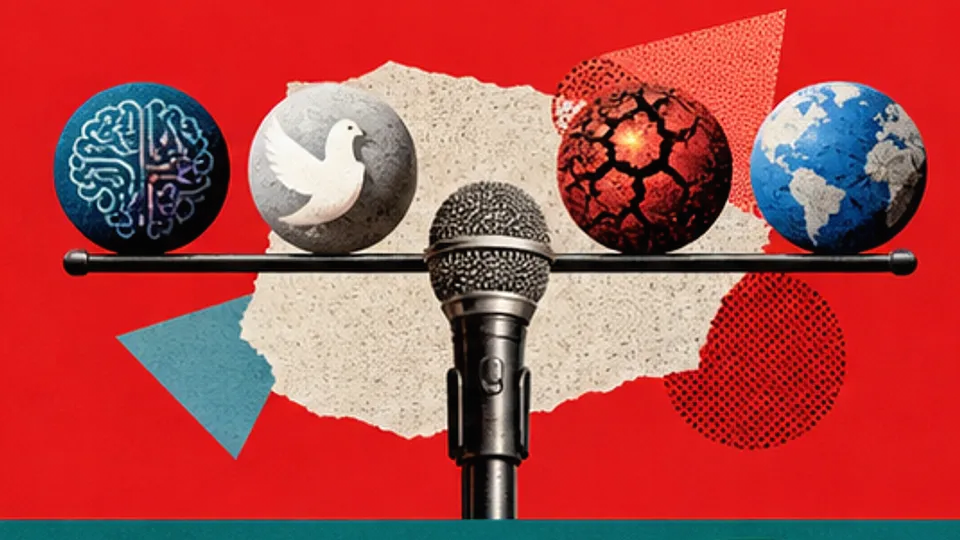
In New York, beside the East River, the microphones of the world went quiet on Monday. The 81st session of the United Nations General Assembly had concluded, and with it a general debate in which three subjects pressed upon every podium: artificial intelligence, the conflict between Israel and the Palestinians, and the war waged by the United States and Israel on Iran.
The assembly is a peculiar institution. It commands no armies and collects no taxes; its power is the power of speech itself. Yet the record of this year’s speeches, drawn up by Al Jazeera as the session ended, reads like a map of our anxieties — a catalogue of everything the rulers of the earth cannot control and dare not ignore.
Four tests
It was Antonio Guterres’s last address in the job. The secretary-general, whose term is drawing to its close, stood before the chamber and warned that the future of the world would be shaped by four tests: artificial intelligence, climate change, wars and inequality. Four horizons, and behind each of them the outline of a storm the assembly has so far only described.
That is why the UN Charter – and the work of the United Nations – matter more than ever
Guterres’s conviction, reported by Al Jazeera, carries a particular poignancy in the mouth of a departing man. Ten years a keeper of the Charter, and his farewell counsel is that the Charter matters — not that it has prevailed.
Palestine, above all
The situation in Palestine was a key issue among the member states, Al Jazeera’s account of the debate records, even as what it calls Israel’s genocidal war on Gaza continues despite what the outlet describes as the so-called ceasefire. A ceasefire in name, then; the speeches long, the war longer. The podium at Turtle Bay has heard appeals for Palestine across generations of delegates, and the queue of those appeals grows shorter nowhere but in memory.
The house and the unilateral
Alongside the wars and the machines ran a quieter theme, less a speech than a confession. According to Al Jazeera, the debate ranged from calls to reform the United Nations itself to appeals for the upholding of international law — appeals made, as its reporting notes, at a moment when the global body has been undermined by the unilateral foreign policy pursued by US President Donald Trump. There is an old irony in this: the organisation’s most powerful member has long treated its charter the way emperors once treated constitutions, as advice addressed to others.
And beyond the chamber, on the road of actual bombs rather than resolutions, stood the third preoccupation — the war of the United States and Israel against Iran, which pressed itself into leaders’ addresses as fact, not theory.
So the 81st session ends, and the delegations fly home to their capitals. What remains behind on the East River is the outgoing secretary-general’s list — intelligence without conscience, a climate without patience, wars without law, wealth without share. The debate is adjourned. The tests are not.