
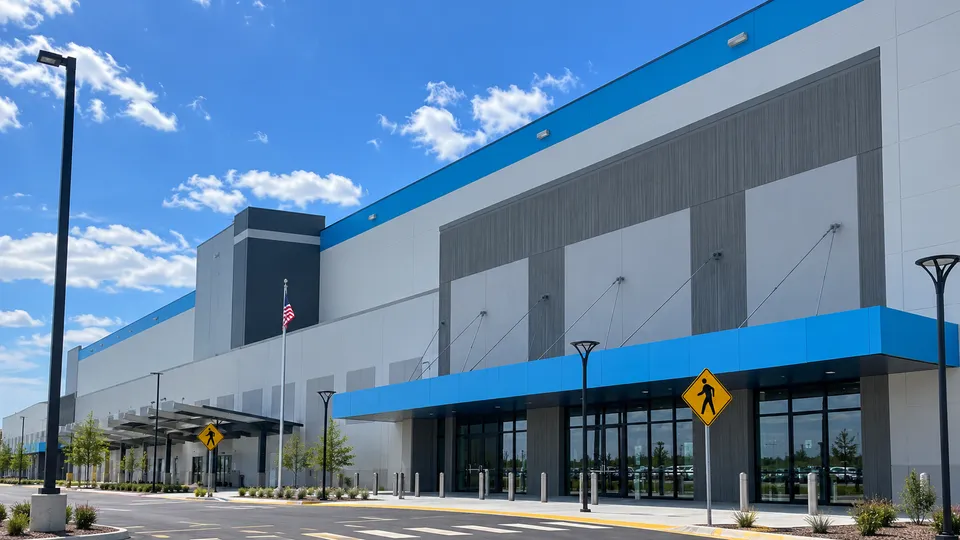
There is a building in Johnston, Rhode Island, so large that a firefighter entering it with thirty minutes of oxygen in his tank can spend fifteen to twenty of them just walking to the far end. Since the Amazon warehouse there opened in July 2025, the town’s firefighters have been called to it about 200 times through September 26 — roughly four times a week, [the Boston Globe reported](<https://bostonglobe.com/2026/10/06/metro/johnston-ri-amazon-warehouse-emergency-fire/>) from Johnston’s records.
Some 160 of those calls were medical: chest pain, back pain, psychiatric problems, pregnancy issues, and calls logged simply as ‘sick person.’ A few were plainly workplace matters, an eye injury reported on September 9 among them, but Fire Chief Calci said most appear to be people who fell ill at work and could not simply go home. “Our rescue crews come back and tell us that the people that work there say that they can’t call in sick, or they’ll risk being fired,” Calci said. “So they come to work sick and then call us, and the rescue has to go pick them up.”
Amazon disputes the picture. Sam Stephenson, a company spokesperson, said it is important to keep the numbers in perspective: employees receive paid “flexible time” of 40 hours a year for part-time workers and up to 48 for full-time staff, and they are encouraged to call 911 whenever they feel it necessary. “Thousands of people work at this site, and our own records show only a small fraction of these calls were related to work,” Stephenson said. “The vast majority were for personal health matters, and of course we encourage our team to take care of themselves first and foremost, whether they’re at home or at work.”
The medical taxi
Mayor Polisena put his town’s complaint plainly: he fears the municipal rescue service has been conscripted as a kind of medical Uber for a private workforce. “The rescue system is to respond to emergencies as they happen,” he said. “It should not be used as a medical taxi, so to speak.” One worker inside the building, who asked that his name be withheld for fear of retribution, told the Globe that paid sick days are hard to take and that employees end up using unpaid time instead.
I look at it as this is a job where you stay at until you figure out what you really want to do. It’s just something to keep you afloat, to survive.
The arithmetic matters even for residents who never set foot in the warehouse. Johnston’s fire department fields about 7,000 rescue calls a year; a heavy drain from a single address, Calci warned, could force reliance on rescue squads from neighboring towns and lengthen response times for everyone.
The fire on the second floor
In July, a 911 call reported fire in a conveyor belt on the second floor. Nobody had pulled the fire alarm; workers learned of the blaze over two-way radio and were ordered to leave. Firefighters arriving had to push through a bottleneck of about 850 employees fleeing through the front entrance while 55 emergency exits around the building stood unused. “They have a very long distance to walk in that building,” Calci said. “So that was obviously a huge public safety concern for all of us.”
Stephenson said employees had cut power to the equipment; the chief’s account is less flattering. Amazon officials, he said, balked when told to cut power to that part of the building, saying they needed to “check with corporate.” The fire was contained quickly and nobody was hurt. But as investigators worked, Calci said, company officials pressed them repeatedly on when employees could get back to work.
“Quite frankly, they’re lucky that was only a small fire,” Polisena said. “God forbid, if that was a large fire. They have a lot of people up there. If something doesn’t change, it’s only going to be a matter of time before something bad happens.” The Office of the State Fire Marshal concluded the fire was accidental — caused by friction when debris jammed under a running conveyor belt — and affirmed problems with the company’s fire-safety practices.
Amazon and Johnston fire officials were set to meet Tuesday on evacuation procedures. Stephenson said the company’s review of the July incident “identified several opportunities to improve the execution of our emergency response procedures, and we immediately remediated those gaps.” Amazon has supplied extra KnoxBoxes so responders can reach secure areas, and the building meets all relevant fire codes — a point the chief himself confirmed. But the chief said Amazon has ignored repeated requests to station firefighting equipment, hoses and compressed-air tanks, at points inside the building, so crews would not burn through their oxygen on the long walk in. Amazon’s answer: there was no formal request, and the equipment is not required by code. Polisena said he was “surprised” and “disappointed.”
What the neighbors count
Johnston is not the only small town keeping a tally. The Occupational Safety and Health Administration has cited Amazon warehouses across the country for unsafe working conditions, and a 2021 Globe investigation found that the Fall River, Massachusetts warehouse — opened in 2017 — had one of the highest worker injury rates in Amazon’s national distribution network. Yet the comparisons cut both ways. At the $400 million, 3.8-million-square-foot warehouse opened in April 2024 in North Andover, a town of about 32,000, a recent conveyor-belt fire ended with workers exiting safely. “To be honest with you, we have not had a problem yet,” Fire Chief John Weir said; his crews have logged 71 calls there this year, 62 of them medical — under two a week, Deputy Chief Graham Rowe said. In North Haven, Connecticut, firefighters answered 68 calls in a year at Amazon’s 855,000-square-foot warehouse, mostly medical, Chief Paul Januszewski said — also under two a week. In Johnston: four.
Towns pay to host the giant. Under a 20-year tax deal in Johnston, Amazon is set to pay an average of $7.2 million a year in property taxes and committed $5.3 million to add four firefighters at a nearby station. Even so, mayor and chief say the company has not responded to their concerns about public safety and equipment. “This is a company with a $1 trillion market cap,” Polisena said. “I mean, the company’s bigger than some small countries. There’s no excuse. Clearly, it’s not a money issue, right?”
A corporation larger, as the mayor says, than some small countries; a town department with thirty minutes of air asking that tanks be left along a long corridor. For now the answer is procedural: no formal request. So the rescues keep rolling out, four times a week, to the biggest address in Johnston.