

Some materials carry electricity without any resistance, but nearly all of them do it only in deep cold, a few degrees above absolute zero. In the late 1980s that changed. A family of copper-based compounds, the cuprates, turned out to superconduct at higher temperatures, warm enough to reach with liquid nitrogen, which is cheap. Almost forty years have passed since then, and physicists still don’t agree on why the cuprates can do it.
Now a team led by Milan Allan of Ludwig Maximilian University of Munich and Ingmar Swart of Utrecht University says it has part of an answer, as Jacek Krywko reported for Ars Technica. They didn’t get it by looking at the material. They listened to it. Their paper in Science has a blunt title: “Equivalence of pseudogap and pairing energy in a cuprate high-temperature superconductor”.
The missing
The puzzle at the centre of the cuprates is called the pseudogap. “The pseudogap is a phenomenon of missing electrons,” Allan said. At temperatures above the point where the material becomes superconducting, some of its electrons seem to vanish. Measurements find far fewer of them at the energies where they ought to be. “Everybody knows that from different probes, you see that there’s these vanishing electrons, but nobody knows why,” he said.
For decades there have been two main explanations. In the first, the electrons are trapped. They freeze into orderly arrangements such as charge density waves, and superconductivity grows up separately. In the second, the disappearance and the superconductivity are the same story. “Other people think they’re missing because they form pairs,” Allan said. Pairs of electrons, known as Cooper pairs, are what carry current in a superconductor. If they form while the material is still too warm to superconduct, they would be a precondition for it: pairs that already exist but can’t yet move together in step.
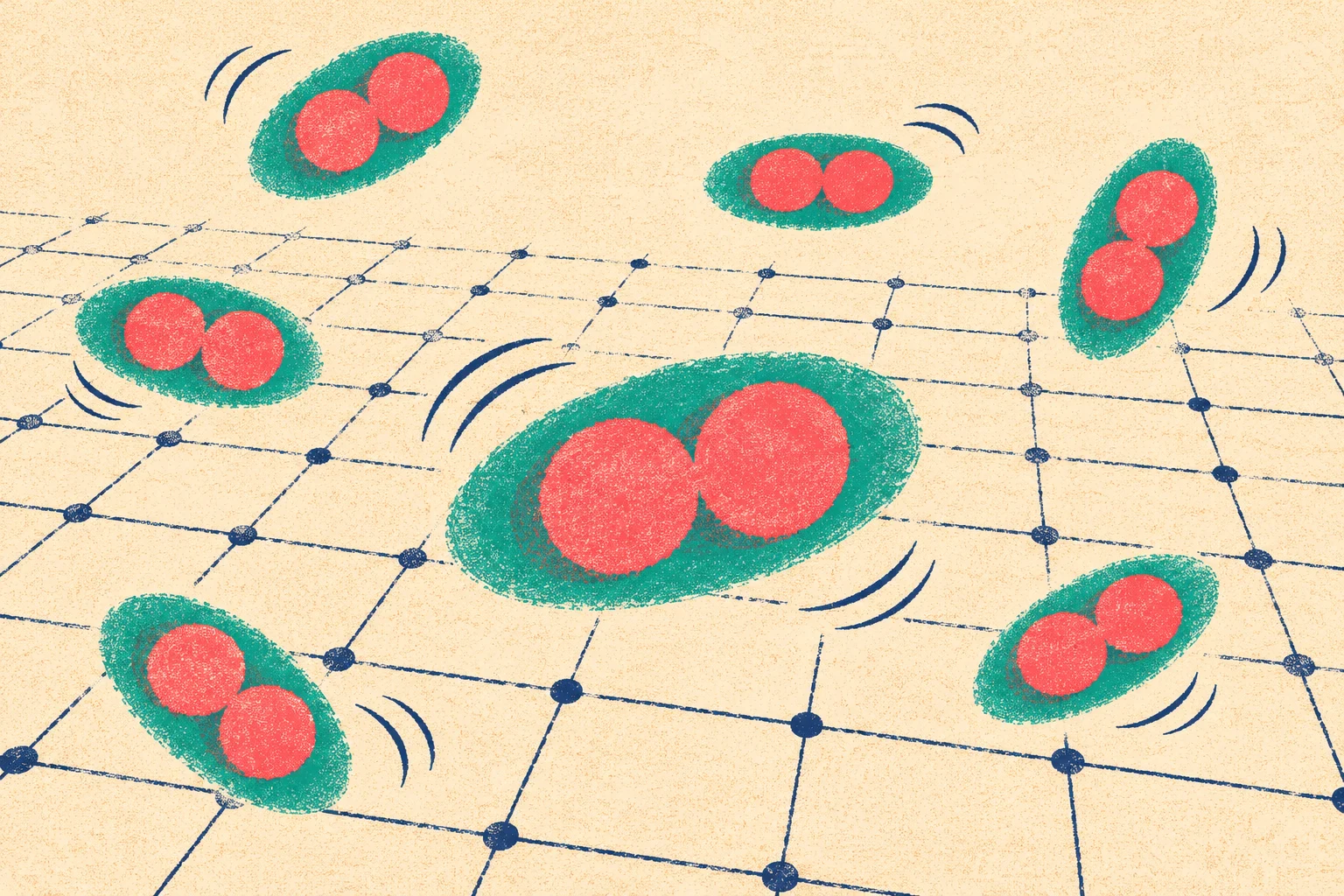
The instruments never settled it. Every probe saw something, and none of it was conclusive. “It’s always something kind of incoherent, hard to grasp,” Allan said. A dispute like this can outlast whole careers, because neither camp can produce the decisive piece of evidence. What was missing was a way to detect the pairs directly.
Rain on the roof
The team chose shot noise. An electric current is a stream of individual charges, and their arrival produces tiny fluctuations. Allan compares it to rain. “If you imagine that you have raindrops and then all of a sudden you make the drops twice as heavy, there’ll be more noise,” he said. “With the electrons it’s similar. If you have two electrons coming always together, because they’re associated with pairing, then it will be more noise.”
The instrument was a scanning tunneling microscope. It passes current between a needle-sharp tip and the sample, so the researchers could listen at chosen spots on the surface and, by adjusting the voltage, at chosen electron energies, much like tuning a radio. In ordinary superconductors, pairing simply doubles the noise. In cuprates the signal is far fainter, because single electrons keep flowing alongside the pairs.
Hearing that faint signal took years. “What it took is very talented and persistent students who worked for, I don’t know, four years on this to get it working,” Allan said. “There was not a single trick. It was electronics craftsmanship.” The work was done by graduate students over four years, and the paper’s headline result rests on it.

The step at the gap
The samples were crystals of a cuprate called BSCCO, cooled to a few degrees above absolute zero. The researchers reasoned that if the pseudogap came only from frozen patterns, the extra noise of pairing should appear only at the energies linked to superconductivity. It didn’t. It appeared right at the pseudogap energy. That energy changes from one spot on the surface to the next, and everywhere they listened, the noise began to rise at the local pseudogap energy. Samples with different chemical compositions showed the same pattern.
Other things can make noise too, such as atoms moving on the surface. “Noise is super hard to interpret, and that was basically the thing that we had the most sleepless nights about,” Allan said. The deciding test used magnetic fields of up to six tesla. These suppress pairing but leave the overall pattern of missing electrons largely in place. As the field grew stronger, the noise fell back toward the level of single electrons, exactly as it should if pairs had been causing it.
In conventional superconductors, two things happen together at the critical temperature: electrons form pairs, and the pairs gain phase coherence, meaning they start moving as one fluid. In the cuprate the team studied, the measured pairing energy is well above the superconducting temperature. “So the picture that emerges is that you first have pre-formed pairs, and then only at lower temperatures, phase coherence sets in,” Swart said.
So the electrons do pair up. What holds the material back is getting those pairs to move together.

“If you have pairing at such high energies, that means that you might be able to push Tc higher,” Allan said, using the physicists’ shorthand for the superconducting temperature. “This is something people hoped for in the very early days of cuprates, and now everybody’s afraid to even mention that. But to me it gives hope.”
Rationing the hope
The optimistic reading is that cuprate electrons could in principle pair at room temperature, and someone would only need to make them coherent. The authors think that’s naive. “I think Ingmar and I both believe that it’s not going to be that simple, because you have all kinds of other effects that are coupled there,” Allan said.
They are also clear about what they have not proved. The experiment rules out frozen patterns as the whole explanation of the pseudogap. It doesn’t rule out that such patterns are tangled up with pairing. “Whatever the detailed explanation of the pseudogap is, pairing should be part of it,” Swart said. An earlier version of the paper is posted on arXiv for anyone who wants to check the details.
The method has a limit too. It loses sensitivity as the temperature rises, so the team couldn’t yet listen above the superconducting temperature, which is where the pseudogap is usually defined. “Hopefully other groups will do that,” Allan said. “What limits Tc, especially if the energy of pairing is high? What happens at Tc? That’s for me the most interesting question.”
Swart wants sharper noise maps of the surface and, eventually, an instrument that detects coherence directly, so that pairing and coherence each get their own marker. Allan increasingly expects better superconductors to come from chemistry, helped by AI, rather than from pure physics. “When it comes to trying to make the superconducting material better and increase Tc, I have more hope in direct trial and error,” he said.