
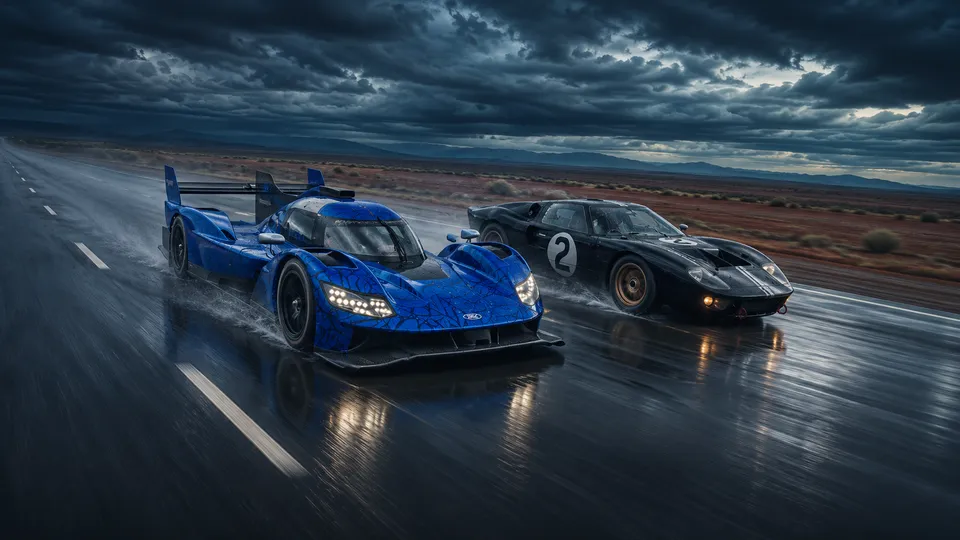
Ford has a new race car. It is called the GT41, and Ford showed it to the public at Ford Field in Detroit during the Thanksgiving Day NFL game between the Lions and the Bears, according to the organisers of the 24 Hours of Le Mans. It enters the FIA World Endurance Championship in 2027, and its main target is Le Mans. The name is a measurement. The original GT40 was 40 inches tall and won Le Mans four years running, from 1966 to 1969. The new car is 41 inches from sill to air intake. Ford’s most famous racing name was a height, and the sequel is that height plus one inch. I find this charming. Most companies pay consultants for names. Ford got out a tape measure.
The history matters to Ford. “Our 1-2-3 triumph at Le Mans in 1966 remains one of the defining moments in motorsport history,” said Bill Ford, the company’s executive chair. He added that the company values that past but is motivated by tackling “new and greater challenges.”
The interesting part is how little of the car Ford actually builds. Jonathan M. Gitlin explains at Ars Technica that the GT41 is an LMDh car, and under those rules the hybrid system and the transmission are standard parts. Ford supplies two things: the engine, a 5.4-litre V8 based on the Mustang’s Coyote, and the software that controls the hybrid powertrain. A version of the Coyote without the hybrid already races, and races well, in the Ford Mustang GT3. According to Le Mans organisers, Ford Racing designed and developed the naturally aspirated engine in-house. They say it drew on Ford’s Formula 1 work with Red Bull Ford Powertrains and its Dakar programme, covering hybrid systems, software, manufacturing and development methods.
Why write rules like this? Here is a hypothetical. Imagine you run a racing series. You need car manufacturers, because they bring the money and the famous names. A manufacturer joins if it thinks it can win. If the biggest budget usually wins, everyone without the biggest budget stays home, and you end up with a series of one. So you make the most expensive parts the same for everyone, and you cap the areas where engineers would otherwise spend without limit. That is roughly the deal here. Ars reports that the total amount of aerodynamic downforce is capped, and so is the minimum drag. Manufacturers are then encouraged to borrow styling details from their road cars, so the prototype looks more like something you could buy.
Put plainly, the rules limit how much your bodywork can improve the car, then invite you to make that bodywork look like your showroom. It is a marketing allowance written into a technical rulebook. That is perfectly sensible, because marketing is why car companies go racing. Gitlin admits he needs more time to find the road-car cues on the GT41. What he does see is quite a few surface similarities with the Genesis LMDh car and the Ferrari Hypercar. So a rule meant to make each car look like its own brand has produced one that looks a bit like two other brands.
Sure.
Ford is an American brand, but it has no current plans to race in IMSA’s WeatherTech championship, so the GT41 won’t be at Daytona in January. Its first race is in Qatar in March, the first of nine WEC rounds next season. Le Mans organisers give the date as 27 March 2027, for the Qatar 1812 km. The 95th 24 Hours of Le Mans, round five, runs from 9 to 13 June. Ford will enter two cars in the Hypercar class. The organisers’ list names Matt Campbell, Mike Rockenfeller, Nick Yelloly, Sebastian Priaulx and Tom Blomqvist as drivers, with Tom Dillmann as reserve. Racer covered the Detroit launch as a big-ticket event. The car’s first 30-hour endurance test was at MotorLand Aragón in Spain, part of a wider European schedule, and more testing is planned in the United States in December and January.
The launch livery is two shades of Ford Racing blue, with an American flag, a bald eagle and a nod to the Spirit of Detroit sculpture. It is not the race livery, which Ford will reveal before Qatar. So a car that won’t race in America is wearing the flag and the eagle anyway, at least for now.
The field will be tough. Peugeot and Alpine will not race next year. McLaren is joining, and Aston Martin, BMW, Cadillac, Genesis, Ferrari and Toyota are all back. This year Toyota won both Le Mans and the overall title, after three years in which Ferrari dominated. Dan Sayers, Ford Racing’s Hypercar programme manager, sounds like a man who has read the entry list. “We know the scale of the challenge ahead,” he said, adding that “the level of competition in Hypercar is incredibly high and there are no shortcuts to success.”
That last part is practically the rulebook’s purpose. The hybrid is standard, the gearbox is standard, and the downforce and drag are capped. The one number on the GT41 that no rival can match is the one in its name.