
Brian De Palma’s 1976 Carrie cost $1.8 million, grossed $33.8 million domestically, and still holds a 94% critics’ score on Rotten Tomatoes, per the [film’s Wikipedia entry](https://en.wikipedia.org/wiki/Carrie_(1976_film)) and aggregated reviews. That is an 18.8x return on a budget United Artists set at $1.6 million before overruns. Mike Flanagan’s eight-episode remake for Prime Video, which finished streaming on October 7, carries no disclosed budget at all; Amazon MGM Studios does not publish production costs for its streaming originals, so there is no ratio to compute this time, only a Rotten Tomatoes score of 85% from 129 critic reviews and a Popcornmeter audience score of 82% from more than 1,000 ratings, according to the show’s Rotten Tomatoes page. Metacritic has it at 72 out of 100 from 33 critics. Those numbers moved while critics were still filing: the score opened at 80% on reviews of the first two episodes shown at the Toronto International Film Festival in September, rose as high as 88%, then settled at 85%, Screen Rant reported tracking the climb.
Jennifer Ouellette, writing in Ars Technica, calls the series a triumphant remix with one major flaw, and credits Flanagan’s affinity for King’s work and his skill at building multifaceted characters across eight episodes rather than the two hours De Palma had. The series restages the same key beats as the novel and the 1976 film, with a different engine driving them.
What the remake rebuilt
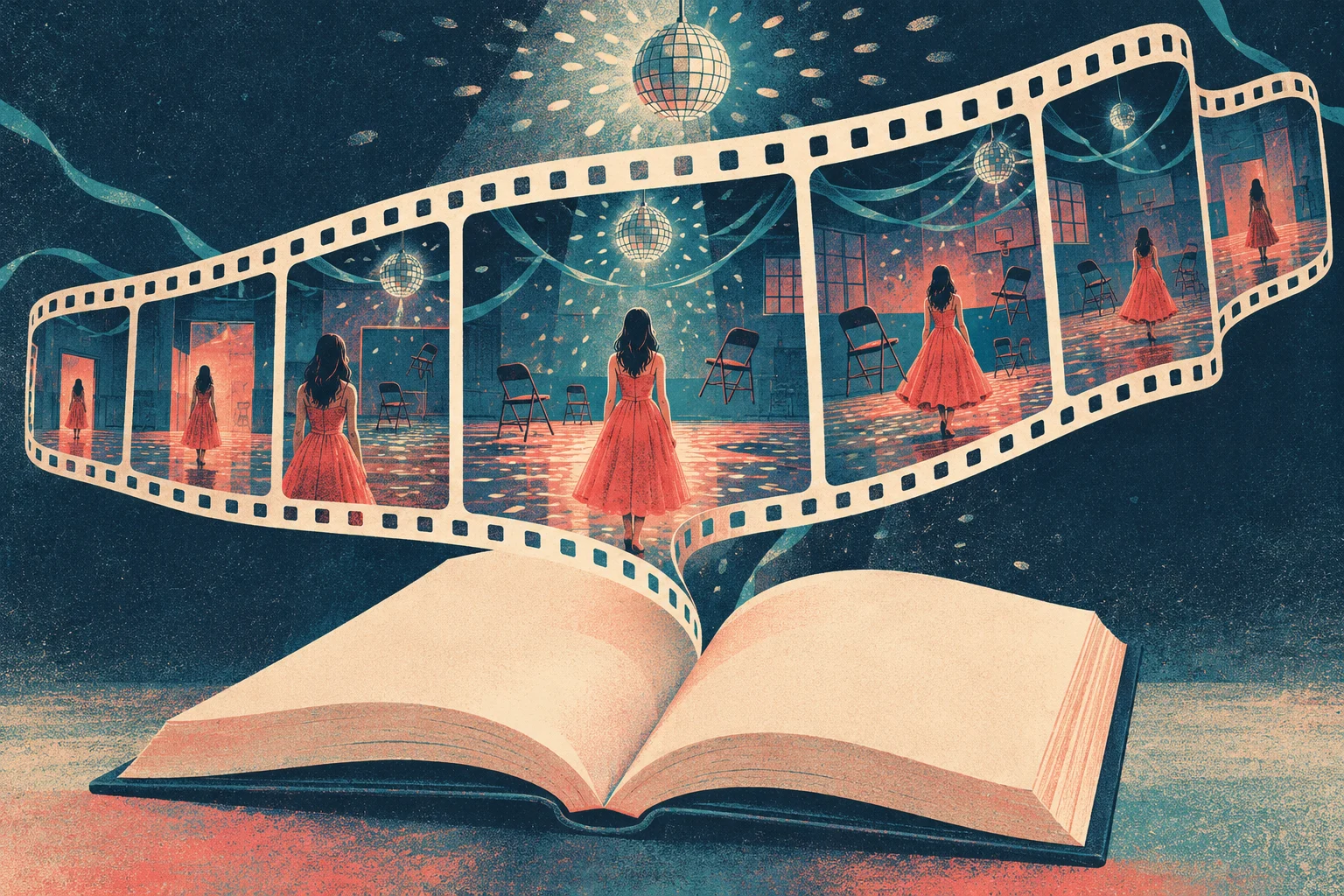
King’s Carrie White is a lifelong social outcast, bullied from childhood, raised by a mother who beats her for imagined sins. Flanagan’s Carrie (Summer H. Howell) has been homeschooled from birth inside what a social worker in the show calls a “cult of three”; she only enters a public building after her conspiracy-theorist father (Tahmoh Penikett) dies in a construction accident and leaves her and her mother Margaret (Samantha Sloyan) exposed to the outside world for the first time. She is two grades ahead academically, reads constantly, and misses every piece of modern teenage machinery: her gold cross trips the school’s metal detector, a lockdown drill reads to her as a real shooting, she has never played a team sport. The locker-room scene that defines the character, where Carrie gets her first period and is pelted with tampons by classmates chanting “plug it up,” is restaged with every classmate filming it on a phone rather than De Palma’s camera lingering on the showers. King’s novel used fictional court transcripts and news clippings as a framing device; Flanagan substitutes documentary-style interviews with survivors looking back on the events, a structural swap that keeps the same device, pre- and post-tragedy testimony, while updating its medium.

Casting took the same scale of search as the writing. Flanagan told interviewers the production screened 1,400 actors for the title role, a 0.07% selection rate for the part that went to Howell, a 22-year-old from Manitoba who had worked in horror since age nine (Curse of Chucky) but, at Flanagan’s request, read neither King’s novel nor watched the 1976 film before shooting. “It’s still to this day the most intense casting experience of my career,” Flanagan has said of the search, adding that Howell brought “an earnestness and empathy and a kindness that doesn’t feel naive” that none of the other 1,400 candidates did.
The audience, measured two different ways
By October 13, according to chart tracker FlixPatrol, Carrie had reached number one on Prime Video’s global television chart in 49 of 51 countries the service monitors, and was the single most-watched title of any kind, film included, in 17 of them, among them the US, UK, Canada, Mexico, Australia and Brazil. It displaced Reacher spinoff Neagley from the top spot on October 8. FlixPatrol’s rankings are ordinal, not absolute: they say what is most watched, not how many people watched it. The closer thing to an absolute figure comes from Nielsen, which previously measured Neagley at more than 3 billion minutes streamed over two weeks; no equivalent Nielsen figure for Carrie had been published at the time of writing, so the size of its audience relative to that benchmark is, for now, an estimate built from chart position rather than a measured number.
The flaw
King’s Carrie dies at the end of the novel and the 1976 film, killed by the same telekinetic rage that destroys the town. Flanagan’s Carrie survives. The mechanism the finale uses to get her there is a character invented for the show, Emaline West (Thalia Dudek), introduced earlier in the season as a fellow telekinetic teenager and revealed at the prom to be, in effect, piloting Carrie’s body for the climactic destruction. A second new character, Adelaide (Kate Siegel), spends the season identifying other carriers of what the show calls the “TK gene,” including, implicitly, Margaret White herself, and recruiting them into a loose network the finale calls the Others.
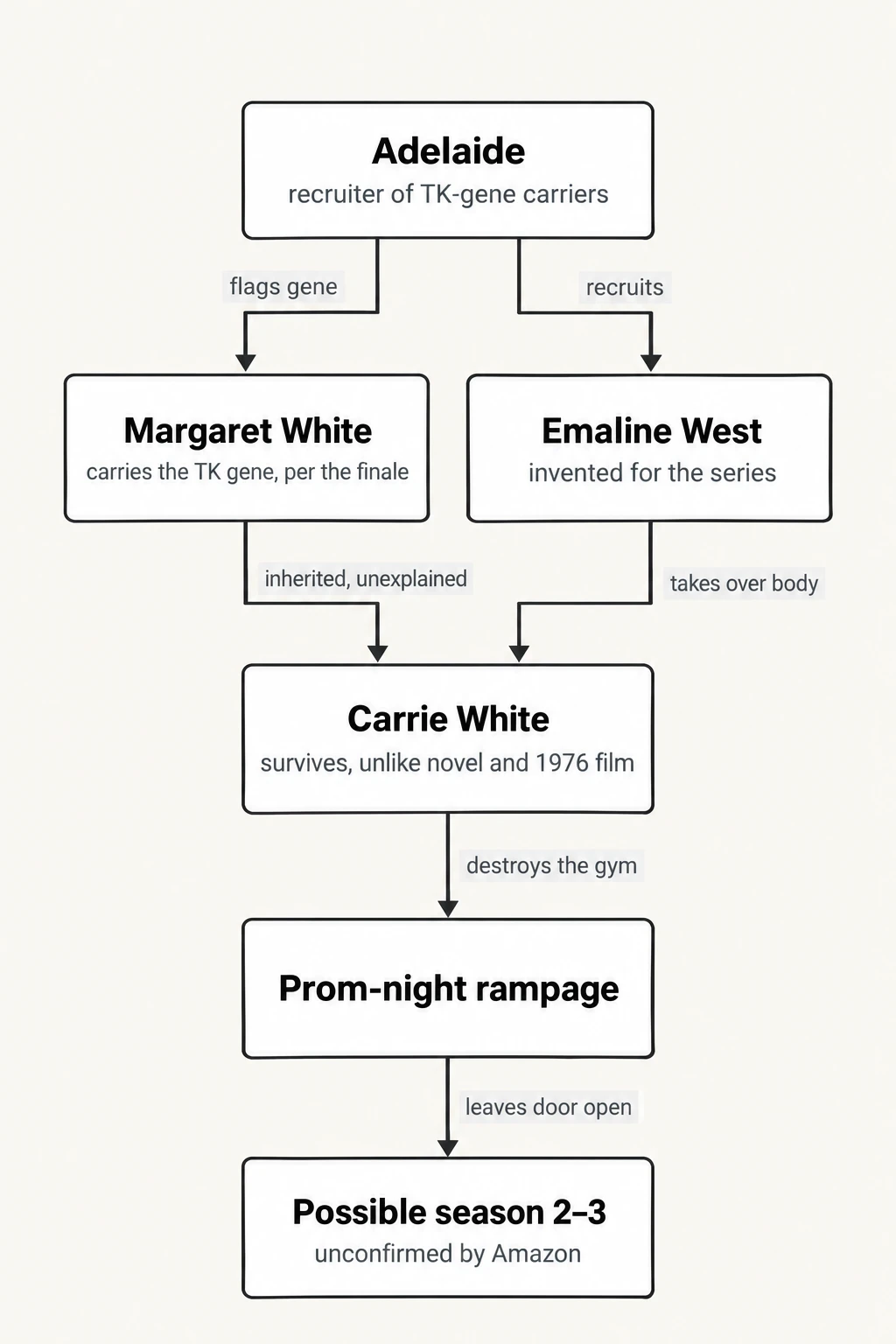
| From | To | How |
|---|---|---|
| Adelaide (recruiter of TK-gene carriers) | Margaret White (carries the TK gene, per the finale) | flags gene |
| Margaret White (carries the TK gene, per the finale) | Carrie White (survives, unlike novel and 1976 film) | inherited, unexplained |
| Adelaide (recruiter of TK-gene carriers) | Emaline West (invented for the series) | recruits |
| Emaline West (invented for the series) | Carrie White (survives, unlike novel and 1976 film) | takes over body |
| Carrie White (survives, unlike novel and 1976 film) | Prom-night rampage | destroys the gym |
| Prom-night rampage | Possible season 2–3 (unconfirmed by Amazon) | leaves door open |
Reviewers who liked the season generally still flagged this mechanism as a cop-out: one review argued that having Emaline take control of Carrie’s body during the massacre “takes away some of Carrie’s responsibility for what happens, which weakens the story,” even while praising the Others as one of Flanagan’s better additions to the mythos. The finale also moves the killing of Margaret White from Carrie, who does it in the book and the 1976 film, to the reporter character, a change multiple critics read as a deliberate effort to keep Carrie from being remembered as the story’s monster. HorrorBuzz scored the opening episodes 4 out of 10 over pacing; TV Guide warned the ending “risks undermining the whole series.”
Flanagan has been explicit that the ending is a pitch, not an accident. “In my dream scenario, I think Carrie has a wonderful three-step arc. It’s a trilogy, really,” he has said, and has floated tying the show’s telekinetic mythology to King’s Dark Tower universe, telling interviewers he believes “this all exists on a certain level of the Tower,” according to an interview published by The Playlist. Amazon has not ordered a second season. Flanagan has also said Dark Tower itself, which he calls his dream project, is moving at what he describes as oil-tanker pace because its rights are split across multiple studios, a process that alone takes more than a calendar year to coordinate, and he has a new Exorcist film and an adaptation of King’s The Mist ahead of it on his schedule. Whether Carrie White’s second life gets a second season is a renewal decision Amazon hasn’t made yet; whether King’s Gunslinger franchise ever reaches the screen Flanagan has spent years promising is a decision nobody involved controls alone.