
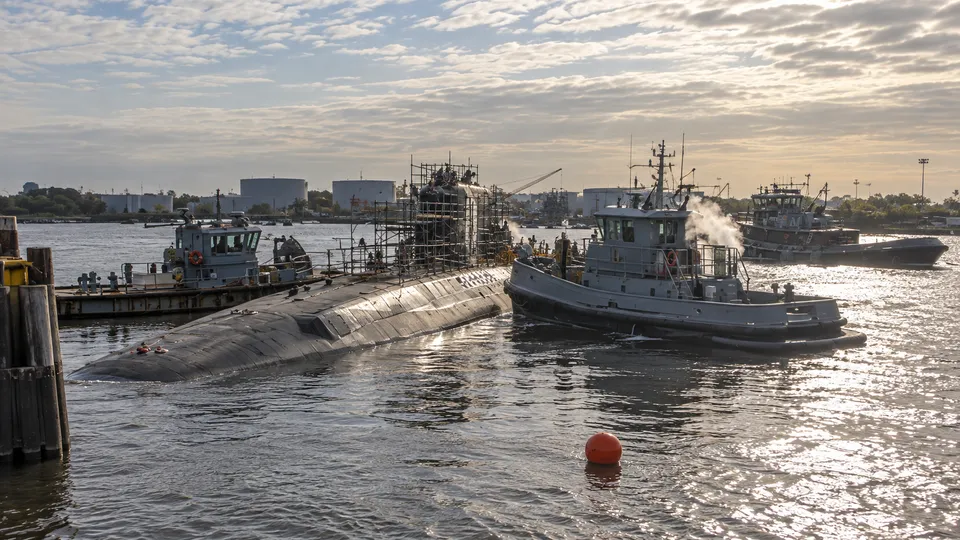
In 2018 the US Navy looked at its four public shipyards — the facilities in Virginia, Hawaii, Maine and Washington that maintain the fleet’s nuclear-powered submarines and aircraft carriers — concluded they were in rough shape, and launched the Shipyard Infrastructure Optimization Program to fix them. The preliminary assessment was about 20 years and $21 billion. That is the kind of sentence that has aged, and the Government Accountability Office has now done the arithmetic on just how.
In a report released last week, the congressional watchdog wrote that the program “will surpass $200 billion and take over 50 more years to execute.” For those keeping score: ten times the money, and the timeline no longer fits in a human career. The GAO said that “developing the plans and cost estimates to rebuild the Navy’s four public shipyards has taken the Navy years longer — and will cost much more — than originally anticipated,” because the service “underestimated the time needed” and “did not fully account for the many challenges, uncertainties, and complex analyses needed to sufficiently plan for an endeavor of SIOP’s magnitude.”
Some of what wasn’t accounted for is genuinely surprising, in the way that finding out your 100-year-old building has problems is surprising. Many of the facilities at the four yards — Norfolk Naval Shipyard in Virginia, Pearl Harbor Naval Shipyard in Hawaii, Portsmouth Naval Shipyard in Maine and Puget Sound Naval Shipyard in Washington — were built between 80 and 120 years ago and have deteriorated under long-deferred maintenance. At Puget Sound, the Navy has identified, since 2023, more than $1 billion in needed retrofits and new construction to mitigate newly assessed seismic risks. At Norfolk, safety risks turned up in failing buildings; one that may eventually be demolished is currently still being used for ship maintenance, which is a sentence that explains a lot about the $200 billion.
There’s also the small matter that the shipyards are being renovated while still running. These are working yards with nuclear submarines in them, and the poor conditions have already produced backlogs. The canonical exhibit is the USS Boise, a Los Angeles-class submarine that spent roughly a decade sidelined by maintenance delays before finally being retired — a boat that waited for repairs until it was time to go.
A Navy official told Business Insider that the original 20-year, $21 billion figure was a preliminary assessment that has since evolved, said the program has already delivered “tangible readiness results,” and added that the Navy welcomes the GAO’s review and is “incorporating their recommendations” as it develops a multi-decade master plan. Translated from the official dialect: yes, the number changed by an order of magnitude, no, that was always possible, and the new number comes with its own master plan, multi-decade.
The GAO made four recommendations, the headline one being that Congress should require the Navy to “annually report consolidated, standardized status updates” on the program’s cost and schedule. The others call for future reviews of requirements and resources and for documenting which organizations are responsible for what. This is the standard watchdog toolkit: when the estimate turns out to be wrong by $180 billion, the remedy is a requirement to say so on a schedule.
I think the interesting question is what a “preliminary assessment” is for, institutionally. Imagine you are proposing a project and you have some latitude in the early estimate. A small number gets the program approved, the first dry dock gets torn up, and from then on the question is never whether to spend the money but whether to stop halfway through a gutted shipyard. Nobody sensible stops. The number grows. Whether the Navy lowballed deliberately or just earnestly underestimated a century of deferred maintenance plus an earthquake problem, the incentive gradient all runs one direction, and the program has now slid comfortably down it into the land where Congress settles for annual updates on the bad news. The submarines, presumably, will wait as patiently as the Boise did.