
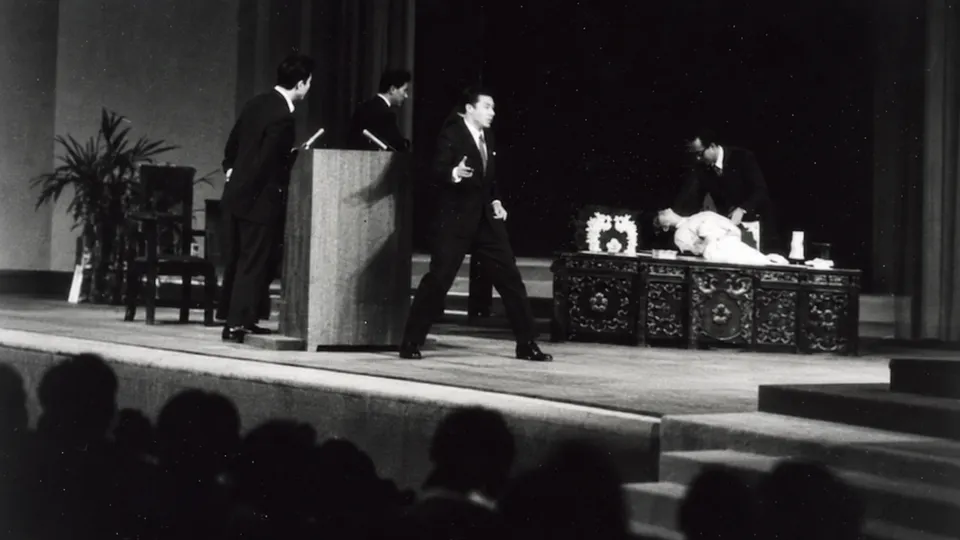
The parenthesis is in the title. Assassin(s) opened in South Korean cinemas on September 23; by the 26th it had passed 1.3 million cumulative admissions and stood at the top of the box office. The film takes as its subject the shooting of Yuk Young-su, the president’s wife, at the National Theater on August 15, 1974 — and it insinuates that the affair was a performance written by the Korean government itself, a self-authored play. That suggestion has now drawn a point-by-point fact-check from the Chosun, the conservative Seoul daily, measured against the investigative record of the time.
By the investigation’s published findings, as the paper lays them out: the gunman, Mun Se-gwang, was seated on the left side of the first-floor auditorium. His first shot was an accident — the trigger went off and the round passed through his own left thigh. The second, fired at President Park Chung-hee as Mun ran toward the stage, struck the rostrum. The third was a misfire. The fourth, aimed, travelled 18.2 metres into the right temple of Yuk Young-su, seated at the right of the platform. The fifth hit the national flag behind the podium. Only a man who had run up from the back rows and aimed rightward from below the stage could have produced that trajectory, the paper notes; from a bodyguard’s position on the platform, it does not come out. The person actually hit by a security guard’s stray round was a high-school girl in the audience, Jang Bong-hwa.
There are claims that six or seven gunshots can be heard on the recording from that day. The prevailing analysis, the Chosun writes, is that reverberation inside a 1970s theater, the clatter of steel chairs and microphone noise layered themselves over the gunfire — that the real shots numbered five, including the one that struck Jang, and that bullets never recovered were lost in the confusion of the scene, not destroyed.
The film wonders how a man with a bullet through his leg could run, and hints that he fired into a harmless spot as a signal — that from this moment, as it has him saying, the play begins. The investigation records answer plainly: the first round damaged no major blood vessel and no motor nerve, and left his movement unimpaired. The insinuation of a staged signal, the paper says, has no basis.
How a man carrying a revolver walked into the National Theater at all is another matter, and here the record is damning without any help from cinema. Mun had rented an expensive Ford taxi and posed as a high-ranking Japanese visitor; the presidential security service, as it happened, had just issued a directive not to put foreigners through intrusive checks. In fluent Japanese, Mun asked a guard whether the Japanese ambassador had arrived yet. Taking him for a Japanese dignitary, the guard let him through without checking his ticket. It was, in the paper’s phrase, a total security fiasco.
Nor does the record support casting doubt on the stolen guns. Mun had broken into the Kozu police box in Osaka and taken two revolvers, loaded with live rounds. He described in detail the interior of the station and the stretch of river into which he had thrown the gun case; after the Korean side relayed his statement, Japanese police searched and found the case. The Japanese side itself acknowledged that his account matched the facts.
The investigation found that Mun had boarded the North Korean vessel Man Gyong Bong-ho and received 500,000 yen in operational funds, together with his orders, from Kim Ho-ryong, an executive of Chongryon, the pro-Pyongyang federation of Koreans in Japan. North Korea denied everything.
According to declassified East German diplomatic documents, Kim Il-sung told the newly arrived Soviet ambassador in October 1974 that Mun was “a leftist of Mindan” — the rival, pro-Seoul federation — and that these were people who followed Kim Dae-jung. The blame, in that telling, belonged to anyone but Pyongyang.
What the Chosun describes as the closest thing to a North Korean confession arrived twenty-eight years later, on May 13, 2002, in a foreign press report of what Kim Jong-il said to Park Geun-hye, then head of the Korea Future Alliance, during her visit to Pyongyang. Of the Mun Se-gwang affair, Kim said that lower-level people had been involved and that he had not known in advance.
The film says the play began with a signal. The record says something duller and harder: five shots, a fiasco at the door, and a flag behind the podium with a bullet in it.