
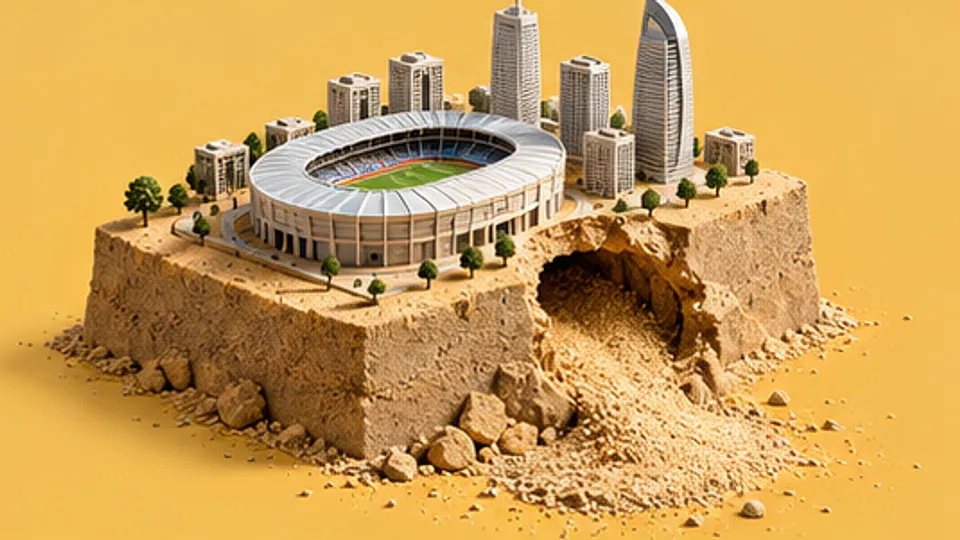
Every few years the desert receives a new drawing, and the latest drawing on the glass desks of Riyadh was a football stadium suspended 350 metres in the air, inside a mirrored wall of a city that itself exists mostly as a promise. That drawing has now been folded away. According to Reuters, citing two people familiar with the matter, Saudi Arabia has put the NEOM Stadium — the most ambitious of the fifteen venues it is building for the 2034 FIFA World Cup — on indefinite hold. Neither the government’s media office nor NEOM’s officials have offered any comment.
The arena, a $2.5 billion undertaking, was to seat 46,000 spectators inside The Line, the linear city of the NEOM megaproject. It would be reachable only by autonomous cars and high-speed lifts, powered entirely by wind and sun, and would stage matches from the group phase through the quarterfinals. The other fourteen stadiums are meant to stand complete by the end of 2033. Of this one there is no completion date at all — not delayed, simply undated.
The arithmetic of a deficit
The reason is money, and the reason for the money is war. Years of low oil prices and royal-scale spending left the kingdom with a deficit of 276.6 billion riyal last year alone. Since February, when war broke out between the United States and Iran, the Strait of Hormuz — the passage through which Saudi oil reaches the world — has been closed, and lately the Iran-aligned Houthis of Yemen have been striking at the kingdom’s core infrastructure itself. The deficit for the first half of this year already stands at 160 billion riyal, which suggests the full-year figure may outgrow even last year’s.
A kingdom of unbuilt monuments
The stadium is only the newest ornament on the fire. Vision 2030, the national reinvention Crown Prince Mohammed bin Salman announced in 2016 to wean the kingdom off oil, is being redrafted in pencil across the board. Its emblem was The Line itself: a vertical, straight-line city 170 kilometres long, 500 metres tall and 200 metres wide, set inside NEOM, a special development zone in the northwest forty-four times the size of Seoul. Five kilometres were meant to rise by 2030, the whole by 2045. Then the first phase shrank to 2.4 kilometres, and construction slipped to 2030 at the earliest — a cancellation in everything but the announcement.
The subcontractors felt it first. In March, the consortium of Samsung C&T and Hyundai Engineering & Construction that held the contract for The Line’s underground transport network was told the deal was being terminated, as the project was reorganised.
Elsewhere the retreats multiply. Trojena, the mountain resort meant to host the 2029 Winter Asian Games, fell behind schedule and handed the Games back. In Riyadh, the Mukaab — a perfect cube, 400 metres high, wide and deep, meant to anchor a new downtown — has had its construction halted altogether.
Even the golf is gone
The Public Investment Fund, the sovereign purse that poured itself into sport, is stepping back too. In 2022 the fund created LIV Golf and used its money to peel the stars away from America’s PGA Tour. In May it announced that the venture “no longer aligned” with its investment strategy and that support for LIV would end with this year. The consequences arrived on schedule: this season the league was unable even to stage the championship that decides its team title, and early last month it filed for bankruptcy protection in an American court.
Kingdoms that run on oil learn the same lesson each cycle: the treasury sets the size of the dream, and war sets the size of the treasury. Mohammed bin Salman’s dream was the largest of its era, measured in kilometres of mirrored glass laid across the sand. Now, contract by contract and largely without announcement, the kingdom is quietly waking from it — while the men who drill, lay concrete and shoot in its name settle the harder accounts of this decade.