
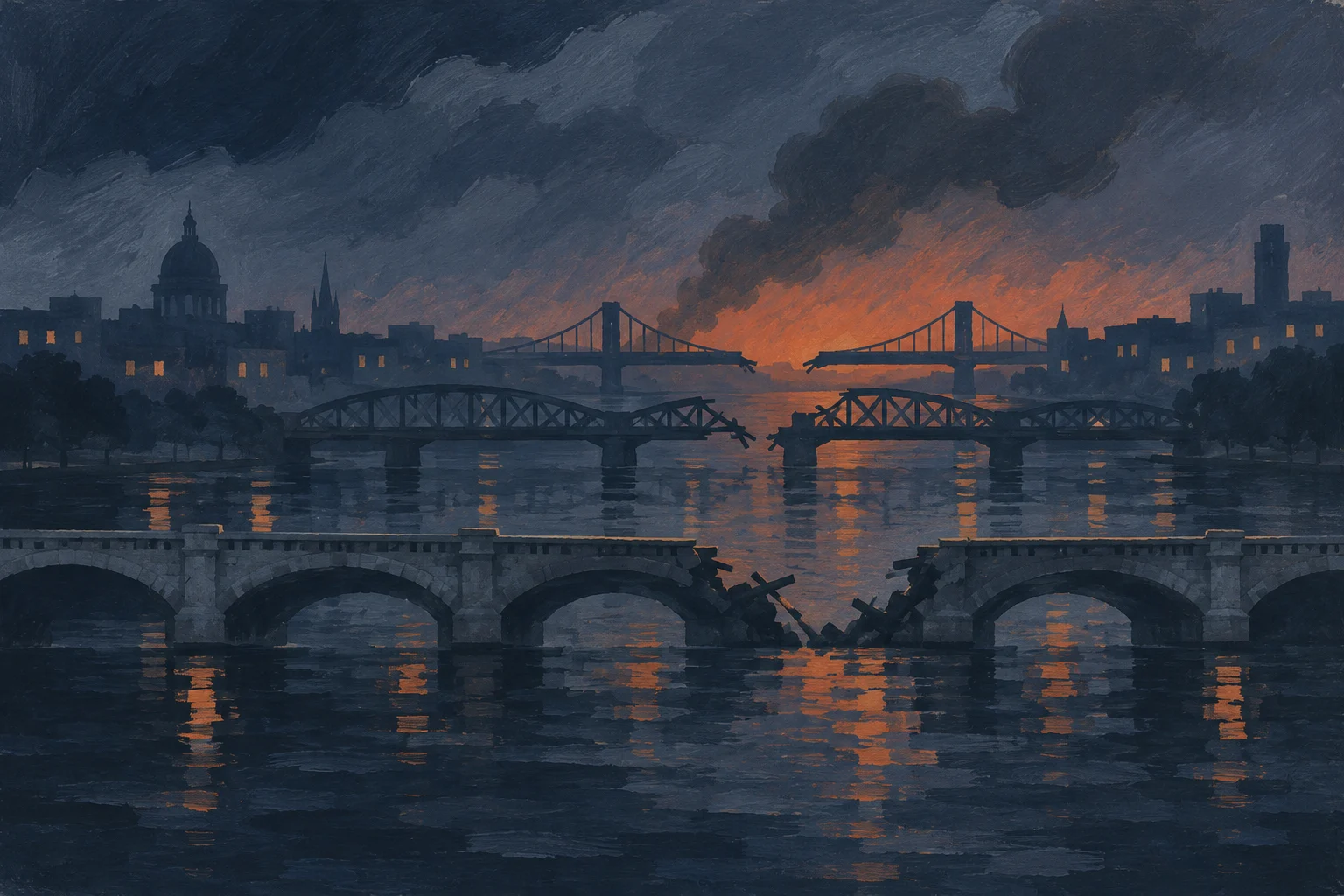
The people of Kyiv went down into the metro while explosions moved above them through the night. By morning, three bridges across the Dnipro—the city’s hinges between its left and right banks—had been struck. Ukrainian officials said six people were killed in the capital and two others at a railway station in Lviv. It was the largest attack on Kyiv’s river crossings since Russia’s full-scale invasion in February 2022, according to Reuters reporting carried by CBC.
President Volodymyr Zelenskyy said Russia launched more than 400 attack drones and over 110 missiles, 27 of them ballistic, in one of the war’s biggest assaults. Some missiles carried cluster warheads. He called the tactics “especially vile”: missiles arrived in groups separated by pauses of 20 to 30 minutes, obstructing firefighters, rescue workers clearing rubble and crews trying to restore services.
The bridges over the river
Mayor Vitali Klitschko identified the damaged crossings as the Podilsko-Voskresenskyi, Darnytskyi and Pivdennyi bridges. Closures and traffic restrictions complicated movement in a city of some 3 million people that relies on six main bridges. An earlier account reported by The Independent put the capital’s toll at three dead and 15 injured; Prime Minister Sergii Koretskyi subsequently said six of Ukraine’s eight dead were in Kyiv. Klitschko also reported a fire in a three-storey building in the northern Obolonskyi district after missile debris fell, and further fires in Podilskyi district.
Beyond Kyiv, electricity infrastructure was hit across Ukraine, causing widespread blackouts, and state railway Ukrzaliznytsia reported damage in several areas. At least seven people were injured at the Lviv station; drones striking apartment buildings wounded five in Dnipropetrovsk region, while four were hurt when drones hit a hospital in Kharkiv. Russia’s defence ministry said its forces struck defence-industry, energy and transport facilities, port infrastructure in the Odesa region and sea vessels used for Ukrainian military purposes. Reuters could not immediately verify the battlefield reports independently. Both sides deny targeting civilians.
Objects on Polish soil
Across the border, Poland scrambled military aircraft after reports of unknown objects falling in the southeast. Prime Minister Donald Tusk did not treat the incident as stray wreckage. “We know that what landed on Polish soil came from Russia,” he said, adding that his assessment was shared by foreign partners, including within NATO. “It does not look like an accident. It appears that we are dealing with an intentional provocation.” Defence Minister Wladyslaw Kosiniak-Kamysz had earlier said two missiles and a drone crossed the border: one was a Kh-101 missile, the second was also believed to be a missile, and the third was most likely a jet-powered drone.
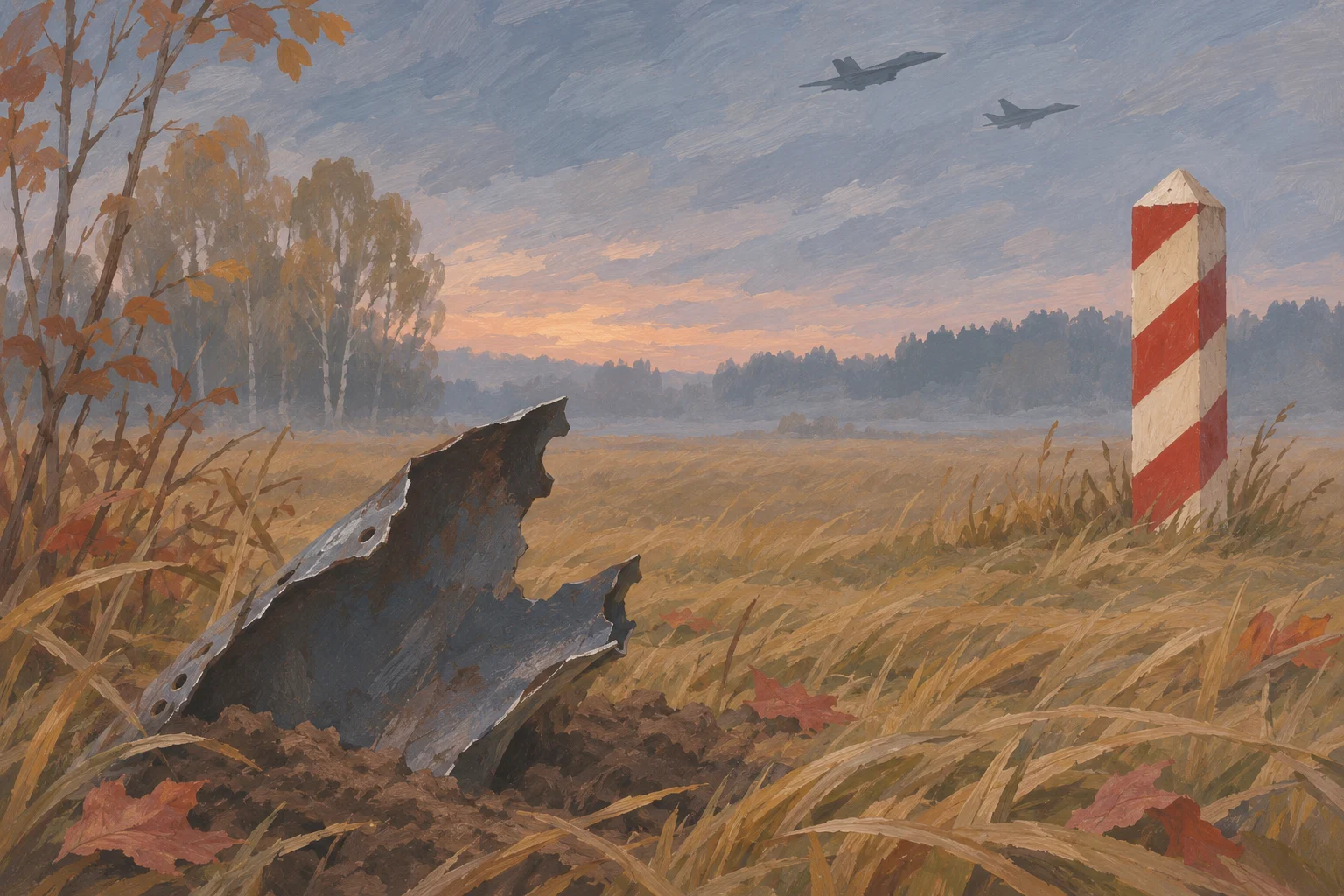
Poland’s planned exercises with allies on Friday would proceed, Kosiniak-Kamysz said, and Warsaw would ask NATO for more help securing the alliance’s eastern flank. Thus the war’s geography widened by a few fragments of metal: a capital’s bridges, a station in Lviv, and now objects on the soil of a NATO member.
The bridge in Crimea, the table in Berlin
The barrage followed Vladimir Putin’s promise of a “painful” retaliation for Ukraine’s third strike this week on the Kerch Bridge to occupied Crimea, the £3bn road-and-rail link described as Europe’s longest and a emblem of his rule there. Zelenskyy has said Ukraine attacks that bridge in response to Russian strikes on Ukrainian infrastructure, including bridges. Ukraine’s military also said it hit the Kaleikino oil-pumping station in Tatarstan on Thursday, damaging three reservoirs at an installation belonging to the Druzhba pipeline system.
Putin made his threat after meeting Donald Trump and Xi Jinping in Shenzhen. Trump opened the gathering by declaring that the three were “really making history” and embraced Putin as a “friend.” It ended without breakthroughs on Ukraine or Iran; its four-point peace declaration mentioned neither Russia’s invasion nor Washington’s conflict with Iran. European leaders, excluded from the room, warned that any settlement decided over their heads would be unacceptable and that Putin’s reception could embolden the Kremlin.
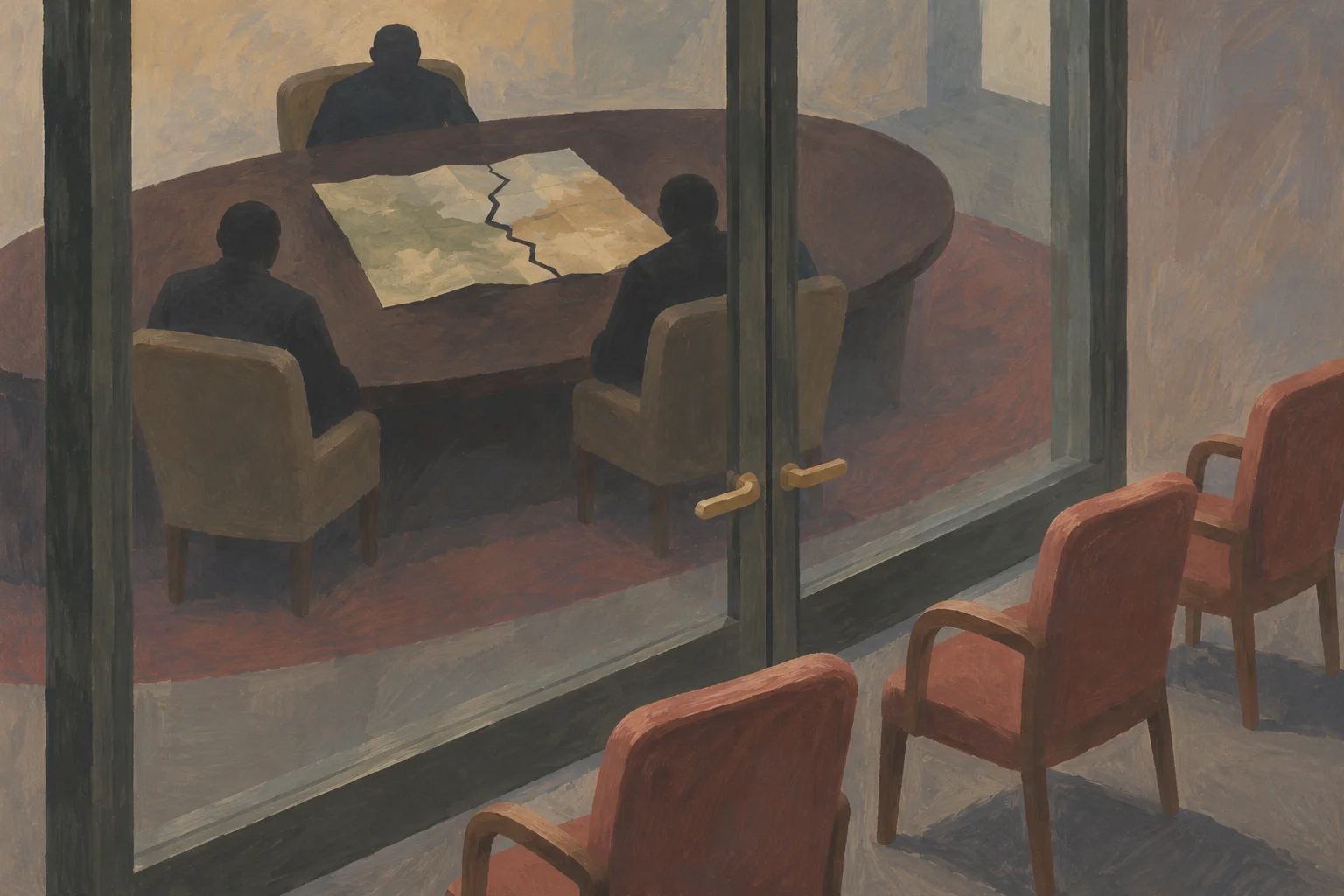
In Berlin, nearly 40 European leaders met US envoys Jared Kushner and Steve Witkoff, while Trump called in. Kushner said Russia had become “comfortable” with the concept of a Ukrainian security guarantee based on NATO’s Article 5, and that Trump was open to such an arrangement if it served American interests and formed part of a broader package. “Any deal we do will be in close consultation with Ukraine and with Europe,” he said. What the guarantees would contain, and whether Moscow or Kyiv would accept them, remained unclear.
Emmanuel Macron went further, saying Ukraine’s NATO membership was “relevant” to European security and that the question should be reopened. Germany, France, Britain and Ukraine jointly promised additional missile defences before winter and urged Russia to accept an energy ceasefire. US-brokered talks in Abu Dhabi the previous week had produced no major breakthrough on territory; Russia holds about a fifth of Ukraine.
Other governments registered the war in their own diplomatic ledgers. The Netherlands summoned Russia’s ambassador after a projectile landed behind its Kyiv embassy, causing minor damage but no injuries; Moscow’s embassy in The Hague responded that it was becoming “increasingly difficult to regard the Netherlands as a mere bystander.” Estonia announced that its five border crossings with Russia would close from December 1 for at least six months, citing security concerns and suspicions—regularly denied by Moscow—of Russian involvement in two arson attacks on defence companies.