
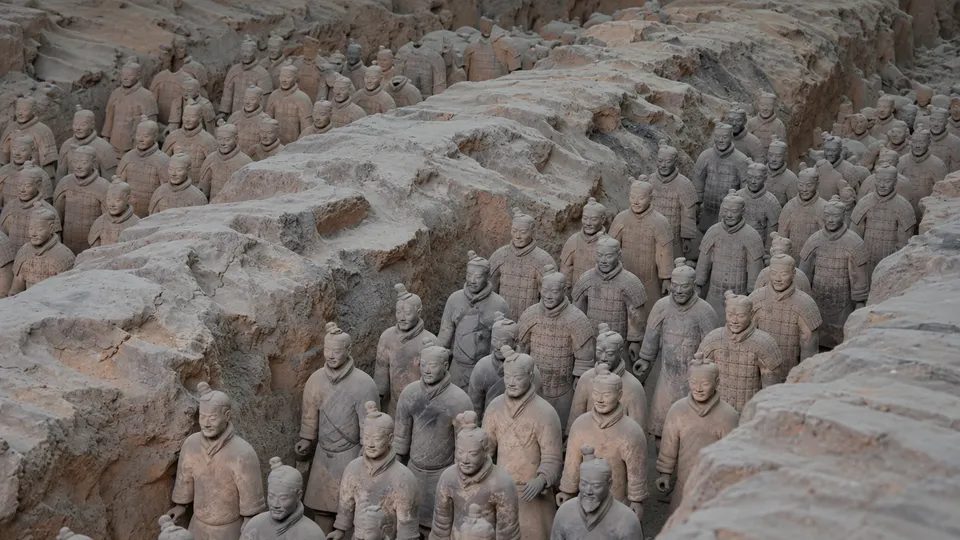
An emperor builds his tomb so that he will be remembered. The people who build it are not supposed to be remembered at all. For more than two thousand years that arrangement held at the mausoleum of Qin Shi Huang, near Xi’an. His clay army stood underground with its own faces, hairstyles, armour and weapons, and the hands that made it stayed nameless.
The hands did leave something, though. While the clay was still soft, a thumb or a fingertip sometimes pressed into the surface, and the kiln fixed that mark for good. According to a new study, some of those marks were left by women, and some by children.
Unit T23
The study is narrow, and its narrowness is part of its honesty. As Arkeonews reports, Xiaoxi Li and colleagues looked at 79 well-preserved fingerprints found on 36 terracotta soldiers from a single excavation unit, T23, in Pit 1 of the mausoleum. Phys.org describes the team as led by Li at the Mausoleum Site Museum in Xi’an. The paper appears in the Journal of Cultural Heritage, volume 82, pages 274 to 281.
Their statistical model estimates that about 45% of the prints came from adult men, 32.7% from adult women and 22.3% from people younger than 15.
So nearly a third came from women, and more than a fifth from children.
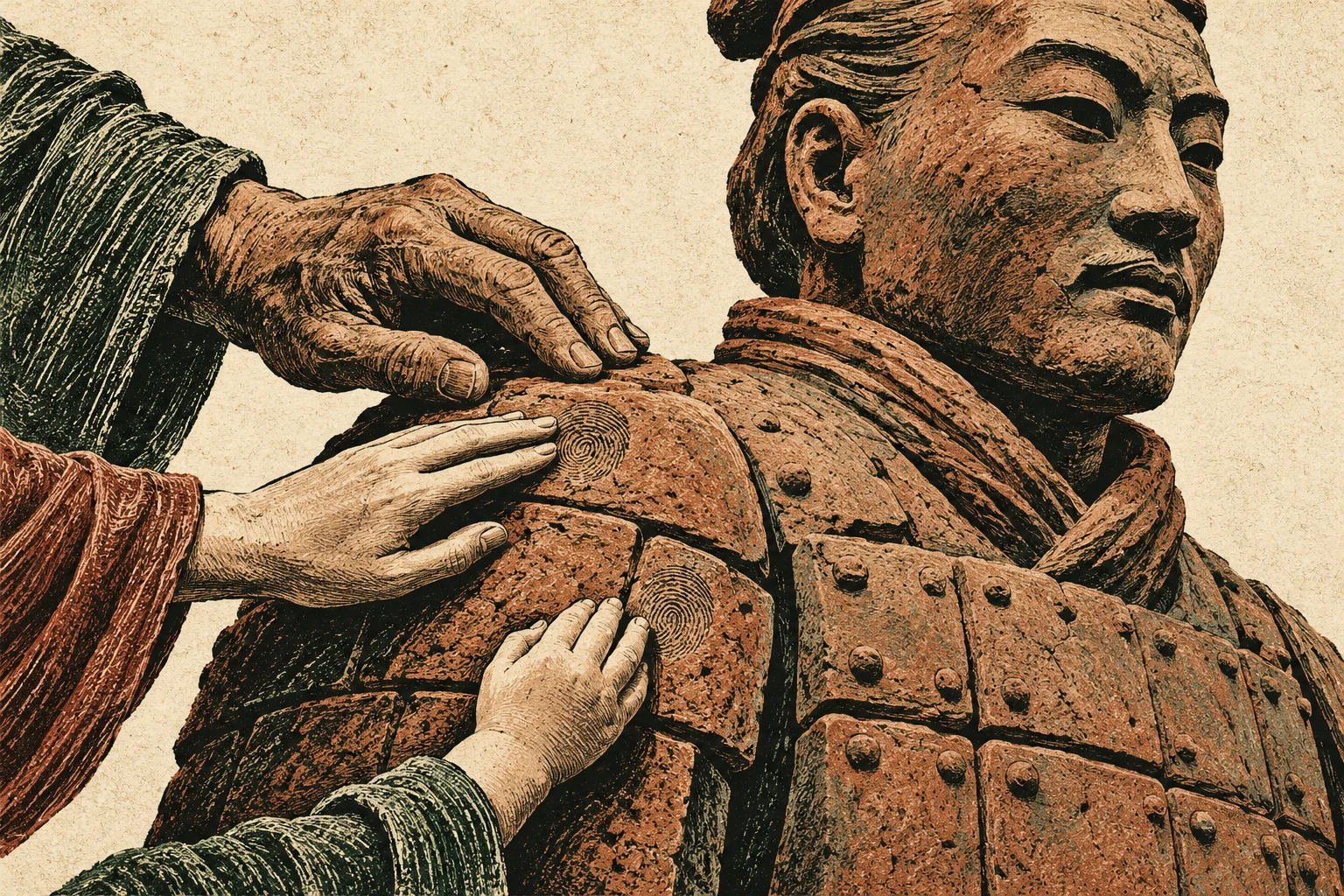
The researchers do not claim these are the proportions of the workforce, and they press the point. One worker might leave several prints on a single figure, and another might leave none that can be read. Phys.org also notes that several prints could belong to the same person. What the numbers describe is the mix of prints in the clay. They do not count the people in the workshop.
Reading a ridge
The method depends on a small measurement: the average breadth of the ridges in a fingerprint. Ridges change size as the body grows, so across a whole population their width carries some signal of age and sex. For any one person it carries much less, because the groups overlap a great deal.
Earlier work usually combined two measurements, ridge breadth and ridge density, meaning the number of ridges in a fixed distance. The trouble is that these are really one fact counted twice. Wider ridges mean fewer of them fit in the same space, so treating the two as separate evidence gives a false sense of certainty. Li’s team instead used a Bayesian mixture model, which takes account of how the measurements depend on each other and estimates the makeup of the whole sample without assigning each print to a person. The model also tries to handle a known trap: the fingerprints of adult women and adolescent boys can look very much alike.
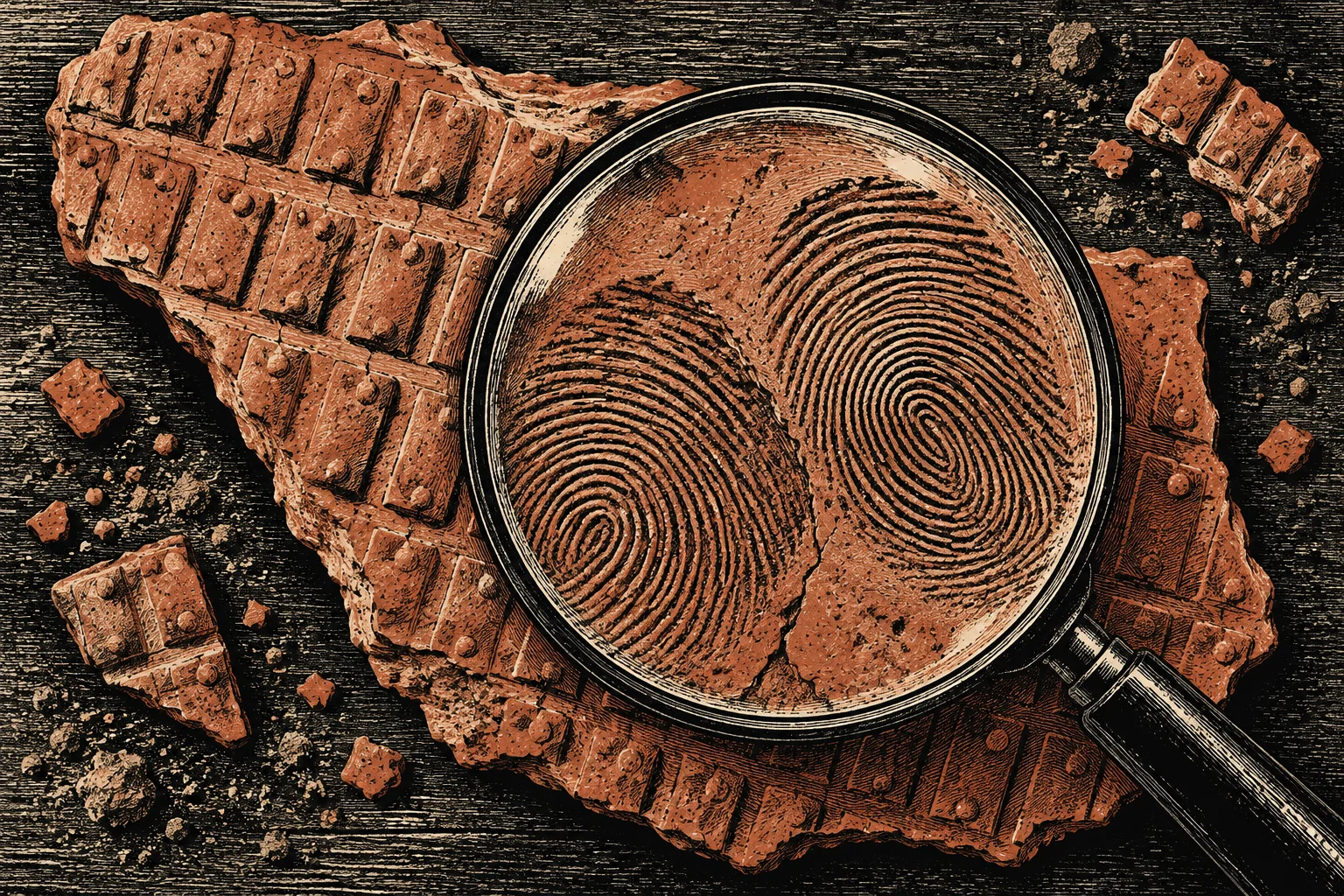
The result, in a passage Phys.org quotes from the researchers: “The model results indicate that the artisan community was not exclusively composed of adult males.”
What the state wrote down
The empire behind the army counted everything. Qin Shi Huang unified China in 221 BCE. Work on his mausoleum had started in 246 BCE, long before he died in 210 BCE, and it consumed huge amounts of material and labour. Farmers found the army in 1974, and decades of excavation since then have shown a carefully organised production system: separate workshops, specialised tasks, managed supplies. Scholars still disagree about whether workshops mass-produced body parts for assembly elsewhere or made whole figures themselves. Chemical analysis of clay linked to the inscriptions “Gong” and “Xianyang” found differences in composition consistent with separate workshops, which means many teams worked for the same dead man.
The same bureaucracy also wrote down who did the work. Qin-period inscriptions on lacquerware refer to craft workers under state supervision as da nüzi, adult woman; xiao nüzi, young girl; and xiao nanzi, young boy. That is lacquer, not terracotta, and the parallel should not be stretched. Still, the records show that the Qin state already listed women and the young among its craftspeople in at least some trades. The fingerprints suggest that something similar may have happened in the workshops supplying the tomb.
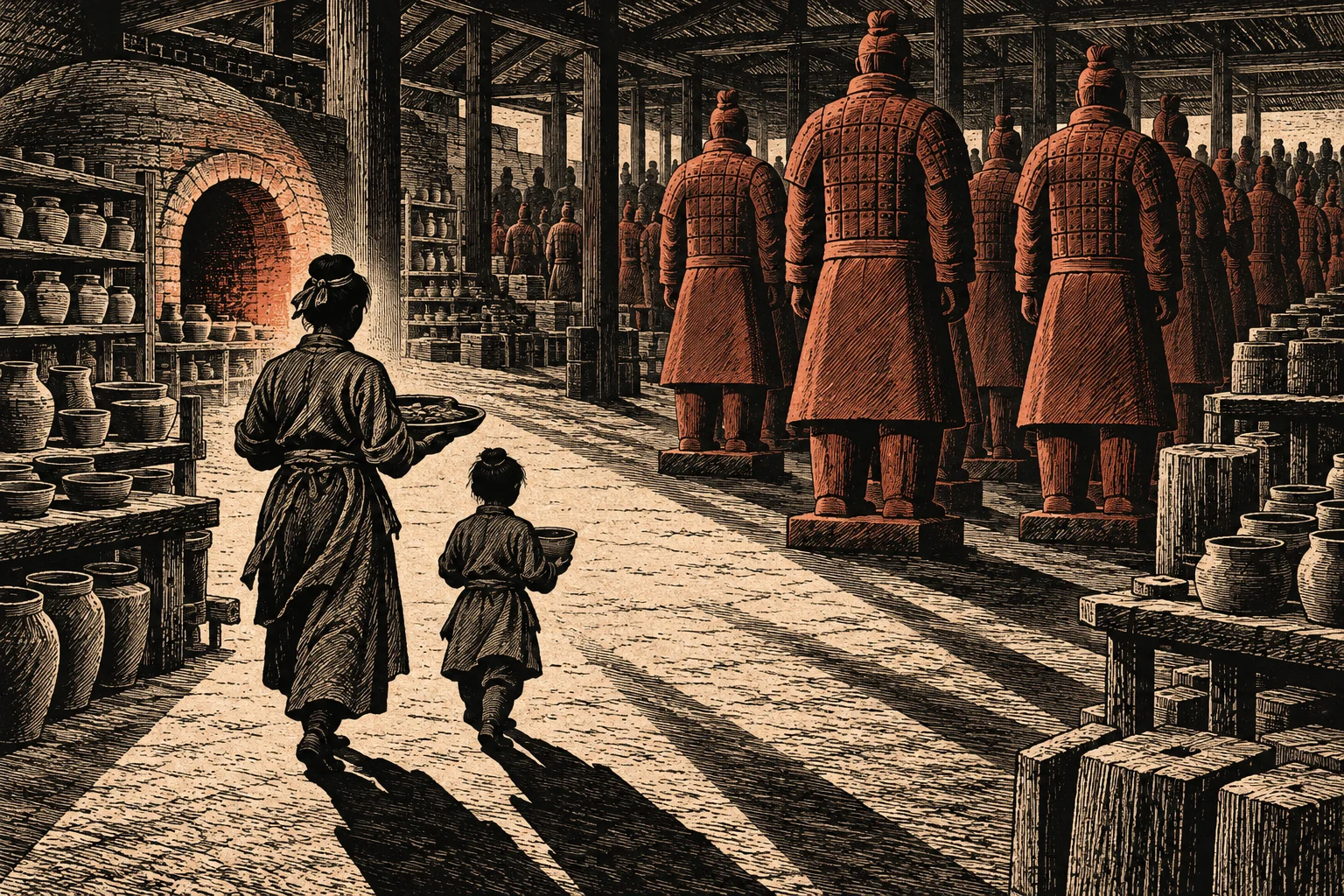
A reflection, offered as one: empires tend to remember their projects by the name of the ruler and to keep the workers only as entries in a ledger. Here a few of those entries turn up again in the clay.
The limits of a fingertip
The study’s caveats matter as much as its findings. To estimate age and sex, the model relies on reference measurements from modern European populations, whose fingerprints may differ from those of people living in Qin-era China. The authors acknowledge that this could inflate the estimated share of women and juveniles. The sample comes from one unit and cannot speak for every workshop in the project. As the researchers put it, in Phys.org’s quotation, “Unit T23 represents only a localized area of Pit 1.”
The prints also say nothing about how these people lived. If women and children worked in the imperial workshops, nobody knows whether they shaped the clay, joined the parts or did other jobs, how long they worked each day, or under what conditions. The prints show that someone of a certain size touched the wet clay, and no more.
For half a century the standard picture of the army’s makers was a crowd of adult male craftsmen. The new estimate does not overturn that picture, but it complicates it. Among the 36 soldiers of Unit T23, some of the prints were small enough that the model reads them as children’s, children who were working, it seems, on the guard of the man who had united China.