
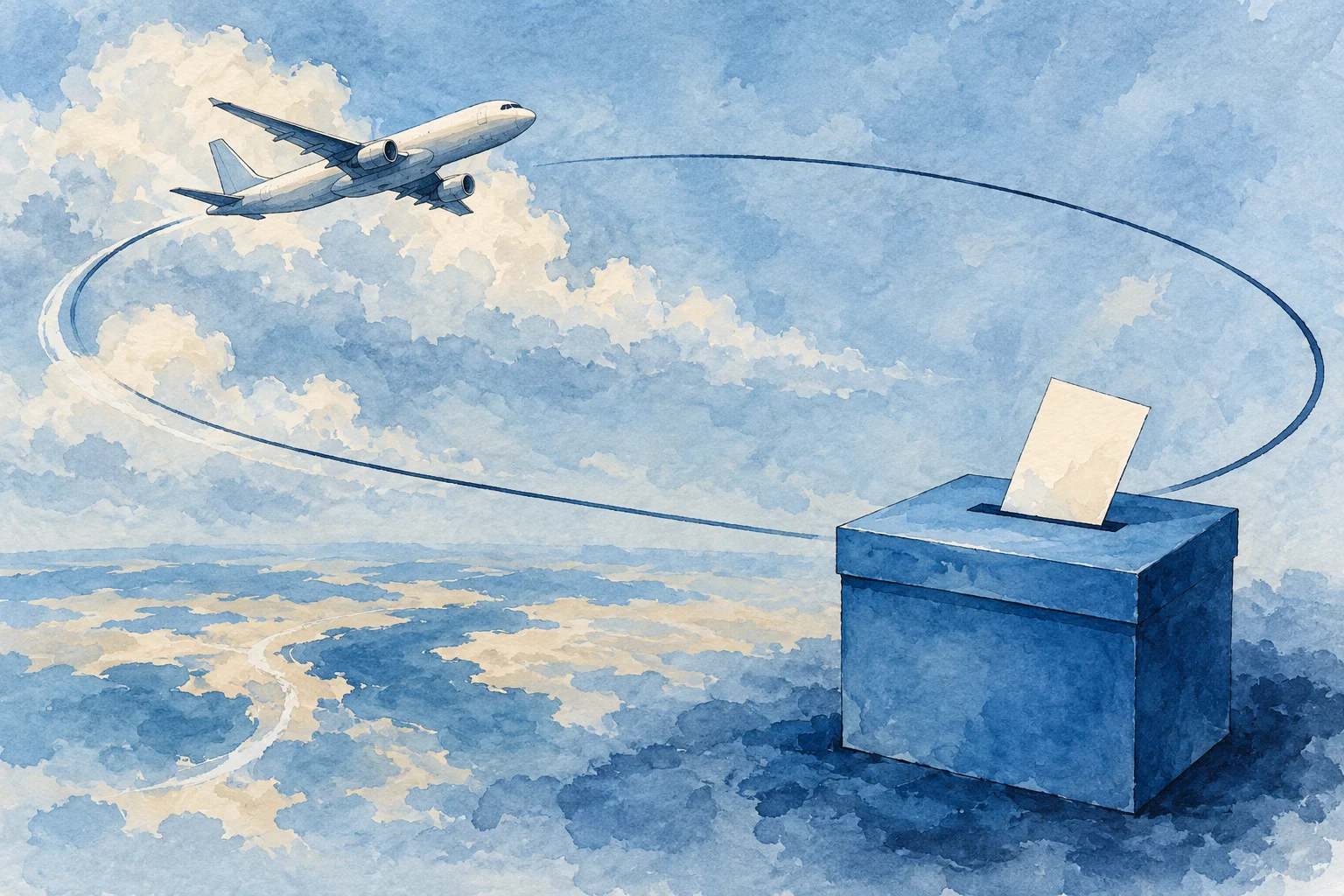
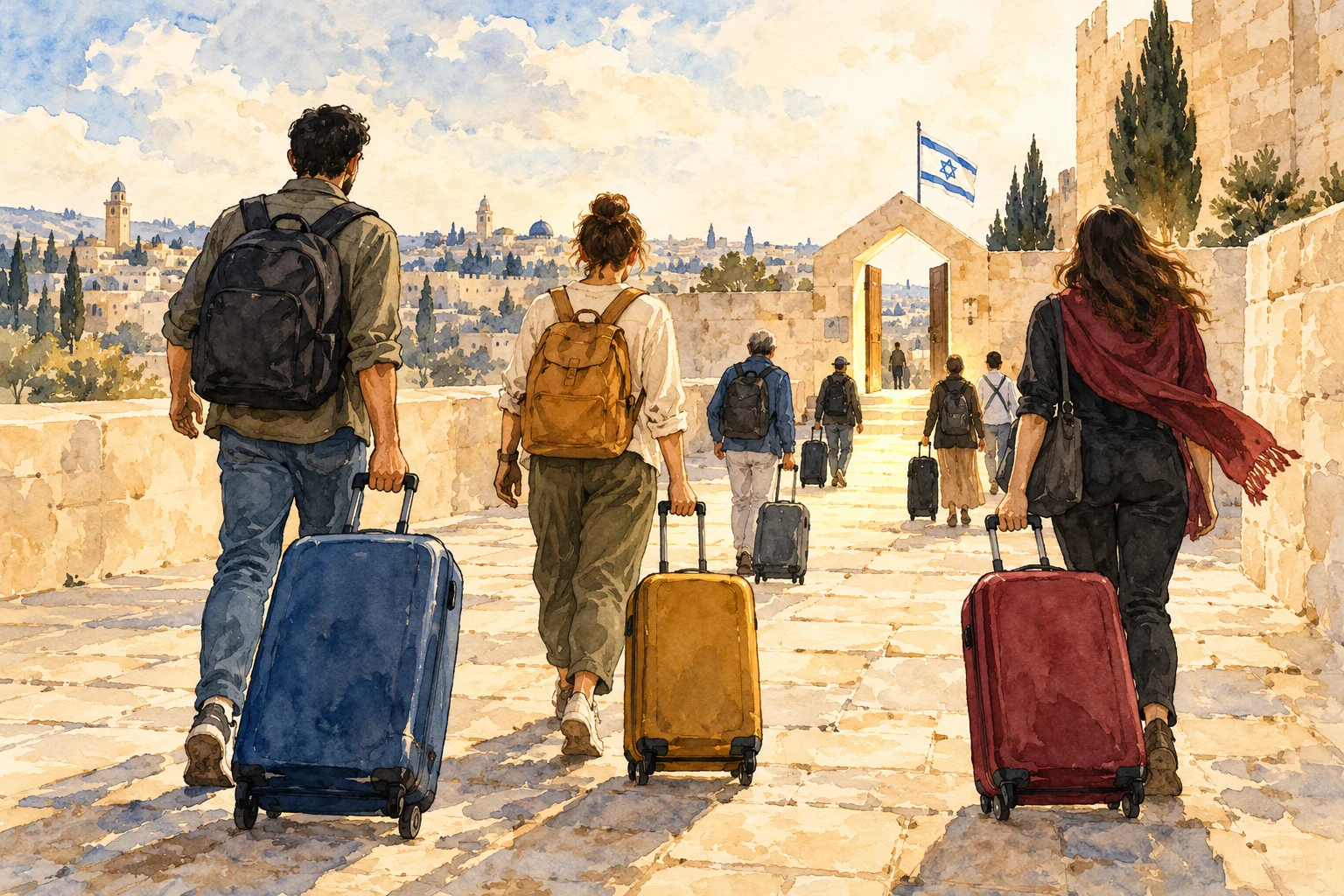
There are elections a man follows in the newspaper, and elections for which he buys a plane ticket. On Tuesday, by the estimate of the American-Israel Democracy Coalition, some 50,000 Israeli citizens living overseas will have crossed oceans, mostly from the United States, to stand physically inside the country and mark a ballot — because Israeli law grants citizens abroad the right to vote but denies them the means: no absentee ballots exist, the Boston Globe reported. The catch is simple and absolute. You must be there.
They are arriving in a country still reeling from October 7, 2023, when Hamas militants from Gaza killed 1,200 Israelis, and amid the wreckage of everything that followed: widespread destruction in Gaza, the war against Iran, incursions into Lebanon, curbs on judicial independence, aggressive settlement and violence in the occupied territories. The race is projected to be tight, and in a tight race the travellers may matter.
The rabbi’s whirlwind
Senior Rabbi Claudia Kreiman of Temple Beth Zion in Brookline will fly to Israel, vote on Tuesday, and fly back the same day. “It is one vote, and what do I know if this vote will make a difference?” she said. “But I want to believe that my vote, with the other 50,000 people traveling, will make a difference.” At least six other members of her congregation are going.
Kreiman carries her reasons in her biography. She moved to Israel from Argentina as a young woman; her mother died in 1994 in the terrorist bombing of a Jewish cultural center in Buenos Aires, a suicide car bomb authorities linked to Hezbollah. “One of the first questions I asked myself was what kind of future do I want?” she said. “What can I do in the world so things like this don’t happen? I made a conscious choice that it would be one of building bridges.” Of this election she says: “I see it as a turning point that will determine the direction Israel takes. I really feel democracy is on the line, and we can do something to change it. What happens in Israel will affect all of us.”
“I’m going to Israel because I have to for Israel’s future,” said Berechman, a dual US-Israeli citizen who holds his citizenship through his father. “This is the most consequential election of Israel’s history, in my opinion. You’re either voting for a democratic Israel or, if Netanyahu wins, endless war.”
The demography of the far-flung
Overseas Israelis account for some 810,000 of the country’s 7.3 million people, according to the Central Bureau of Statistics; every citizen living anywhere — including children born abroad to at least one Israeli parent — holds the franchise. Ora Peled Nakash, cofounder of the American-Israel Democracy Coalition, notes that those who choose life abroad tend to be the educated and the resourced, and many skew liberal or progressive, though ultra-Orthodox communities in the United States lean toward the Netanyahu government. Her coalition has spent more than a year spreading one piece of knowledge. “People mistakenly thought that not being a resident of Israel, it would impact your eligibility to vote,” she said. Israeli government officials, for their part, have criticized progressive groups for trying to shape the vote by encouraging expatriates to travel.
Analysts say the margin could be a hair. Four years ago Netanyahu’s right-wing coalition took 48.4 percent of the vote and converted it into 64 of Parliament’s 120 seats. His main opponent, the Globe reports, is Gadi Eisenkot, a former general who rejects Palestinian statehood but has pledged to crack down on settler violence in the occupied West Bank and to engage the Trump administration on rebuilding Gaza.
Robert Leikind, director of the American Jewish Committee New England, is unsurprised by the pilgrimage. “Because they’re Israelis, because they’re Jews, people are deeply invested in the well-being of the society and its survival,” he said. “What’s at stake in the minds of people isn’t just one policy or another. It’s the health and stability and future survival of the country.” Dror Avieli of Newton bought tickets for two sons in California and Wisconsin to join him; even his ex-wife is traveling, and a third son already lives in Israel. “It’s an amazing feeling, a mix of excitement and fear,” Avieli said. “Excitement to see a change in the results and seeing Bibi out, and fear if it is not happening.”

Those who stay home
But a pilgrimage is also a verdict on yourself, and some have rendered a different one. “Although my sister and mother from Israel have begged me to fly and vote, and offered to pay for the trip, I have chosen not to do that,” said Noam Shoresh of Newton, a director of computational biology and epigenomics at the Broad Institute at MIT and Harvard. “I don’t think Israel as a society, as a Jewish-Israeli society, will change and end the oppression of Palestinians on its own. The only way this will happen is from outside pressure, mainly from here.” Even a center-left government, he argues, would provide political cover “to say they want peace” while continuing the occupation. “They want quiet at the cheapest possible price.”
Hani Murad, a Palestinian American psychologist in Newton born in Nazareth, who immigrated forty years ago and worked for the United Nations in the Middle East, will not vote either. “The bottom line is that none of the Israeli political parties accept that Israel should be a country for all of her citizens,” he said. Members of his family in Israel will vote, but many Palestinians, he notes, wonder whether participation grants the process a legitimacy it has not earned. “As Palestinian citizens of Israel, the vast majority of us do not see the Israeli governments representing or advocating for our aspirations to live in safety, peace, and security.”
So the jets descend on Ben Gurion with their cargo of citizens who live elsewhere and belong here. It is a peculiar feature of the modern state — the nation scattered across the earth, summoned home for a single day to decide what the nation will be. Thousands are paying dearly for a few days in the country, for one mark on one paper. What they will have purchased, on Tuesday night, no one yet knows.