
The federal program that discounts internet service for American schools and libraries moves somewhere between $2 billion and $3 billion a year, depending on whose number you read, and its chairman wants public comment on whether it should exist at all. Federal Communications Commission chairman Brendan Carr led a 2-1 vote on June 25 to adopt FCC-26-41, a combined Notice of Proposed Rulemaking and Further Notice of Proposed Rulemaking that asks, among dozens of other questions, whether E-Rate “should be limited or sunset to reflect today’s extensive connectivity rates.” Comments closed this week; Ars Technica reported that schools, libraries and state officials filed en masse to stop it.
The dollar figures in that fight don’t agree, and the gap is worth sorting out before comparing them. Ars Technica calls E-Rate a “$2 billion-a-year program.” A 23-state attorneys general coalition led by Washington describes it as providing “over $3 billion a year.” The Congressional Research Service puts the long-run average at $2.5 billion to $3 billion annually since the program’s 1997 start, and gives an actual Funding Year 2025 commitment total of $2.66 billion. None of those contradict each other: they’re measuring committed support, not disbursement, against a statutory cap Ars reports at $5.2 billion a year, adjusted for inflation and rarely approached because payouts track the approval rate on applications, not the ceiling.
How the money moves
E-Rate is funded through the Universal Service Fund, which collects money the way a sales tax collects money: the FCC sets a quarterly “contribution factor,” a percentage of revenue that interstate telecom and broadband carriers must pay in, and carriers pass that cost to subscribers as a line item on phone and internet bills. The USF splits roughly $8 billion a year across four programs — Lifeline (low-income phone and broadband), High Cost (rural buildout), Rural Health Care, and E-Rate — administered by the Universal Service Administrative Company under FCC oversight. E-Rate then discounts schools’ and libraries’ internet and network-equipment costs by 20 to 90 percent, the rate set by how poor and how rural the community is. Per the CRS, 96,416 of the nation’s 100,083 public schools — 96.3 percent — participate, along with 12,230 of 16,751 public library locations, about 73 percent.
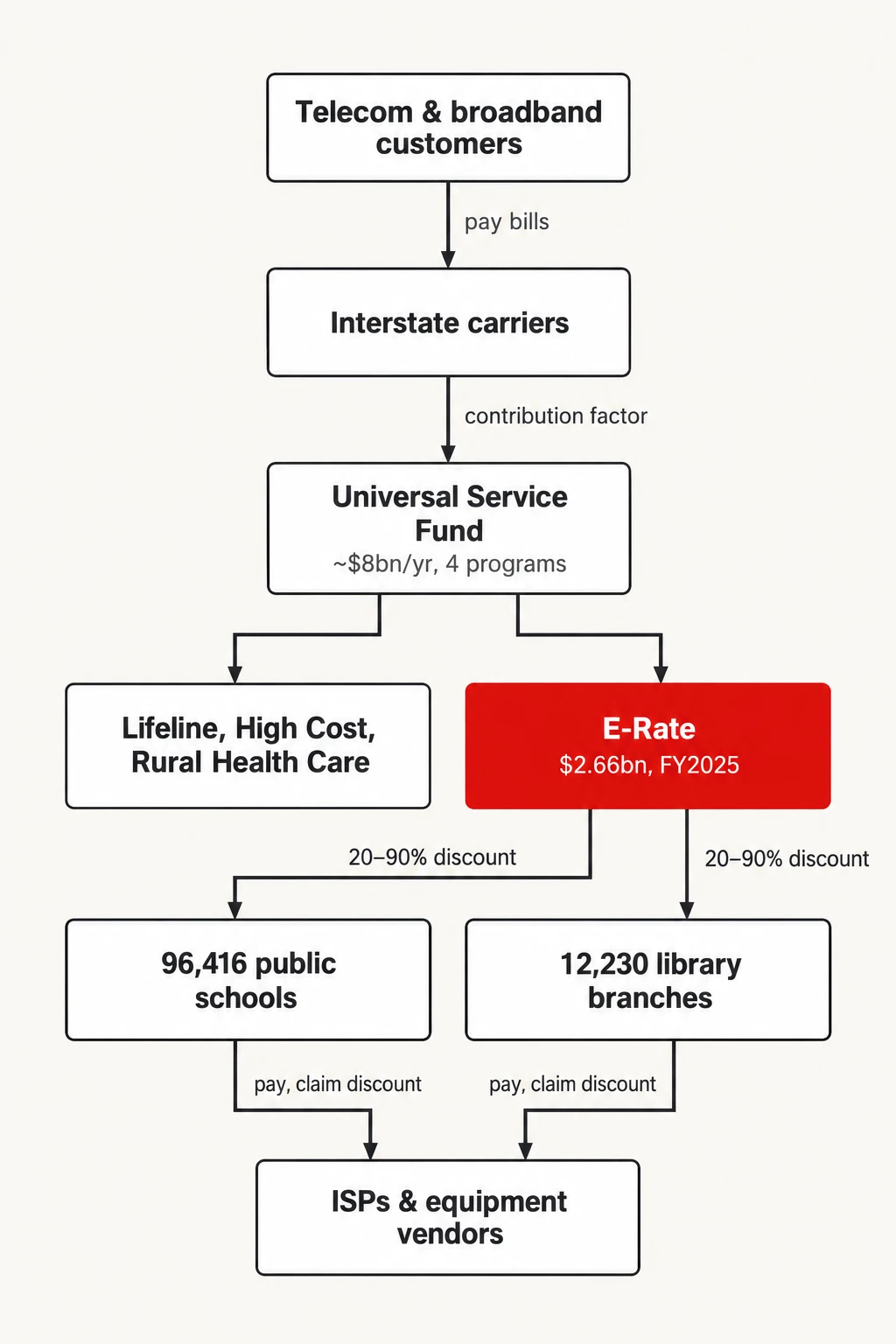
| From | To | How |
|---|---|---|
| Telecom & broadband customers | Interstate carriers | pay bills |
| Interstate carriers | Universal Service Fund (~$8bn/yr, 4 programs) | contribution factor |
| Universal Service Fund (~$8bn/yr, 4 programs) | Lifeline, High Cost, Rural Health Care | |
| Universal Service Fund (~$8bn/yr, 4 programs) | E-Rate ($2.66bn, FY2025) | |
| E-Rate ($2.66bn, FY2025) | 96,416 public schools | 20–90% discount |
| E-Rate ($2.66bn, FY2025) | 12,230 library branches | 20–90% discount |
| 96,416 public schools | ISPs & equipment vendors | pay, claim discount |
| 12,230 library branches | ISPs & equipment vendors | pay, claim discount |
Based on Universal Service Administrative Company / Congressional Research Service
The sunset question
E-Rate dates to Section 254 of the 1996 Telecommunications Act, which Senator Ed Markey, its House-side author, has said has put nearly $62 billion into schools and libraries since inception. Carr’s proposal reads that mandate as having an expiration date built in: “In establishing the program in 1996, Congress was addressing a specific problem: limited access to advanced telecommunications and Internet services in schools and libraries,” the NPRM states. “Given the substantial expansion of broadband access in schools and libraries over the last three decades, we seek comment on whether and to what extent the E-Rate program has fulfilled that mission and whether continued funding is consistent with Congress’s original objective.” That is the argument an agency makes when it wants to retire a program Congress didn’t explicitly sunset: show the problem solved, then ask whether the solution’s authorizing purpose survives.

Carr’s screen-time case
The other half of Carr’s argument is about what schools did with the connectivity once they had it. Carr has said school districts “experimented with a massive increase in screen time for students,” replacing “reading books, penciling out answers, and interacting with teachers” with devices, and his formal statement on the item cites figures that more than half of students now use a computer for up to four hours a day, a quarter for more than four, and that by eighth grade more than half of students report using computers in all or almost all classes, up from 30 percent in 2019. None of those numbers are about E-Rate’s broadband subsidy specifically; they’re about device and curriculum choices school districts made using budgets that include, but aren’t limited to, E-Rate money. Carr’s own proposal doesn’t present data isolating what share of the screen time he’s describing runs over E-Rate-funded connections versus devices and software districts bought with other funds.
Legal authority in dispute
The American Library Association’s comment to the FCC disputes Carr has the authority to end the program at all: “Importantly, the FCC does not have the authority to terminate the E-Rate program. The E-Rate program is mandated by Congress, and the FCC is responsible for administering it.” The group also points to language in federal law assigning decisions about inappropriate content to “the school board, local educational agency, library, or other authority responsible for making the determination” — not the FCC. Washington attorney general Nick Brown led 23 state attorneys general in a comment letter making the same argument: that unilateral elimination would be illegal because Congress created the program. “Internet access is a necessity and a public good for schools and libraries,” Brown said. “This letter won’t be the final word if the FCC moves forward with an illegal plan to cut funding from Washington schools.”
What the comment record shows
Participation is uneven enough that the national averages hide real gaps. The Texas Library Association told the FCC that “only 35 percent of Texas public libraries currently receive E-Rate discounts, compared with 65 percent of public libraries nationwide, and only 55 percent meet the Commission’s own recommended broadband speed benchmarks,” arguing that “a gap this size, in the nation’s second-most populous state, is evidence of unmet need working through real obstacles — not evidence that the need has passed.” Washington’s attorney general’s filing put the state’s dependence the other way: 218 of 295 public schools there rely on E-Rate, districts receive a 77 percent average discount, the state got more than $40 million this year, and its K-20 education network alone relies on $6.87 million in annual E-Rate funding. For the Shelton School District, where over 90 percent of children qualify for free or reduced lunch, the filing says there’s no existing budget line to replace that money.
The smallest filing in the docket is also the most concrete. Paul Lapka, principal of Rock Valley Christian School in Iowa, told the FCC: “We estimate our annual Internet cost at approximately $3,120 and our annual E-Rate support at approximately $1,560,” a 50 percent discount. “If support were reduced, we would face higher local costs, delayed network upgrades, and pressure to redirect funds from other school priorities.” Cable lobby group America’s Communications Association made the same point from the vendor side, telling the FCC that “schools and libraries must continue to pay for broadband service, maintain and replace internal network equipment, and upgrade capacity as their needs evolve” regardless of what Carr decides about screen time. The Schools, Health & Libraries Broadband Coalition called it “disheartening and surprising” that the FCC was asking whether to “shelve or significantly reduce” what it called “the financial pillar supporting most schools’ and libraries’ digital connections.”

Precedent: the hotspot cut
Carr’s FCC has already narrowed E-Rate once. Last year it voted 2-1 to end E-Rate funding for lending Wi-Fi hotspots and for Wi-Fi on school buses, with Carr arguing those uses were “illegal” under the program’s original 1996 scope. Markey and Senate colleagues objected at the time, noting the FCC had provided $48 million in fiscal 2024 for bus Wi-Fi alone, with more than 8,000 schools and libraries requesting over 200,000 hotspot connections for students and educators. Commissioner Gomez, the FCC’s lone Democrat, dissented on both that vote and June’s: E-Rate, she said, gives children in low-income and rural communities “the same shot at a digital education as anyone else,” and the agency’s inquiry into screen time goes beyond its mandate — “The FCC is not the nation’s parent. It is not the nation’s teacher. And it is not the nation’s school board.”
Reply comments in the docket are due November 12. With Republicans holding a 2-1 majority, whatever Carr proposes next is likely to clear the commission on the same split that opened the inquiry. What happens after that is less certain: the American Library Association and the 23-state attorneys general coalition have both previewed the argument they’d make in court — that an agency cannot unilaterally end a program Congress created by statute — and Washington’s attorney general has already said litigation is on the table if the FCC acts. Whether a reviewing court agrees that “mission fulfilled” is a lawful basis for sunsetting a 29-year-old entitlement program is the number to watch next, not any dollar figure in the docket.