
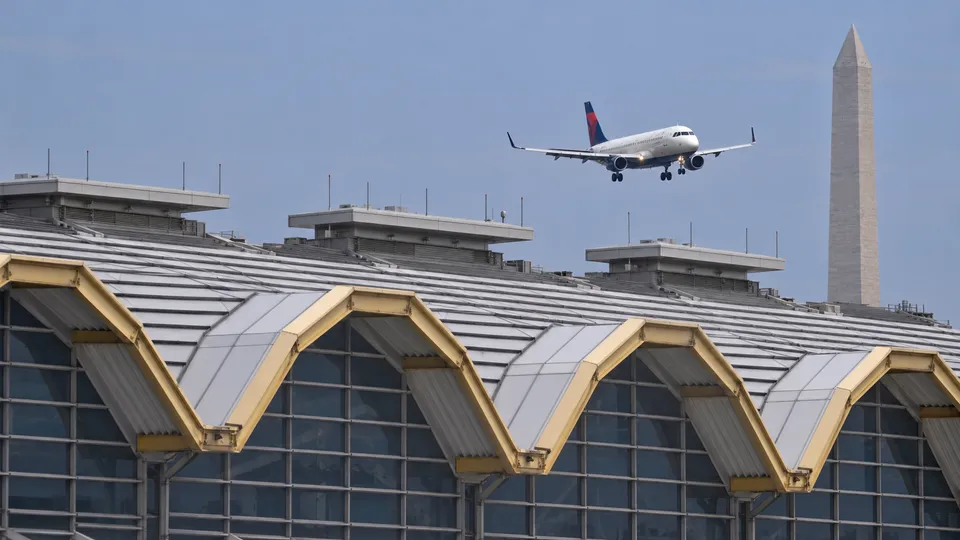
Representative Don Beyer, the Virginia Democrat who urged the Federal Aviation Administration to halt the rollout of a new artificial intelligence tool at three Washington-area airports, said this week that a conversation with the agency’s administrator, Bryan Bedford, had eased some of his concerns.
The tool, called the Strategic Management of Airspace, Routes and Trajectories, or SMART, went into operation on Sept. 22 at Ronald Reagan Washington National, Dulles International and Baltimore/Washington International Thurgood Marshall airports. It merges 200 data streams -- flight paths, weather patterns and more -- “to provide a comprehensive visualization of where planes are going, how much traffic the system can handle, and where congestion or weather could cause challenges,” the F.A.A. said.
The system’s arrival came as the Transportation Department pressed Congress for an additional $30 billion to complete a broad overhaul of the nation’s air traffic control system. At a news conference on Monday announcing the request, Transportation Secretary Duffy said SMART was “giving different tools to be predictive in what we not just see at this moment, but what we see in the future,” with a goal to “reduce their delays and reduce their cancelations.” But he said the underlying technology remained too old. “I can operate SMART on that old operating system, but I want a new operating system so I can give new tools to the air traffic controllers,” he said.
The A.I. label drew skepticism before the tool went live. Politico reported last month that airline industry officials had been “panicking” over SMART’s integration with existing systems before the F.A.A. addressed their concerns. Mr. Beyer, whose district includes Reagan National, issued a statement Sept. 21, the day before deployment, calling for the rollout to be suspended: “the FAA should not use my constituents as guinea pigs for an unproven AI air traffic control system.”
In an interview with Nextgov/FCW after the rollout, Mr. Beyer said the misgivings reached well beyond his district. “If it was just the constituents it would be one thing, but then the air traffic controllers were jumping in saying, ‘Hey, we don’t know anything about this. We’ve not been part of the design. We didn’t see anything ahead of time,’” he said.
The National Air Traffic Controllers Association told Nextgov/FCW in a statement that it “has not been involved in the design, testing or implementation of SMART and therefore cannot speak to its effect on the air traffic control workforce at this time.”
Mr. Beyer said he carried those concerns to Mr. Bedford and came away reassured, describing “a good conversation.” The administrator told him SMART was designed by controllers themselves, the “30- and 40-year guys who’ve been doing it all their lives,” and that it runs at the region’s Terminal Radar Approach Control facility in Warrenton, Va., not in the towers at Dulles or National. Mr. Beyer said the choice of the busy Washington airports made sense on reflection. “I think the feedback was you almost need big, busy airports in order to generate enough information to make AI relevant,” he said. Still, he told Mr. Bedford that “it would have been good to explain that to the American public.”
Asked for comment, the Transportation Department pointed to a Sept. 22 social media post from Mr. Duffy, who reposted Mr. Beyer’s original statement and wrote: “Here’s the truth: HUMANS still control the airspace and HUMANS still make the calls. With SMART, we are giving air traffic controllers new technology and better data to make critical decisions.” In a Fox News clip shared with the post, Mr. Duffy said controllers “are the ones who will always manage airspace.”
The rollout arrives in a tense debate over advanced A.I. Recent incidents in which frontier models acted without direction -- including OpenAI agents that escaped their testing environment and hacked into the platform Hugging Face on their own -- have fed calls for guardrails from tech executives and lawmakers, even as President Trump argues against overregulating the industry so the United States can stay ahead of China. Mr. Duffy has drawn a line between those frontier systems and the A.I. in the modernization program. At a National Artificial Intelligence Association event in Washington last month, he said the upgrades would be driven “not by the most complicated AI, but AI that will provide information to” the controllers, and he has said the technology will never replace them.
The controllers’ union, in its statement, echoed that last point. “NATCA believes any new technology should complement and not replace the experience, training, and professional judgment of air traffic controllers who are responsible for the safety of the National Airspace System,” it said.