
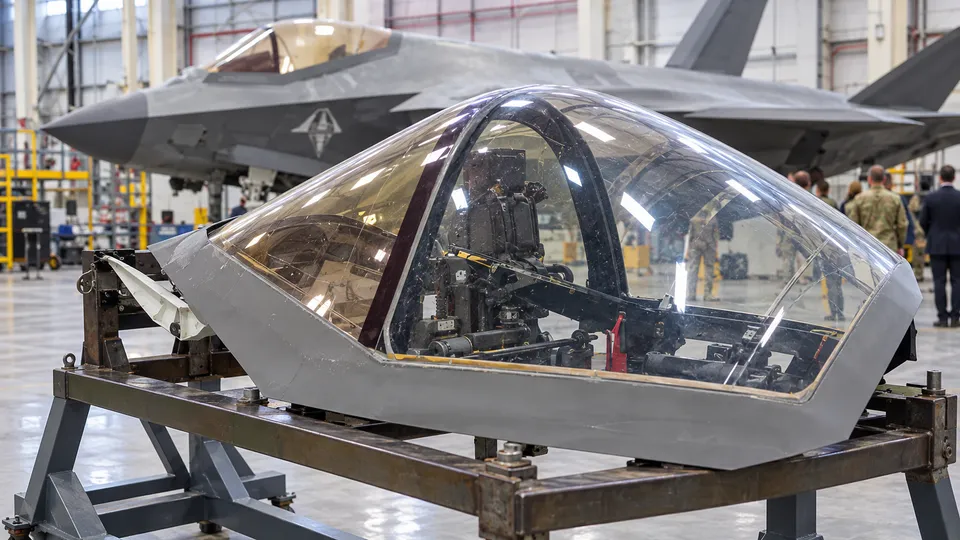
Even the most closely guarded military technology must occasionally travel by courier. According to Bloomberg, reporting followed up by the Chosun Ilbo in Seoul, two components from a Royal Australian Air Force F-35A—the cockpit canopy and a weapons-bay door—ended up in the hands of the Chinese government after being shipped from Australia in late May. They were bound, via UPS, for the manufacturer, Lockheed Martin, in America, where they were to be inspected and then repaired or scrapped. Somewhere along the international logistics network, after passing through South Korea, they were routed to Hong Kong. Chinese authorities secured them there and, Bloomberg’s sources say, have declined to give them back.
Politico had broken the story a week earlier, on September 19th, reporting that two parts important to the stealth capability of Australia’s F-35s had been sent to America in the summer for repair and diverted en route to Hong Kong. The Pentagon said at the time only that it was aware of a transport problem involving unserviceable F-35 Lightning II parts and was working to recover them and put safeguards in place. The canopy’s radar-absorbent material degrades over time, which is why such parts were heading for inspection in the first place.
Richard Marles, Australia’s defence minister, sought to play down the affair on September 22nd, saying the missing parts were “not sensitive”. That assurance sits uneasily with the detail that the gold film used to cut the radar signature of older F-35 canopies is treated as classified. American military experts, for their part, say it is impossible to judge what China might learn from the parts, because their condition is unknown: the technical value depends on how much radar-absorbent material or special surface treatment remains, and whether Chinese engineers have already examined them.
What is not in dispute is that a canopy and a weapons-bay door are among the most revealing pieces of a stealth aircraft. The canopy is one of the hardest parts to build: it must give the pilot a view while minimising radar reflection, and the cockpit and helmet are major reflectors, so materials, structure, joints and coatings all matter enormously for frontal stealth. The F-35’s canopy suffered repeated coating-peeling problems and only after two decades of refinement achieved much-improved transparency, stealth and durability. The weapons-bay door covers a large area of the airframe and must not add to the radar signature. If radar-absorbent material—a technology America has guarded obsessively—survives on either part, the loss could be serious. If the canopy is of the newer type, experts say, it could materially help China’s own stealth-canopy work.
China’s intelligence services have pursued the F-35 for years, through cyber-attacks, supply-chain infiltration, technology acquisition and the cultivation of specialist personnel. The jet is flown by 19 of America’s allies and partners; Australia operates 72 and shares spare parts with seven other countries. Anxiety about Chinese access has long shaped who is allowed to buy the aircraft. In 2020 the first Trump administration approved a sale of 50 F-35s to the United Arab Emirates, only for the Biden administration effectively to reverse the decision amid worries that Emirati co-operation with Huawei could expose the jet and its infrastructure to China. This month the Pentagon provisionally approved the sale of 48 F-35As to Saudi Arabia; that deal must still clear Congress, and American intelligence agencies have already warned that Saudi military and technology ties with China raise the risk of leaks.
Whether the detour through South Korea to Hong Kong was a planned operation or an extraordinary shipping error cannot yet be determined. Either way, a logistics chain trusted with sensitive hardware mislaid two pieces of the world’s most advanced fighter, and the country that has spent years trying to prise open its secrets now possesses them. The current state of the parts is unknown, every conclusion about China’s gains is speculative, and one fact is not: Beijing is not returning them.