
Here is a fairly basic design principle for an army that faces North Korea across a mined demarcation line: when you post a sentry, the sentry should have a loaded gun. South Korea’s front-line regulations say exactly that — rifles and crew-served weapons are supposed to be carried with a loaded magazine attached, a state the military calls saptan. On Oct. 4, People Power Party lawmaker Kang Sun-young disclosed the results of a Defense Ministry audit finding that, in practice, every single front-line army corps — the 1st, 2nd, 3rd and 5th, stretching from Ganghwa Island in the west to the east coast — had at some point posted guards with unloaded weapons. So had the Marine 2nd Division, which does coastal and riverside guard duty under the Capital Corps’ direction. The ministry’s own formulation, per the Chosun Ilbo, is worth savoring: “without any revision of the guidelines or underlying official documents, some units were operating some firearms” in an unloaded state. “Some units” here means all of them.
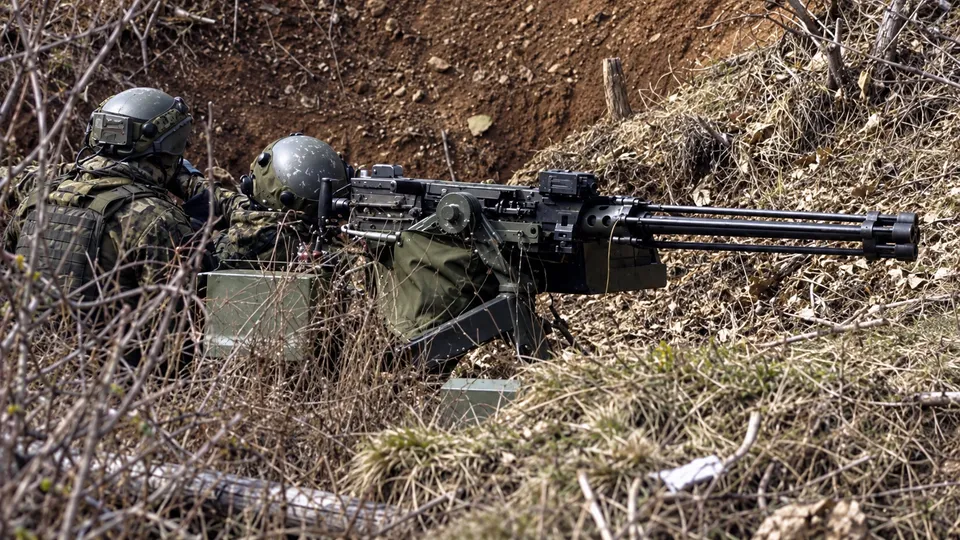
The audit began in August, after a July 29 Chosun Ilbo report that the 1st Corps had been running guard posts with no live rounds in either personal or crew-served weapons. It turns out that was not one corps’ eccentricity but something closer to a folkway. From January, on the 1st Corps commander’s orders, sentries at guard posts (GPs) and general outposts (GOPs) carried unloaded K2 rifles, K6 heavy machine guns and K4 automatic grenade launchers. In the 2nd Corps, K16 machine guns went unloaded at GPs, and K15s and K6s at GOPs. The 3rd Corps left crew-served weapons unloaded for about a month from July, citing a “combat experiment,” while its 22nd Division’s GPs went a considerable period with unloaded personal weapons. The 5th Corps unloaded everything except the K2 rifle. The Marine 2nd Division, which has no GP or GOP line, was nonetheless in a fully “empty gun” state on its most forward duty. All of it, according to Kang’s office, began after December 2023 — the month Kim Jong-un redefined inter-Korean relations as those of “two hostile states.”
Now, the interesting part is not really that colonels bend rules. It is who is supposed to notice, and what the audit says about them. By regulation, the Joint Chiefs of Staff set how much ammunition front-line units carry, and the army’s Ground Operations Command — which runs all front-line ground operations — sets the principles for loading and carrying it. The JCS guidelines add that even if a corps commander reviews conditions and changes the directive, he must report it to the Ground Operations Command for review before implementing it. None of that happened, and according to Kang’s office the ministry’s auditors concluded that neither the JCS nor the GOC knew any of this was going on. “The Joint Chiefs of Staff and the Ground Operations Command did not even know about the lax reality of the front-line corps,” Kang said, “and the military’s leadership must take this as a serious wake-up call.”
For consequences, the ministry will issue an “institutional warning” — a reprimand addressed to an organization rather than a person — to the Ground Operations Command, the 1st, 2nd and 5th Corps, and the 3rd Corps’ 22nd Division. The JCS gets an “improvement” measure to fix its supervisory system. And no individual will be disciplined at all, including Han Ki-sung, the 1st Corps commander who had been suspended from duty over the affair. The ministry’s reasoning: it could not determine exactly when each unit started deviating from the ammunition-carry rules, and with so many people involved in each unit, “identifying individuals is realistically limited.” This is the same bureaucracy that, per its own audit, could reconstruct in fine detail which machine gun at which post lacked a magazine in which month. When the question is “what happened,” the records apparently work fine. When the question is “whose fault,” they fog over.
The wider backdrop makes the fog harder to excuse. While South Korean sentries stood watch with empty rifles, North Korean troops were treating the military demarcation line as a border to be fortified — laying mines and building fences, and crossing the line repeatedly since 2024. According to Kang, North Korean soldiers have crossed the MDL more than 50 times since August alone. On Sept. 21, a landmine explosion wounded three South Korean officers. Within the South Korean military, skepticism about the audit is open. One military source told the Chosun Ilbo that reporting everything upward is the nature of a military organization, that it is hard to accept the JCS and GOC knew nothing about guard conditions across every front-line corps, and asked: “Isn’t this an audit that ends up shifting all the blame onto the corps?”
Which brings us to the man who runs the Ground Operations Command, Gen. Lee Sang-ryeol. Earlier this year, when he commanded the 3rd Corps, Lee approved a front-line division’s guideline allowing gate sentries to carry a collapsible baton instead of a rifle. The 21st and 22nd Divisions duly stood gate duty with batons only, until press coverage forced the directive’s withdrawal. Lee, an ROTC graduate rather than a Korea Military Academy man, was promoted to lieutenant general and given the 3rd Corps last November, after the Lee Jae-myung government took office — and then, five months later in April, promoted again to four-star general and made commander of the Ground Operations Command. One military source connected the dots drily: “A general who thought it was acceptable to replace rifles with batons got an exceptional promotion, so how could that not have shaped the mood in the front-line corps?”
The GOC, for its part, is about to receive an institutional warning — which, as punishments go, is a letter addressed to a building.