
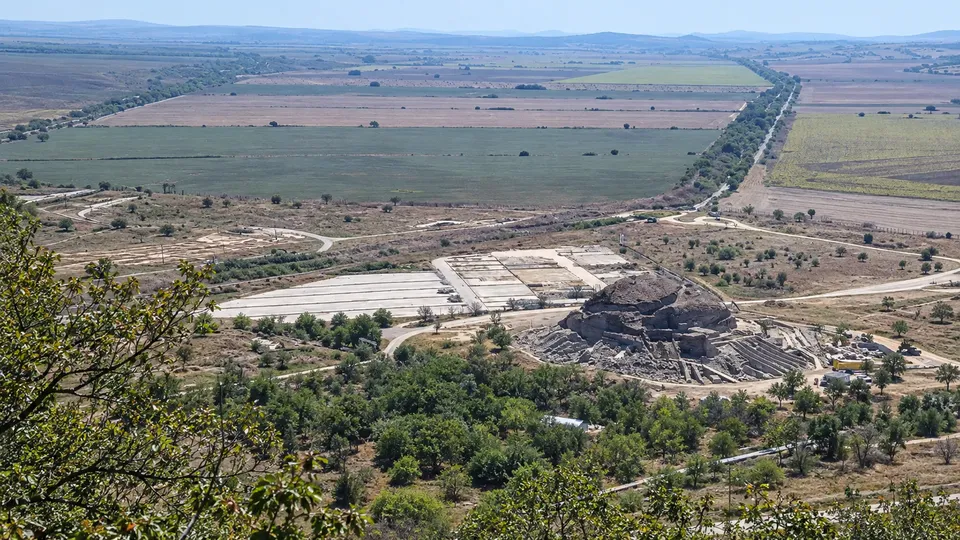
Salt made them rich; beer may have made them happy. Archaeologists digging at Provadia-Solnitsata, a prehistoric settlement in north-eastern Bulgaria, report what could be some of the earliest evidence of brewing in Europe: a cache of emmer wheat, carbonised by fire roughly 6,500 years ago, that had been deliberately soaked in water and allowed to germinate. Malting, the first step of brewing, is a fiddly business; someone, around 4500 BC, appears to have mastered it.
The grain was found in a burned two-storey house. On the floor of the lower level, excavators came upon two small ceramic bowls lying upside down; beneath them lay charred ears of grain, unusually well preserved thanks to the very fire that destroyed the building. What looked at first like an ordinary food store turned out, on inspection, to be something more interesting.
The excavation team sent samples to Elena Marinova-Wolff, an archaeobotanist in Germany, who identified the crop as emmer, one of the principal wheats grown in the region at that time. More telling was what had happened to it: the grains had begun to germinate. Dry grain, with a moisture content of roughly 11-12 percent, keeps its embryo dormant. After days of soaking, moisture rises sharply and germination begins, prompting enzymes to convert stored starches into simpler sugars. That process is malting, and those sugars are exactly what fermentation needs.
The team therefore argues that the wetting was no accident. Someone selected the grain, steeped it for days, let it germinate and was then interrupted, apparently by the blaze that consumed the house. According to the excavators, the find is the first specific early evidence of beer production on the territory of modern Bulgaria. Vasil Nikolov, the dig’s director, presented the season’s discoveries in September and went further, describing it as probably the earliest such evidence in Bulgaria and suggesting it might rank among the earliest known in Europe.
A settlement built on white gold
Solnitsata was no backwater. Occupied between roughly 5600 and 4350 BC, it grew up around one of prehistoric Europe’s most precious commodities. Its inhabitants extracted salt from local brine and turned it into something that could be stored, traded and hoarded. Excavations have revealed substantial houses (some reaching two or three storeys, with storage below and living quarters above), defensive structures and signs of a specialised, organised economy. The malt-bearing house belonged to this developed settlement and dates to an earlier phase of the Late Chalcolithic.
Fermented grain drinks were already familiar in the prehistoric Near East, so the notion that brewing knowledge travelled north-west into Europe before 4500 BC is hardly outlandish. What gives the Bulgarian find its weight is the combination of date and place: controlled malting, in a domestic setting, at Europe’s oldest known centre of salt production. The people of Solnitsata were evidently as adept with grain as they were with brine.
Ritual tipple or daily bread-in-glass?
Why they brewed is the murkier question. The excavation team has floated the idea that beer may have been drunk in part for its intoxicating effects and could have played a role in ritual practices. That is speculation, and the dig’s researchers are candid enough that it rests on thinner ground than the malt itself. A sprouted grain can show that beer was being made; it cannot say whether the drink ended up on a feast table, at a ceremony or at both. Archaeology seldom preserves the party.
The firmer lesson is about technique. Malting demands foresight, patience and a grasp of a biological process invisible to the naked eye. The batch at Solnitsata never became beer, but its makers had clearly learned the craft from somewhere, and were practising it inside their homes rather than in any workshop archaeologists have yet found. At a settlement already famed for turning salt into wealth, a handful of blackened grains now suggests a second, homelier industry. The world’s oldest known breweries keep retreating into the past; Europe’s turn may have come.