

One thing almost nobody talked about during the US midterm campaign was Europe. Neither party spent much time on Donald Trump’s handling of the war in Ukraine, his designs on Greenland or his combative stance toward the European Union, as Virginia Pietromarchi noted in Al Jazeera. Then the Democrats took both chambers of Congress, and Europe paid attention regardless.
The scale was large. As of November 9, Associated Press tallies cited by IE University had Democrats on 54 Senate seats to the Republicans’ 44, and 254 House seats to 162, with 19 House races still uncalled. The first reaction in Europe, Courthouse News reported, was relief, along with very low expectations of any quick repair to the transatlantic relationship.
Erik Jones, who directs the Robert Schuman Centre for Advanced Studies at the European University Institute, put the mood precisely. Europeans now look at the US “much less in horror” than they have for the past two years, he said. Then he added the catch: “this midterm election does not change that trend.”

The trend is worth spelling out, because it is really a story about a contract. The postwar deal ran roughly like this: America wanted a secure Europe, and Europe depended on America to provide that security. Both sides liked it. The US got stable allies and a say in European affairs, and Europe got protection without having to pay the full price. Contracts like that last as long as both parties think they are getting a good deal, and on the American side that belief has been fading for a while. Analysts trace the erosion to Barack Obama’s pivot to Asia. By now Democrats and Republicans both want Europe to take more responsibility for defending itself. Trump did not come up with that position. He sped it up by attacking NATO, threatening to take Greenland and siding with Russia over Ukraine. A Democratic Congress can make the renegotiation more polite. It cannot make one side want the old terms back.
The two-thirds problem
There is also simple arithmetic. Fredrik Erixon, an economist who directs the European Centre for International Political Economy, pointed out that the Democrats lack a veto-proof majority. Overriding a veto takes two-thirds of each chamber, meaning 67 senators and 290 representatives. Using the November 9 counts, Democrats are 13 short in the Senate and 36 short in the House. So on Ukraine, Iran and tariffs, Erixon said, “there is still a lot of space for the president to behave in the same fashion.”

Take Iran. The war there has driven energy prices up, and Trump has two broad choices. He can make a deal, which might leave Iran with leverage over the Strait of Hormuz, or he can resume a fight that voters dislike. Europe pays under either option, in the form of a cost-of-living crisis that is already fuelling protests. Some Democrats want to use the next funding bill to cut off money for the war. I think this is the interesting route. A president can veto legislation telling him to stop a war. Vetoing the bill that keeps the government funded is a more expensive move. The power of the purse is the one lever that does not need 67 senators to work.
Ukraine is murkier. The new Congress may support Kyiv more strongly, but probably not decisively. Ukrainian officials are worried about the two months before it sits in January, when Trump will still be dealing with a friendly Congress and may try to strike something with Vladimir Putin. Some experts think a weakened president looking for wins abroad becomes harder to predict. Ahead of US-Russia-Ukraine talks in Abu Dhabi, Trump promised a “big, beautiful agreement” that “might involve all of Europe.” Those talks have not produced a breakthrough so far.
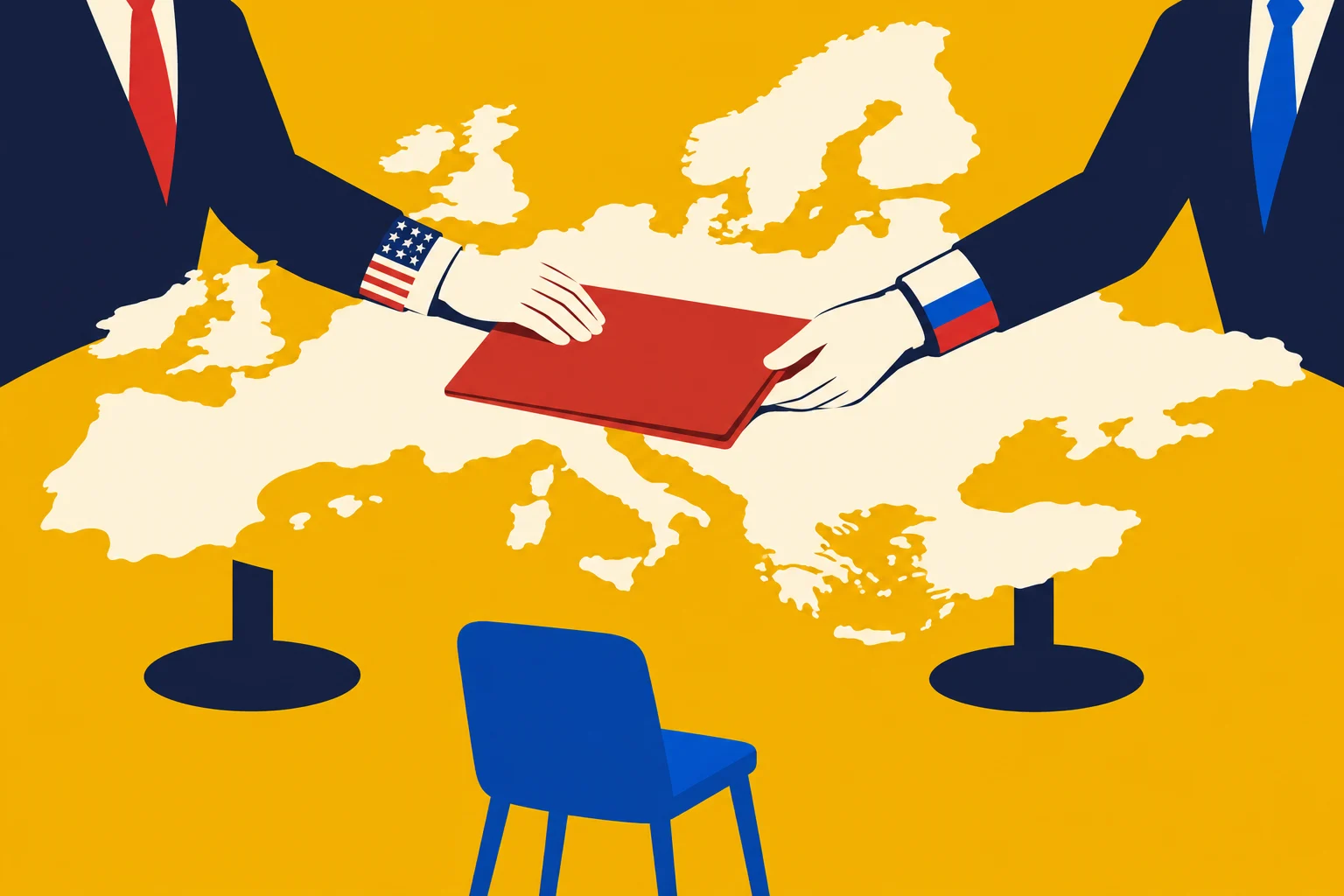
“Might involve all of Europe” is a funny phrase when Europe would very much like to be involved. Michele Valensise, president of the Institute for International Affairs and a former secretary-general of Italy’s Foreign Ministry, said that “Trump’s moves are difficult to predict” and that Europeans need a seat in any peace contacts. Talks between only the US and Russia, he warned, would “unfairly weaken the position of the European allies.” Put another way, if you are one of the parties a deal is about, you do not want to find out its terms afterwards.
Then there is the Pentagon’s review of US forces stationed in Europe, which is expected to be finished next month. Congress does not write that report.
A deal nobody will reopen
Trade offers even less comfort. Democrats have become more protectionist themselves, so a change of majority does not mean a change of mind. Even if US courts strike down some of Trump’s tariffs, Erixon said the US-EU trade deal would have to be renegotiated, and “the US administration will not initiate such a process in the next two years.” So Europe is left with an agreement that both sides think needs rewriting, where the only party able to start the rewrite has said it won’t. Asia has similarly modest hopes for relief on tariffs.
That leads to Jones’s advice, which comes from an ally and is still fairly bleak. Using the next two years to mend ties with Washington “would be time wasted,” he said. Europe should instead “prepare for when the US will care even less.”
For a continent that has spent two years in horror, being told to expect indifference next is apparently the good news.