

Eighteen years ago the EU and Syria finished negotiating a free-trade-and-political-dialogue treaty that neither side ever signed. On November 16, the EU’s 27 foreign ministers agreed to sign that unratified 2008 text as it stands, while in the same session opening talks on a new one to replace it. That is the actual mechanism behind Monday’s headline about “reviving” EU-Syria ties: not a single new agreement, but a two-track move that puts a two-decade-old document into force with no new conditions attached, and defers any human-rights bar to a second, still-unwritten text.
“Syria needs investment and a successful transition,” the EU’s foreign policy chief, Kaja Kallas, said after the Foreign Affairs Council meeting in Brussels, as Al Jazeera reported. “The aim is to give Europe and Syria a framework for trade, political dialogue and closer cooperation as soon as possible.” The 2008 association agreement was negotiated under Bashar al-Assad but stalled over his government’s human-rights record and was never fully signed by either side. Fourteen years of civil war and Assad’s fall on December 8, 2024 later, Brussels is reaching for the same unsigned text as a shortcut.
Two steps, not one
The sequence, confirmed by Anadolu Agency and detailed by EU news outlet eunews.it, runs in two steps. First, the EU signs the 2008 text as drafted, giving both sides an immediate legal framework. Second, the Council issues a fresh negotiating mandate for a “modernised” version, which is where the new conditions sit: Kallas said ministers want “clear conditionality regarding human rights,” plus a requirement that Damascus drop the Assad government’s recognition of Russia’s claims over occupied Ukrainian and Georgian territory. “Everybody said that we need to engage with Syria,” Kallas said, “because if we don’t engage, then this vacuum will be filled by other players.” Diplomats are now working through what she called the “technical and legal aspects to prepare the agreement for signature.”
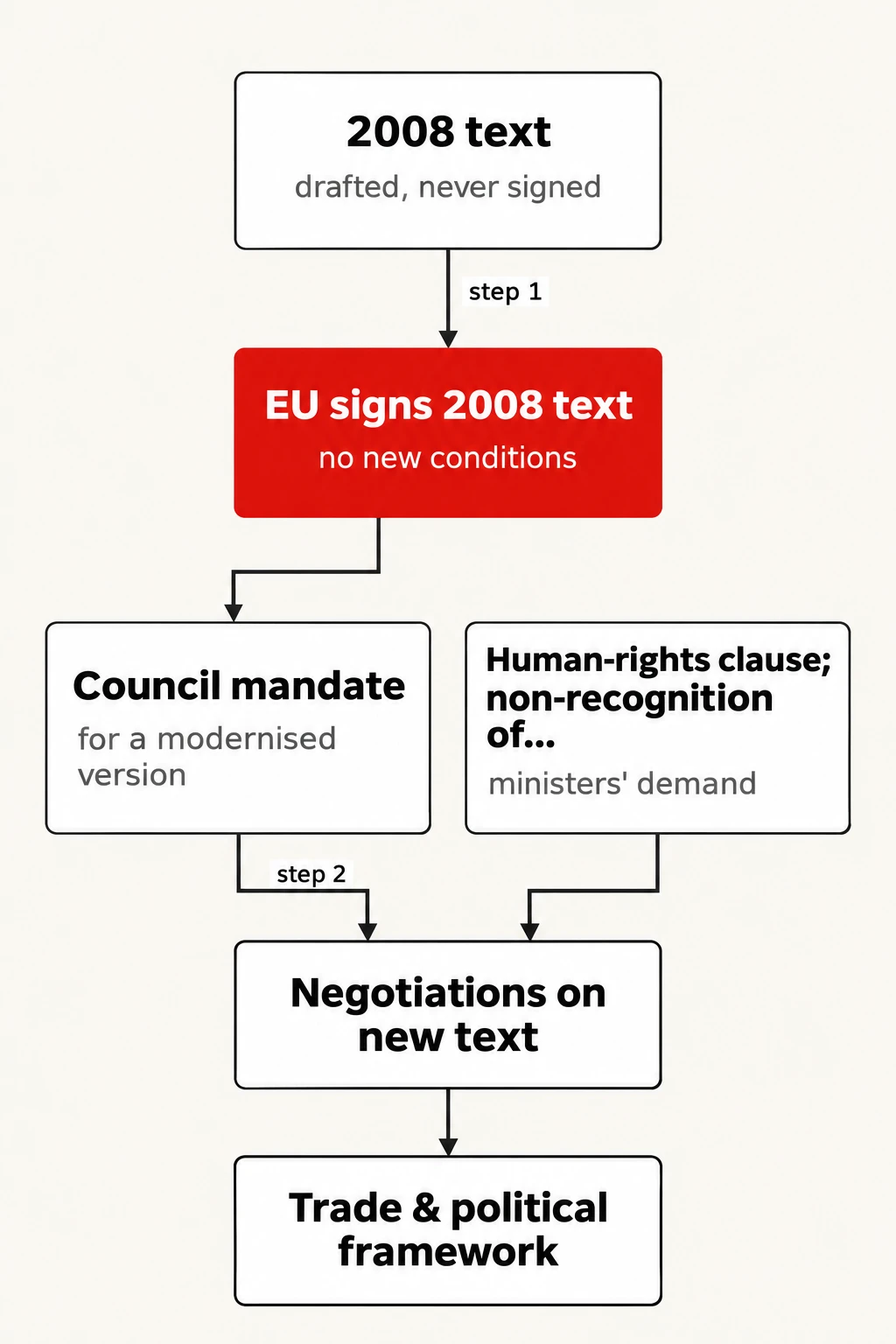
| From | To | How |
|---|---|---|
| 2008 text (drafted, never signed) | EU signs 2008 text (no new conditions) | step 1 |
| EU signs 2008 text (no new conditions) | Council mandate (for a modernised version) | |
| Council mandate (for a modernised version) | Negotiations on new text | step 2 |
| Human-rights clause; non-recognition of… (ministers' demand) | Negotiations on new text | |
| Negotiations on new text | Trade & political framework |
Based on EEAS / Anadolu Agency account of the 16 Nov. 2026 Foreign Affairs Council
Worth noting what step one does not carry: the original 2008 text was blocked specifically over Assad-era human rights abuses, yet the plan is to sign it unchanged, with no comparable test applied to the current transitional government of President Ahmed al-Sharaa. The rights conditionality and the Ukraine/Georgia clause apply only to the second, modernised agreement, which has no mandate yet and no deadline.
What already happened without any treaty
The EU did not wait for a treaty to change Syria’s economic position. In February 2025 the Council suspended sectoral sanctions on energy and transport and unfroze five banks, including the Syrian Central Bank, according to the Council’s own press release. On May 20, 2025, the EU agreed to lift all remaining economic sanctions, as Euronews reported, formally adopted a week later and removing 24 entities from its asset-freeze list, including the Central Bank and Commercial Bank of Syria and firms in oil, cotton and telecoms. Arms embargoes and controls on goods usable for internal repression stayed in place, and the Council described the relief itself as “reversible and conditional.” The EU ran a separate, narrower sanctions track in parallel: after violence in Syria’s coastal region in March 2025 it designated two individuals and three entities under its Global Human Rights Sanctions regime, adding five more people in June. Rights conditionality, in other words, already exists for named individuals — it is the blanket economic relief, and now the 2008 treaty, that moved ahead of it.
The money, by basis of comparison
The figure in circulation is €620 million ($680m), announced by Commission President Ursula von der Leyen during a January 9, 2026 Damascus visit as a two-year envelope for 2026-27 covering humanitarian aid, early recovery and bilateral support. That number sits inside several larger and smaller ones that measure different things. Since 2011 the EU and its member states have mobilised “around €41 billion” in combined humanitarian, development and stabilisation assistance for Syrians inside the country and across the region, according to the European External Action Service’s own account. Of that, €963.8 million specifically went to non-humanitarian recovery, dialogue and accountability work. A separate pledging conference in Brussels on March 17, 2025 raised €5.8 billion overall for Syria and its neighbours, of which €3.37 billion came from the EU and its member states for 2025-26.
| Figure | Amount | Period / scope |
|---|---|---|
| Cumulative EU + member-state aid since 2011 | €41bn | Syria and the region; all assistance types |
| EU non-humanitarian aid since 2011 | €963.8m | Recovery, dialogue, accountability |
| Brussels IX conference, EU/member-state share | €3.37bn | 2025-2026; Syria and neighbouring countries |
| New Syria package (announced Jan. 2026) | €620m | 2026-2027; humanitarian, recovery, bilateral support |
| EU bilateral development component | ~€140m/year | 2026-2027; about flat versus €139m in 2025 |
Source: European External Action Service; analysis of EU budget lines by Syria Dispatch
Broken down against the Commission’s own budget lines, the headline €620 million’s bilateral development component works out to roughly €140 million a year across 2026-27 — essentially flat against the €139 million committed in 2025, according to an analysis of those budget lines by Syria Dispatch. The same outlet notes that the Commission’s 2026-27 programming document itself describes Syrian institutional “absorption capacity” as a “binding constraint” — diplomatic language for the fact that Damascus has struggled to spend money as fast as Brussels can allocate it, a problem a joint Commission-EIB mission flagged in Syria as far back as 1982.
Refugees: whose million?
Syria’s civil war displaced roughly 6.8 million people abroad, about one-third of the pre-war population, over nearly 14 years. By September 24, 2025, the UN said one million of those refugees had returned since Assad’s fall, alongside 1.8 million internally displaced people who had gone back to their areas of origin, as Al Jazeera reported at the time. By December 2025, UNHCR’s representative in Syria, Gonzalo Vargas Llosa, put the cumulative total higher still — 1.3 million refugees and nearly two million internally displaced people returned since December 2024, more than three million people in total — and projected that 2026 could add roughly one million more returning refugees, which would put the two-year total above four million, according to reporting on his UNHCR briefing. He said a quarter of returnees lack basic documents, including identity papers and property records, and that most returns have come from Turkey, Lebanon and Jordan.
Monday’s Al Jazeera report on the EU’s treaty move still cites “more than one million” returned refugees — the same order of magnitude as the UN’s September 2025 milestone, not the 1.3 million UNHCR itself was already citing by December 2025. The number repeated alongside the diplomatic announcement is roughly a year stale, which matters for a treaty whose stated purpose is partly to make returns easier: if a quarter of people who have already gone back lack the papers to reclaim property or register residency, €140 million a year in “institution-building” money is a small base against that backlog, long before any modernised agreement adds its human-rights test.
The next marker is the Council’s actual negotiating mandate for the modernised text — not yet drafted, with no deadline — which is where the human-rights conditionality Kallas described will either show up in treaty language or stay a talking point attached to a document Damascus hasn’t seen.