
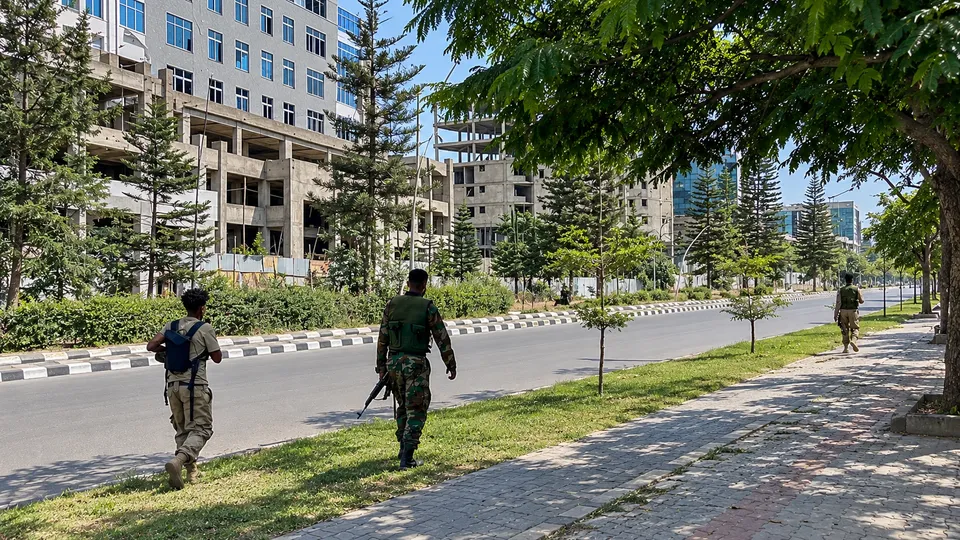
The war in northern Ethiopia has a new map. The Ethiopian National Defence Forces, fighting alongside pro-government militias, have retaken Alula Aba Nega Airport in Mekelle, the capital of the Tigray region, and federal troops and allied fighters have since been seen in control of the city itself. That is according to a source with knowledge of events in Mekelle and a humanitarian source, both unnamed, who spoke to Reuters on Saturday.
On the other side of the lines, the Tigray People’s Liberation Front — the TPLF, which leads an armed opposition alliance — confirmed the broad shape of events in its own way. In a statement posted on social media late Saturday, the group said it had temporarily moved out of Mekelle to operate from somewhere else.
Temporarily moved out of Mekelle
That is one way to describe losing your capital. It is also, to be fair, a recognisable piece of insurgent vocabulary: guerrilla movements that cannot hold a city against a national army tend to prefer not to, and to describe the resulting departure as a tactical choice rather than a defeat. Whether the TPLF’s withdrawal turns out to be temporary, in the relevant sense, is exactly the question the coming weeks will answer.
For now, the sequence is straightforward. Fighting erupted last week between the federal government of Prime Minister Abiy Ahmed and the TPLF and its allies. After more than a week of intense combat, government forces advanced into Tigray; on Saturday they took the airport, and rebels were seen leaving Mekelle. The confrontation is not confined to Tigray, either: fighting also rages in the neighbouring Amhara and Afar regions, according to reports by AFP and Reuters.
Some context, which by now carries a grim familiarity. Tigrayan forces seized airports in the region in late September, and a rebel alliance declared war, as rews reported at the time. The government has now reversed the most symbolically important of those gains. The airport was the first piece of Mekelle to go, as pro-government forces claimed on Saturday, and the city followed within about a day.
The Pretoria Agreement, 2022 to 2026
What has shattered in the past week is the Pretoria Agreement, the peace deal signed in November 2022 that ended the previous Tigray war. That earlier conflict, which began in late 2020, was among the deadliest of this century; NPR reported at the signing that the victims of the two-year war could be counted in the hundreds of thousands. The accord, mediated by the African Union and signed in South Africa on 2 November 2022, committed both sides to a permanent cessation of hostilities and to an orderly, smooth and coordinated disarmament of Tigrayan forces, followed by an implementation deal in Nairobi spelling out how that disarmament would work.
Permanent and orderly have both now had a difficult autumn. The basic design problem of the Pretoria deal was always that it deferred the hardest questions — who governs Tigray, what happens to its armed forces, what becomes of disputed territories — to a process of implementation that required both sides to keep cooperating. For nearly three years they did, more or less. Then the cooperation stopped, and the fighting that has now carried federal troops into Mekelle began.
A few cautions are worth stating plainly. The reporting so far rests on unnamed sources on the ground, and on the TPLF’s own statement; conditions in Mekelle make independent verification slow. Claims of control in this war have been fluid — towns have changed hands repeatedly — and a city that has been taken is not always a city that stays taken. The TPLF governed Tigray for decades and fought the previous war to a negotiated draw after the federal government lost, and then retook, Mekelle once before, in 2021.
What is clear is narrower but still significant: the 2022 peace is over, the federal government holds the Tigrayan capital’s airport and, by multiple accounts, the city, and the movement that ruled the region says it will now operate from somewhere else. The last time both sides reached this point, hundreds of thousands of people died before anyone signed anything.