
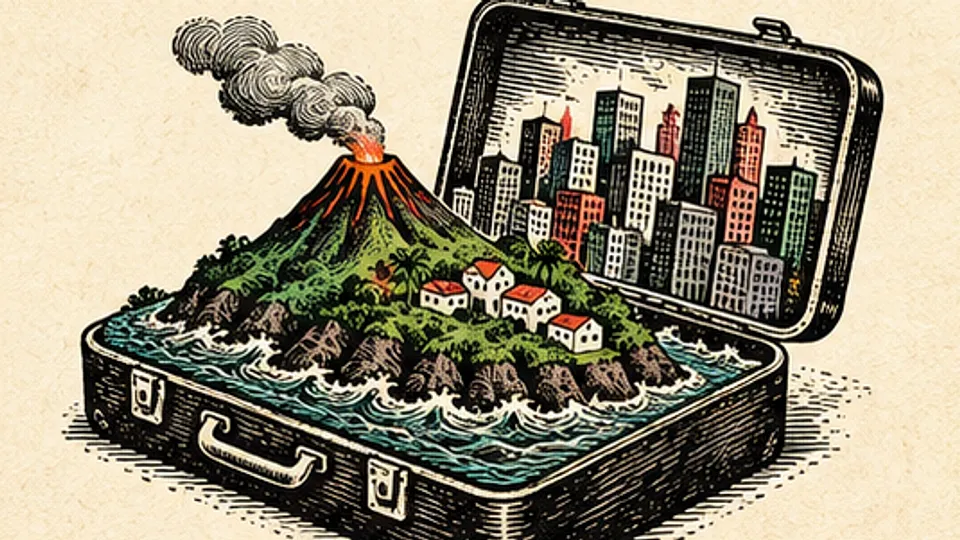
A volcano that had slept for 150 years erupted on Tristan da Cunha on Oct. 10, 1961, emptying the world’s most remote inhabited island and delivering its 264 residents into modern British life, a displacement the BBC revisited on Monday.
The island, a British outpost of 40 square miles in the South Atlantic, sits roughly halfway between Cape Town and Rio de Janeiro, more than 1,500 miles from any other populated land and reachable only by a seven-day boat trip. Its people farmed and fished, did not use money and shared just seven family names among them.
“We heard the rumbles first, then the ground just automatically cracked… Then the smoke and the fire started coming out the ground,” one islander told the BBC in a 1998 film. Mary Swain recalled running to her husband with a shout: “Jump up quick, Fred, the Earth is opening!”
Cracks opened a few hundred meters from Edinburgh of the Seven Seas, the only village. The islanders escaped by fishing boat to nearby Nightingale Island and were picked up the next day by a passing Dutch liner, carrying almost nothing. “A rifle, an overcoat and a lamp,” Ms. Swain recalled. In England they were housed on a disused military airbase near Southampton.
“Just over a year ago, they’d never seen traffic or a road or a house higher than a cottage,” the broadcaster Tim Brinton said in a 1963 BBC program. “They’d never seen shops because on the island, money wasn’t used… For them, there’s been no industrial revolution.”
Tristan had been annexed by Britain in 1816, partly to keep it from aiding any rescue of Napoleon from St. Helena, and was first settled the next year by a Scottish corporal, William Glass, who stayed when the garrison withdrew. Failed potato crops and wrecked fishing boats repeatedly brought the community near starvation.
England offered trials of its own. Islanders had never seen a car, a bicycle, a television set or an income tax form. “Here is too much gas and smoke,” Joey Repetto told the BBC in 1963, saying of the trip to their lodgings, “I steady coughed without stopping.” His father, Gerald Repetto, chafed at clock-driven work: getting up at the same time, going to the same place, doing the same job every day. The island’s single policeman had presided over almost no crime; in England, one islander was attacked by two youths who smashed his prized gold watch.
Ms. Swain did not soften her verdict. “We don’t like the weather... There’s too much sickness and we don’t like the place at all,” she said. Money, she explained, was the deeper shift: “If we haven’t got no money, well, we just go without it... I can still go out and get my own potatoes. I can still go and get my own fish.”
The younger islanders were less homesick. They took to Italian suits, record players and social dances. “Country and western music is our favourite, by Johnny Cash and Ernest Tubb,” one teenager said in 1963. “We’ve forgotten how to do the waltz. But I like to twist myself.”
A government survey party found in 1962 that the volcano was dormant and the village largely intact; the lava had turned at the last moment and run into the sea, which the islanders took as an act of God. Some thatched roofs had burned, passing sailors had ransacked houses and dogs had slaughtered the sheep, but the cattle were fat on island grass and the chickens had multiplied.
The authorities held a secret ballot at the airmen’s camp. Every Tristanian over 21 voted, and the count to go home was 148 to five. Most of the community returned in November 1963. Asked what she looked forward to most, Ms. Swain said: “A free life. We can get our own fish and everything of our own back there without money.”
Elaine Repetto, who was born on the island and left in 1984, told the BBC in 1998 that the bond persisted. “We are strongly independent and used to battling with the elements in order to survive… We have to rely upon each other in a way you would find in few other places,” she said. “Today, the volcano is still a smoking reminder of the events which shaped our view of ourselves and our contact with the outside world.”