
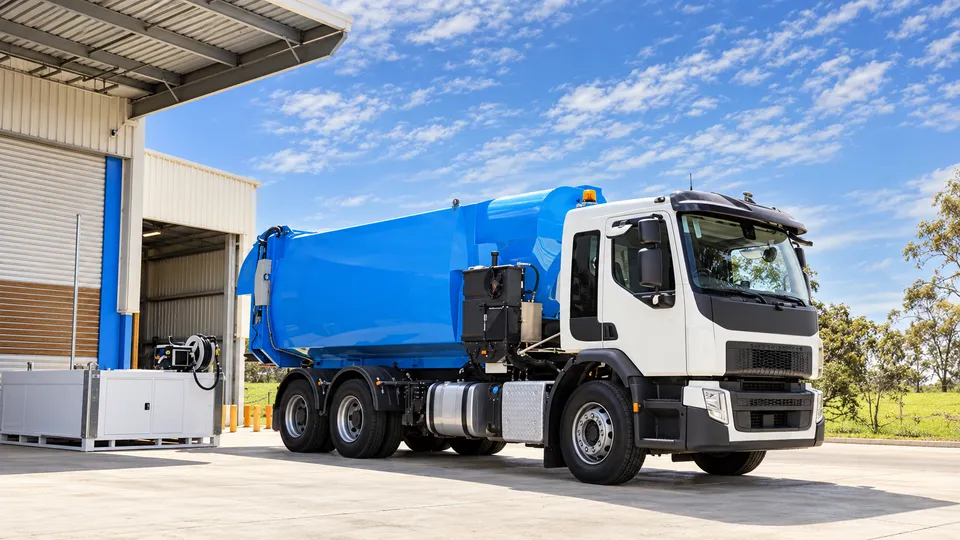
Garbage is a nice business. People keep making it, councils and companies keep paying someone to take it away, and the trucks, landfills and recycling plants that do the taking are expensive enough that not many people bother competing with you. This is the kind of thing infrastructure investors love: steady cash flows that don’t depend much on the economy. And when cash flows are steady, you can borrow a lot against them.
So: the Swedish private equity firm EQT has agreed to buy Cleanaway Waste Management, Australia’s big listed waste company, and it is borrowing a lot. According to the Australian Financial Review’s Street Talk column, EQT Infrastructure partners Ken Wong and Tobias Küng and managing director Sam Franklin have put together a A$5.6 billion debt package for the take-private, which the paper values at A$9.4 billion. Twenty lenders are in, which seems to be roughly every major lending bank in the country. Street Talk calls it the biggest acquisition financing on Australian soil in several years, bigger than Macquarie Asset Management’s A$4.95 billion loan for its A$11.7 billion purchase of Qube, and it’s happening while borrowing costs are inching up.
The deal
Here are the terms. On Monday Cleanaway signed a binding scheme implementation deed with Sedum Group Pty Ltd, a vehicle owned by EQT-managed funds. Under the deed, shareholders get A$3.095 a share in cash, less any dividends paid before completion, and the board unanimously recommends the deal unless a better offer turns up. That price is EQT’s earlier indicative offer of A$3.13 minus the 3.5-cent final dividend Cleanaway paid on Oct. 8. Do the subtraction and you get exactly A$3.095, so EQT has kept its headline number intact. Coverage has put the enterprise value at around A$9.3 billion, against Street Talk’s A$9.4 billion. Either way it’s a lot of money for garbage.
It got there in steps. EQT first approached the company, unsolicited, at A$3.00 a share. It then went up to A$3.13, which was 32.1% above Cleanaway’s A$2.37 close on Aug. 12, and was given up to nine weeks of exclusive due diligence. Diligence apparently went well.
There is also a wrinkle, and it is very Australian. Before the deal closes, the board may pay a fully franked special dividend of up to 19 cents a share, and depending on how many franking credits it has available it is looking at somewhere between 14.5 and 19 cents. That comes out of the A$3.095, not on top of it. So the cash total doesn’t change, but some of it arrives as a dividend with tax credits attached. Australian companies that have paid tax build up franking credits, and those credits are worth something to some local shareholders and nothing at all to a Swedish buyout fund. When a company is about to be bought, it makes sense to hand the credits out to the people who can use them, before the new owner gets them and can’t.

The debt
Now the arithmetic. A$5.6 billion of debt against a A$9.4 billion deal is about 60% debt. For Qube, A$4.95 billion against A$11.7 billion is about 42%. Qube was the bigger deal, but Cleanaway is getting more debt in absolute terms and a lot more as a share of the price. Mallesons, which advised the lenders on the Qube financing, says that money went to an acquisition vehicle owned by Macquarie and its co-investors, which included UniSuper and Pontegadea, Amancio Ortega’s family office. The Qube deal closed in August. So the record held for roughly two months.
One way to read this is that banks look at Cleanaway’s cash flows and see something close to a utility, and lend accordingly. Another is that there is a set number of big Australian acquisition loans in a given year, banks want their place in the league tables and their fees, and “every major lender” partly reflects how few chances there are to lend this much. These readings aren’t really in conflict.
I think the interesting thing about twenty lenders is what it does to risk for everyone. Imagine you are one of those banks. If the money were split evenly, you would be holding about A$280 million, which is a size you can manage, and every other bank in town is holding the same thing. That’s comforting until it isn’t. If Cleanaway’s cash flows fall short, all the major local banks find out at once. If borrowing costs keep rising, the floating-rate part of that A$5.6 billion gets more expensive, and garbage contracts don’t always reprice as fast as interest rates do. EQT’s equity is the first loss, which is the point of having equity. The banks are betting that the trash keeps coming. That’s a reasonable bet.
What’s left
The deal still needs approval from the Australian Competition and Consumer Commission, the Foreign Investment Review Board, and the competition authorities in Kuwait and Saudi Arabia. Cleanaway’s shareholders aren’t buying trucks in Riyadh, but EQT’s funds evidently own enough in the Gulf for regulators there to want a look. An independent expert also has to find that the scheme is in shareholders’ best interests. The shareholder vote is expected at the end of February 2027, with completion by the end of March.
The market believes it will happen. Cleanaway shares rose 19.8% to A$2.96 by late Monday morning, according to Capital Brief, which is 13.5 cents, or about 4.6%, under the deal price. That is what investors want to be paid for five months of waiting, five sets of regulators and an independent expert. Waste-management stocks are not known for excitement, and the spread suggests this one won’t be either.