
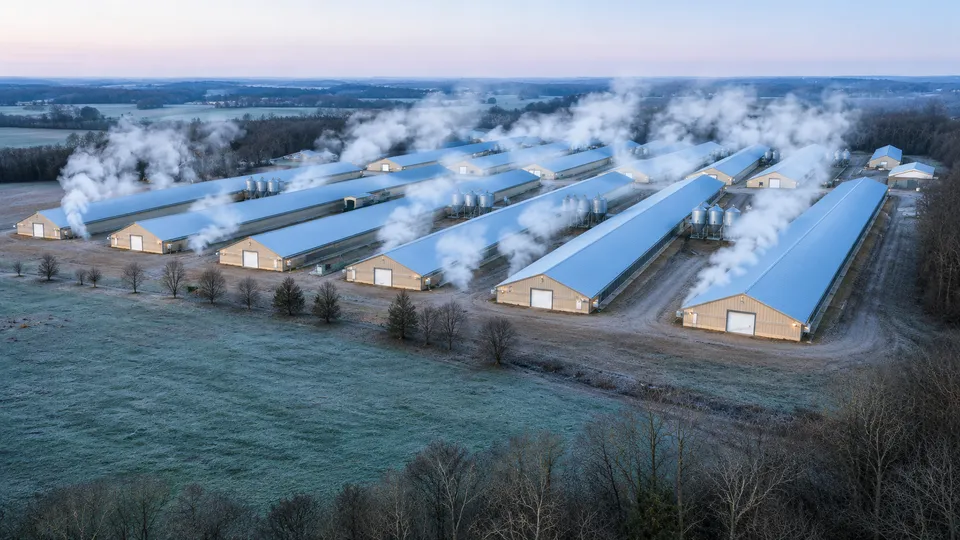
Some promises are made to be kept. Others are made so that time can do the work of breaking them. In 2005 the US Environmental Protection Agency made one of the second kind. It told the country’s confined livestock and poultry operations, the long barns of hogs, dairy cows and chickens, that the government did not yet know how much pollution they released into the air, that it would find out, and that until it did, they could carry on.
Twenty-one years later, on October 30, 2026, the agency announced that it would not find out after all.
The agreement
The arrangement had a long bureaucratic name, the 2005 Animal Feeding Operations Consent Agreement and Final Order, and in the agency’s corridors it became simply the Air Compliance Agreement. It grew out of a National Academy of Sciences report that called for better ways to estimate what these operations put into the air. Farms that signed up agreed to take part in an industry-funded study, the National Air Emissions Monitoring Study, which gathered data on ammonia, hydrogen sulfide, particulate matter and volatile organic compounds between 2005 and 2007. About 2,600 operations, covering nearly 14,000 farms, joined. In exchange they received what amounted to an amnesty: protection from Clean Air Act enforcement while the government worked out its numbers.
The deal hinged on a single sentence of future tense. Once the EPA published final methods for estimating emissions from a given animal sector, every operation in that sector would have to apply them and determine what the Clean Air Act required of it.
The study ended. Its data aged. The agency’s Science Advisory Board reviewed early drafts in 2013. Updated drafts appeared in November 2024, and public comment closed in August 2025. The methods were never made final.
The announcement
Now they never will be. In its press release, the EPA said it would not finalize the methodologies, and that its enforcement office would work to end the 2005 agreement, notifying the participating operations as far as it can and then terminating it. The reason given was the study itself, the one the agency had waited on for two decades.
“Good science requires good data, and these data are too old and too limited to support methods that farms could rely on.”
That was Abigale Tardif, acting head of the Office of Air and Radiation. Jeffrey Hall, who runs the enforcement office, said the agency had “advanced the rule of law” by resolving “long-obsolete obligations” and would “honor its commitment not to achieve regulation by enforcement.” The Deputy Agriculture Secretary, Stephen Alexander Vaden, spoke of farms freed from the risk of “potentially massive fines and legal costs” and said: “Today, under the leadership of President Trump and EPA Administrator Zeldin, that uncertainty comes to an end.” The release also says the decision does not change how the agency carries out the Clean Air Act.
Here is the circle, and it deserves a slow look. Data are collected. The agency spends years not finishing the work. The data grow old. The age of the data becomes the reason the work cannot be finished. Delay ends up serving as the argument for itself.
The applause
The industry, which had pressed for this result for years, welcomed it. Rob Brenneman, president of the National Pork Producers Council, said in a statement: “This move confirms what farmers have long known: Every farm is different, and there is no one-size-fits-all model to apply to them.”
The National Milk Producers Federation said the decision ended more than 20 years of uncertainty for the dairies that had volunteered. In comments filed last year it had told the agency that the draft dairy models rested on monitoring at only five dairies, and that they gave per-cow estimates that swung widely with herd size and predicted negative emissions in sub-freezing weather. Other livestock groups applauded as well.
The law that remains
Critics read the same announcement as surrender. As Georgina Gustin reported for Inside Climate News, in a story republished by Ars Technica, they say the agency is walking away from enforcing the Clean Air Act at large farms. One of them, Heinzen, made a narrower and sharper point. The administration, she said, has made plain it has no intention of regulating air emissions from these operations. But the statute has not moved. Facilities above the emissions thresholds still need permits, and once the agreement ends, so does the amnesty its signatories enjoyed.
“There’s no EPA-issued methodology to estimate emissions,” she said. “That doesn’t mean that there aren’t good studies out there of emissions from different types of animal feeding operations that can be used.” She pointed to California, which uses its own livestock emissions models to enforce its own air rules. “We just don’t have one set of national emissions factors from EPA,” Heinzen said. “That does not absolve these factory farms from their obligation to comply with federal law.”
Yet who will hold them to it? On that she was blunt. “No one’s going to estimate anything,” she said. “As EPA said in its press release, we’re certainly not about to try to enforce the law.” The words were her gloss, not the agency’s, but they sit uncomfortably close to Hall’s pledge to avoid “regulation by enforcement.”
So the obligation stays on the books, and the people who might enforce it have announced they will not. A law in that condition still exists. Whether anyone can feel it is another matter.
What was never counted
One gas sat outside all of this. The Air Compliance Agreement never covered methane, although the US livestock industry is the country’s single largest source of it. Year after year, Congress writes language into its annual spending bills that effectively bars livestock facilities from reporting their methane emissions.
The EPA says it will keep working with the Department of Agriculture, land-grant universities and producers on practical, science-based ways to understand and reduce farm air emissions. Twenty-one years ago, the promise was much the same.