

Large companies now spend 28% of their software budget, on average, on upgrades, migrations and licensing changes they did not choose and often expected, at the time, to make things worse. That is the headline number from a survey of 2,018 CIOs and senior IT decision-makers — 1,011 in the US, 1,007 in the UK — fielded May 11–19, 2026 by the pollster Censuswide and commissioned by Origina, as Ars Technica reported. Every respondent held director rank or above at a company with at least $1 billion in revenue or 10,000 employees, and every one of them runs IBM, HCL, VMware/Broadcom or SAP software at scale, according to Origina’s press release. Origina sells the alternative: independent, third-party maintenance for exactly those four vendors’ products, once the original vendor’s own support contract has run out. That conflict of interest doesn’t make the arithmetic wrong, but it means 28% is what 2,018 CIOs felt their organization spent, not an audited budget line.
The report, titled “The Software Tax” and co-authored by Origina’s founder and CEO Tomás O’Leary with Boston University economist Marshall Van Alstyne, defines “unwanted” precisely: 95% of respondents say their organization paid, in the past three years, for a vendor-driven upgrade, migration or licensing change that it believed at the time would reduce performance, reliability or business value. 53% say it happened more than once. The most recent such change cost, on average, $12.87 million per organization — one event, not a running total, and the survey publishes no breakdown by company size, so a handful of very large deployments could be pulling that mean well above the median respondent’s experience.

How a perpetual license becomes a recurring bill
The mechanism is the same across IBM, SAP and VMware/Broadcom licensing: a vendor sets an end-of-support date for a given software version, after which the customer stops getting security patches and, often, the ability to run the product under its original terms at all. Avoiding that means upgrading, migrating architectures, or buying a new license bundle — on the vendor’s timeline, at the vendor’s price. Van Alstyne’s framing is that “once a customer makes relationship-specific investments, the vendor gains leverage”: custom integrations, trained staff, data locked into a vendor’s format each raise the cost of leaving, and that cost gets priced into the next renewal. 78% of respondents agree their primary vendor, not their own organization, sets the timing and terms of change. 76% say they have very little real negotiating leverage. 80% say leaving a major vendor outright would cause significant business disruption.
Broadcom’s handling of VMware, one of the four vendor families the survey screened respondents on, is the clearest documented case of what that leverage looks like outside a poll. Weeks after closing its acquisition of VMware in November 2023, Broadcom stopped selling perpetual licenses outright, cutting a catalog of roughly 8,000 SKUs down to a handful of subscription bundles. AT&T told a New York court in August 2024 that Broadcom had offered it a 1,050% annual increase to keep supporting the 75,000 virtual machines it ran on VMware, and that migrating off VMware entirely would cost it up to $50 million, as The Register reported. Broadcom’s defense was that its staff could no longer support products that no longer existed in its catalog. The two companies settled on undisclosed terms that November. AT&T had the scale and the lawyers to go to court; most of the 2,018 CIOs in Origina’s survey, running smaller deployments, don’t.
The cost shows up past the invoice. 84% of respondents say senior engineers are “always” or “often” diverted from other work to handle vendor-driven upgrades and migrations instead of building anything new. 91% say their organization retired functional hardware within the past three years purely to meet a vendor’s software support deadline, at an average loss of 1.65 years of hardware life that was still useful — equipment scrapped not because it broke, but because a license said so.
The timing matters because AI programs compete for the same engineering hours and the same budget line. 34% of respondents say vendor-driven costs were a major contributor to slowing, pausing or cancelling an AI or data initiative; another 56% call the contribution moderate — on Origina’s numbers, roughly nine in ten CIOs running an AI program report some drag from software-tax spending. That lines up with a shift rews covered in September: enterprises increasingly build software in-house with AI coding tools rather than buy it, partly to cut exactly this kind of vendor dependency.
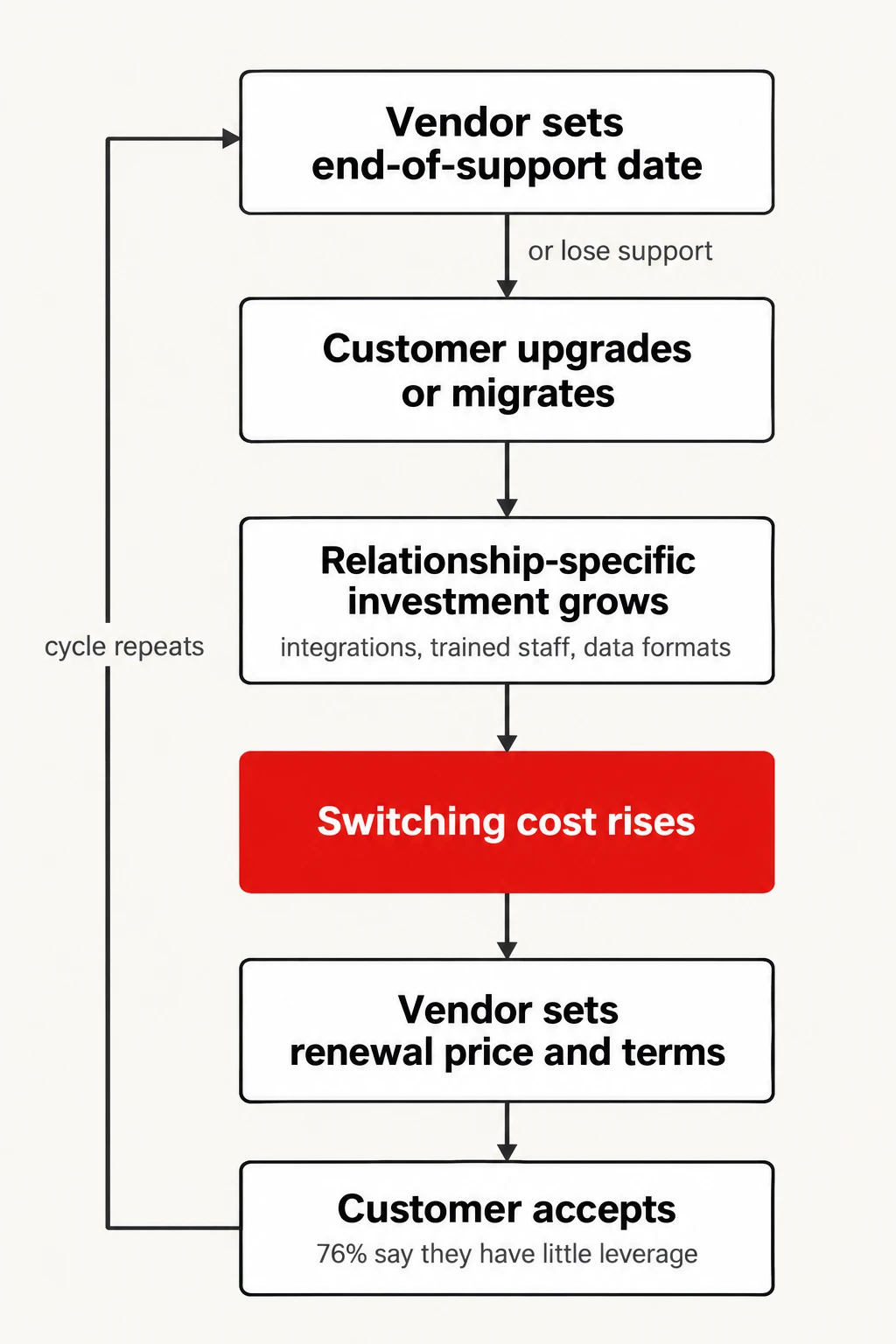
| From | To | How |
|---|---|---|
| Vendor sets end-of-support date | Customer upgrades or migrates | or lose support |
| Customer upgrades or migrates | Relationship-specific investment grows (integrations, trained staff, data formats) | |
| Relationship-specific investment grows (integrations, trained staff, data formats) | Switching cost rises | |
| Switching cost rises | Vendor sets renewal price and terms | |
| Vendor sets renewal price and terms | Customer accepts (76% say they have little leverage) | |
| Customer accepts (76% say they have little leverage) | Vendor sets end-of-support date | cycle repeats |
Negotiate the exit before the entry
O’Leary frames compliance as a rational response to a rigged position, not a failure of individual CIOs:
When the alternative to an unwanted upgrade is losing support on systems the business runs on, saying yes is often a rational response. That’s exactly the problem. The market has left some of the most experienced technology leaders in the world with little room to refuse, and that cost shows up in budgets, in engineering time, and in innovation that never gets funded.
Van Alstyne’s prescription is procedural rather than legal: “negotiate the exit before the entry” — write exit clauses, modular architecture and multi-vendor compatibility into the contract before signing, not after switching costs have compounded. His other line is that “you don’t have to leave a vendor to benefit from being able to” — the option to leave has negotiating value even if it is never used.
Asked what would actually change the dynamic, 91% of respondents say they would support legislation giving enterprise software customers protections comparable to long-term residential tenants — notice periods, defined grounds for termination, limits on unilateral rent-style increases. 82% would support software-support obligations modeled on the EU’s hardware “right to repair” rules, which require manufacturers to keep spare parts and repair documentation available for years after sale. Neither exists for enterprise software in the US, the UK or the EU today; the appetite recorded here is sentiment from respondents who, by their own account in the same survey, have little leverage to get it written into law.
Origina’s incentive to publish a number like 28% is obvious — it is the company selling the alternative. What it can’t manufacture is AT&T’s $50 million migration estimate or a 1,050% renewal quote filed in a New York court. Whether the response to the software tax turns into actual contract terms, actual legislation, or just another cited statistic in next year’s version of the same survey is the number worth watching.