
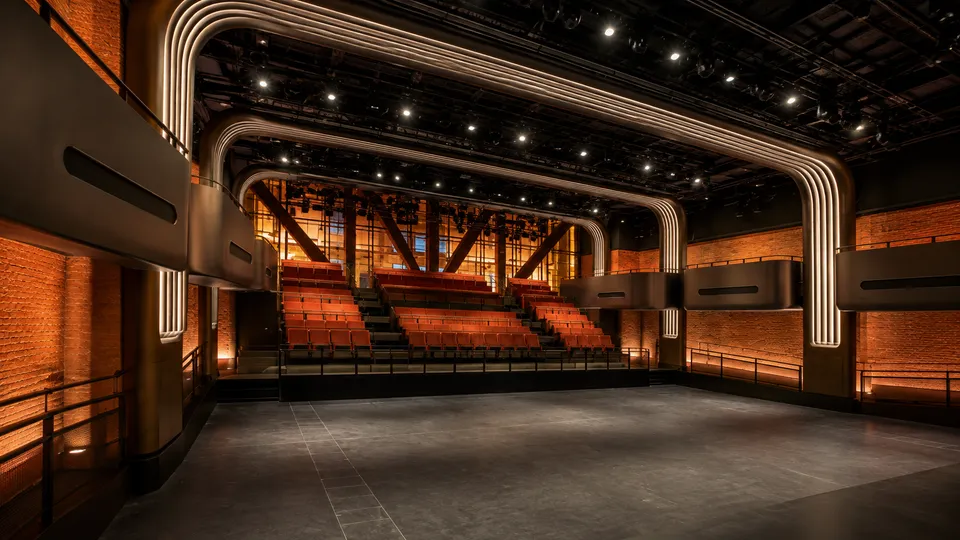
Four chimneys, sixty million pink-pig associations, and the river rolling by. Battersea Power Station — the brick colossus whose silhouette Pink Floyd floated an inflatable pig between for the cover of Animals back in 1977 — has already been colonized by Apple’s UK headquarters and an Apple Store. On September 28, 2026, the colony gets a chapel: Apple Music Hall, a 600-capacity live venue and production facility, opens its doors, and the first man on the stage is Elton John.
The room itself trades the usual arena sterility for something clubbish: brick walls, bronze detailing, art deco-inspired arches, a large glass wall framing views toward the complex and the Thames. The 38-foot-wide stage can face forward like a conventional show or rearrange for performances in the round.
But the architecture is the garnish. The machinery is the meal. Around the audience hangs a 48-speaker spatial sound system serving both conventional stereo and full immersive Spatial Audio. Two dedicated recording and mixing studios sit inside the venue, each able to capture a multitrack recording and deliver a Spatial Audio mix during or after the show. More than 16 cameras — iPhones working alongside professional broadcast equipment, no, really — cover the stage from a dedicated control room. Concert audio, multitrack recording, Spatial mix, broadcast mix, video: all from a single performance.
An artist can perform an intimate live show for fans at Apple Music Hall and walk out with a finished Spatial Audio recording, a broadcast-ready mix, and multicamera video, all from a single show.
So runs Apple’s statement, as reported by Music Week. Apple’s own newsroom announcement says the hall ‘is designed intentionally to close the gap between intimacy and production value and allow for an unprecedented level of creative control.’ Which is one way to put it; another is that the artist plays a small room and walks out owning a finished album, a broadcast and a film.
Six hundred seats in London is, by definition, exclusive — a velvet rope measured in square footage. Apple’s counterweight: performances will be available online globally, for everyone who cannot get onto that rope.
After Elton comes Baby Keem on October 2, and the programme stretches out like a festival poster: Skye Newman, Troye Sivan, Arlo Parks, Burna Boy, Chase & Status, and Charli xcx, listed for December 2. Communion ONE handles bookings; DICE is the ticketing partner, with tickets also going through the Apple Music Hall website.
古Apple frames all this as the heir to its iTunes Festival days — the same old formula, artist programming lashed to digital distribution, except now the distribution has walls. And that is the actual news under the glamour: a streaming service is now a live-venue operator and a production factory at once. If the model works, the purpose-built concert-hall-cum-recording-studio stops being a curiosity and becomes a format. The chimneys have seen stranger transformations.