

A leadership PAC is a fundraising vehicle a sitting member of Congress sets up to move money to other candidates, not to themselves. Federal law caps what it can give to any one candidate at $5,000 per election — $10,000 across a primary and a general — and bars it from spending a cent on the sponsor’s own race. What it buys instead is influence inside the caucus: early money for junior colleagues, chits toward a committee chairmanship, a name on other people’s finance reports. Michigan’s senator-elect Abdul El-Sayed filed one with the Federal Election Commission on November 6, 2026, three days after the Associated Press called his race over former congressman Mike Rogers. He named it Habibi PAC, after the Arabic endearment — roughly, ‘my dear’ — that ran through his campaign, as Al Jazeera reported.
Leadership PACs gave $79.3 million to federal candidates in the 2024 cycle, according to OpenSecrets’ tally cited in that reporting — most of it to Republican candidates, though the single largest individual leadership PAC that cycle was a Democratic one. The structure is decades old: lawmakers have run these committees since the 1980s to buy standing inside their own party, a few thousand dollars at a time, disclosed on a schedule the FEC publishes. El-Sayed’s filing does not yet say how much Habibi PAC has raised or which candidates it plans to fund — that detail arrives with its first financial report.
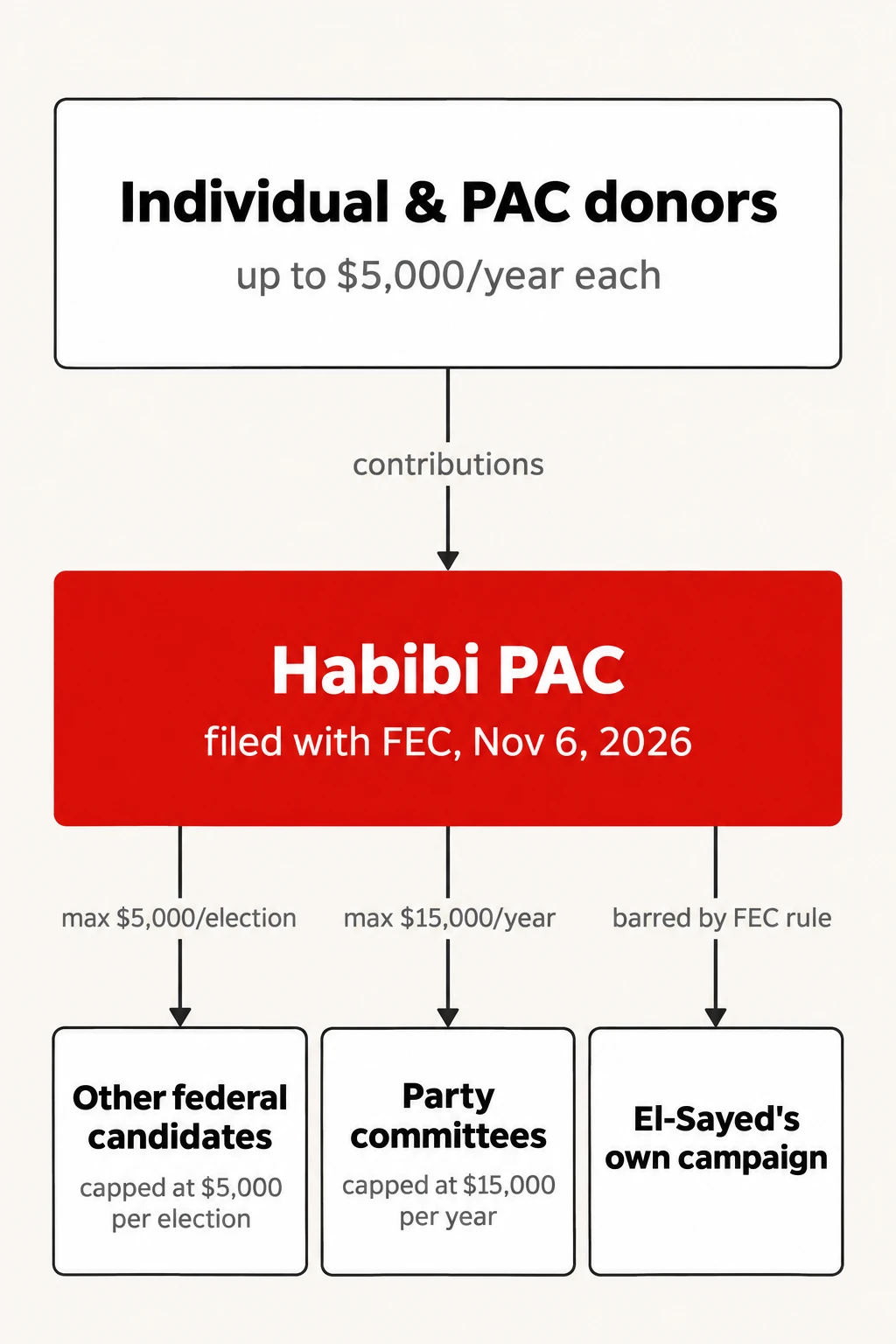
| From | To | How |
|---|---|---|
| Individual & PAC donors (up to $5,000/year each) | Habibi PAC (filed with FEC, Nov 6, 2026) | contributions |
| Habibi PAC (filed with FEC, Nov 6, 2026) | Other federal candidates (capped at $5,000 per election) | max $5,000/election |
| Habibi PAC (filed with FEC, Nov 6, 2026) | Party committees (capped at $15,000 per year) | max $15,000/year |
| Habibi PAC (filed with FEC, Nov 6, 2026) | El-Sayed's own campaign | barred by FEC rule |
Based on Federal Election Commission
The name is a rebuttal. AIPAC’s super PAC, the United Democracy Project, had spent $30,638,639.63 against El-Sayed by the final weekend of Michigan’s August Democratic primary, according to FEC filings Al Jazeera tallied at the time — a record for a single AIPAC-linked race. Add allied PACs and the primary-season total against him topped $54 million in FEC-reported spending, and more than $60 million counting $6.5 million from the dark-money Center for Democratic Priorities, which files nothing with the FEC at all. A separate super PAC, which began taking AIPAC money after the pre-election disclosure deadline, spent a further $12.7 million attacking him in the general election’s final weeks.
Those are different accountings, not the same number restated. The $30.6 million figure is AIPAC’s super PAC alone, as of one date in August. The group’s own cumulative FEC filings for the primary and general combined come to $31.47 million against El-Sayed, by Responsible Statecraft’s count of UDP’s reports — AIPAC’s single costliest loss of the 2026 cycle. El-Sayed, for his part, told supporters after his win: ‘To AIPAC, who spent $42 million against us: thank you for giving me the opportunity to beat you twice,’ folding in allied dark money the FEC tallies don’t capture.
The money that didn’t work
Across the cycle, UDP and its allied PACs put $84.1 million into races the group calls decided, and $55.3 million of that — nearly two-thirds — went to candidates who lost, a sharp fall from the group’s 87% win rate in 2024 and 69% in 2022, per Responsible Statecraft’s analysis. Michigan accounts for more than a third of that losing money on its own.
JD, Habibi, there is this delicious irony in the fact that you’re constitutionally obligated to swear me in in January.
That line, aimed at Vice President JD Vance in his victory speech, is the other half of the PAC’s name. The Constitution makes the vice president the Senate’s presiding officer, which means Vance will administer El-Sayed’s oath. Trump had called El-Sayed a ‘jihadist’ on the trail, and Vance had campaigned against him in Michigan; neither can now avoid him on the floor.
El-Sayed is not alone in filing a leadership PAC this week. Arizona’s incoming House member Amish Shah registered one called PACStreet Boy; Iowa’s senator-elect Josh Turek, a Paralympic wheelchair basketball gold medalist, filed WheelPAC; North Carolina’s senator-elect Roy Cooper filed One NC PAC, per Turkiye Today’s rundown of post-election FEC filings. The move is a freshman ritual, not a one-off: new members typically register a leadership PAC within days of winning, long before they cast a single vote.
What Habibi PAC actually does with its money is unknown because it has not yet had to say. A newly registered nonconnected committee that files semi-annually in a non-election year owes the FEC its first disclosure of receipts and disbursements by January 31, 2027 — the year-end report covering everything from its November 6 registration through December 31. That filing, not the name, is where the number to watch sits.