
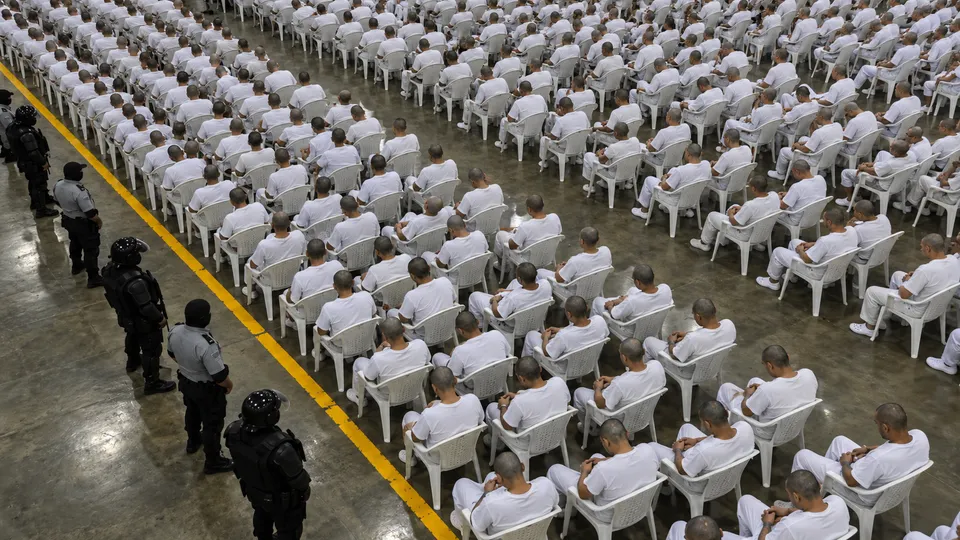
El Salvador has been under a state of exception since March 2022, and the arrests have never really stopped. By Human Rights Watch’s own count, police and soldiers have taken more than 90,000 people into custody, including more than 3,000 children, and the prison population has swollen to an estimated 118,000 — roughly 1.9 percent of everyone in the country, a share no other nation matches. At some point all of those people have to be tried, or processed, or whatever the right word is for what happens next.
What happens next, as Al Jazeera reported, is the mass trial. Human Rights Watch released a report on Wednesday documenting widespread violations in proceedings where hundreds of people can be tried and convicted together. The report examines four indictments covering more than 600 defendants, and a single court ruling that involved more than 120 people. Defense lawyers, the group found, have struggled even to access the case files — which is to say, the documents describing what their clients are accused of.
It is worth pausing on the mechanics, because they explain the numbers. A normal trial is designed around one defendant: one set of facts, one defense strategy, one lawyer who knows the file. A trial of 150 people reverses the arithmetic. The prosecution writes one indictment, presents one theory — you are all gang members, or all collaborators — and the courtroom becomes a queue. Each defense lawyer becomes responsible not for a case but for a slice of a crowd, often without the file that would let them argue otherwise. The state’s costs per conviction fall dramatically. So does the chance that anyone’s individual innocence gets examined. That is not a bug in the system; it is approximately the point of it.
The government’s position, since the crackdown began, is that mass detention crushed the gangs and gave Salvadorans their streets back, and the homicide numbers have indeed fallen sharply — which is why the policy remains popular at home and admired abroad. The question Human Rights Watch keeps asking is what was in the machinery that produced that outcome, and the answer, increasingly well documented, is a justice system in which being tried in batches of 120 or more, with counsel who cannot read your file, counts as due process.
There is a logic to it that almost makes sense if you squint: if you arrest on an industrial scale, at some point you either release people or convict them on an industrial scale. El Salvador has chosen the second thing. The trials are fast. The files are unavailable. The cells are full.