
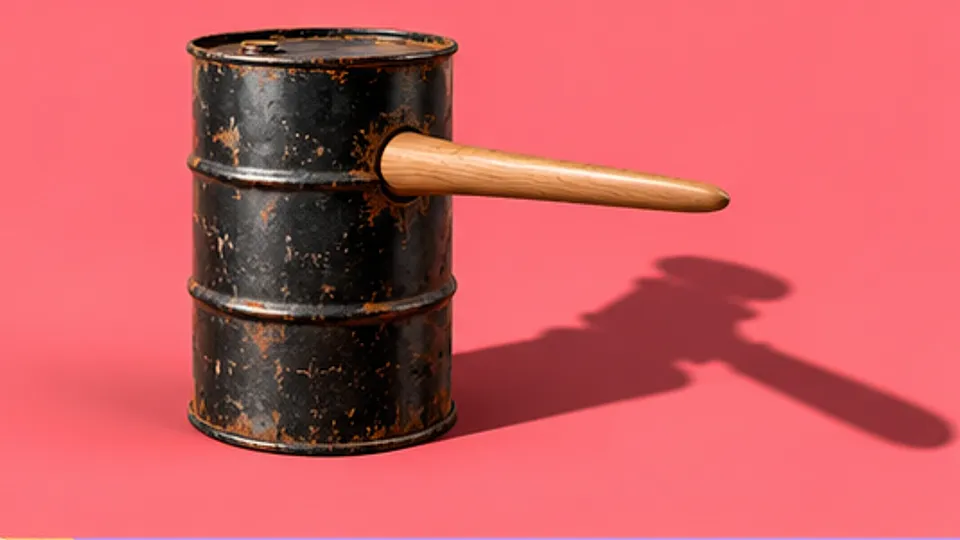
In 2018 the city and county of Boulder, Colorado, sued Exxon Mobil and Suncor Energy under Colorado law. Their claim is that the two companies produced fossil fuels and marketed them deceptively, that this led to “unchecked” use and a fast rise in atmospheric greenhouse gases, and that Boulder now pays for the results: extreme heat, more and bigger wildfires, damage to the ecosystem. On Monday the Supreme Court heard nearly two hours of argument on whether that lawsuit can go forward at all. It was the first case of the term, and only eight justices heard it, because Justice Samuel Alito recused without giving a reason. CBS News noted that his 2025 financial disclosure lists individual holdings in ConocoPhillips and Phillips 66, but not in Exxon or Suncor.
The eight-justice bench matters more than usual here, and the reason is mechanical. Boulder won in the Colorado Supreme Court. The companies are the ones appealing. If the justices split 4-4, the lower court’s decision stands and Boulder’s case continues. The justices also added a second question on their own: whether they have jurisdiction to review the Colorado decision in the first place. If they decide they don’t, Boulder’s case continues then too. So the companies need five votes out of eight, and Boulder needs to avoid losing. In litigation that is a pleasant spot to be in.
It also helps to remember how early this is. Nothing has been tried. Exxon and Suncor tried to move the case to federal court and lost. Then they asked the Boulder County District Court to dismiss it on the ground that federal law blocks the claims, and lost again. The Colorado Supreme Court sided with Boulder too. The question now is whether the case gets to the stage where people present evidence, and both sides have every reason to care about that stage.
The pitch
Kannon Shanmugam, arguing for the companies, called the suit an “unprecedented effort” to regulate global conduct through state law. “A state does not have the power to regulate out-of-state conduct based solely on attenuated effects on the state,” he said. He then gave the number: let this go forward and some 90,000 municipalities would “have the ability to make national and international energy policy by asking juries to impose catastrophic damages on selected fossil-fuel producers.” He also argued the suits interfere with the federal government’s control of foreign affairs. The Trump administration, which got 10 minutes of the companies’ argument time, agreed. Principal Deputy Solicitor General Sarah Harris said the suit “egregiously exceeds” constitutional limits on state power, and that “Interstate air pollution is an inherently federal area, and Congress hasn’t authorized this suit in the Clean Air Act.”
Kevin Russell, arguing for Boulder, made the more interesting move. He told the justices Boulder isn’t suing over emissions, which the Clean Air Act regulates. It is suing over production and allegedly deceptive marketing, which that law doesn’t cover. “It is not an effort to reduce emissions,” he said. “Under our deception theory, they can continue to produce as much fossil fuels as they like and contribute to as much air pollution and greenhouse gas emissions, as the market will bear when consumers are properly informed about the consequences of that decision.”
Here is how I read that. The wrong in Boulder’s theory is lying, and burning fuel is fine. An Exxon that told the full truth could sell exactly as much oil as truthful marketing would let it sell and owe Boulder nothing. That framing is well suited to getting past preemption. Federal law regulates what comes out of smokestacks and leaves advertising to the states. It does create a hard problem later, because someone will have to estimate how much climate damage in Boulder comes from the gap between informed and misinformed consumption. But that is a problem for the trial, and the companies don’t want there to be one. Russell’s filing said the suit “merely asks that petitioners bear their fair share of local costs incurred in part because of their tortious conduct,” and he told the justices Congress “stands at the ready” to preempt “unreasonable state laws” if it chooses to.
The bench
Justice Brett Kavanaugh came closest to the companies. He said several times that four of the court’s decisions going back to 1972 treat interstate air and water pollution as federal matters. “We don’t have to reinvent the wheel,” he said, adding that Congress, in writing the Clean Air Act and its amendments, had presumably relied on those precedents. He has wanted this case for a while: when the court turned down an earlier petition in it in 2023, the docket records that he would have taken it.
Justice Elena Kagan offered the analogy Boulder would want. States sued tobacco companies in the 1990s and opioid makers more recently over deception, and those claims went forward. “This is chapter three,” she said. According to a statement from the Center for Climate Integrity, which backs Boulder, she also asked: “This is the same kind of lawsuit against the same kind of actors for the same kind of harm. And I guess I’m not understanding how this one would be preempted and the other is not?” On the companies’ structural federalism argument, the group quoted her asking, “Where’s the text for that? Where’s the support for that? Where’s the precedent for that? Where’s the anything for that?” Kavanaugh’s answer, later on, was that “this court has consistently said that air and water pollution are different in our federal enclaves.”
Chief Justice John Roberts asked Russell what would happen “on the ground” once every state’s local governments filed suits of their own. Russell said more litigation over the details would follow either way. Then Roberts raised a point that works for Boulder: state courts already hear mass torts and “complaints about operations of the internet” that involve conduct far outside the state. “I guess I’m not quite sure what makes this situation different,” he said.
The Daily Caller reported that Justice Amy Coney Barrett, a possible deciding vote, questioned a central part of the companies’ argument. The Center for Climate Integrity quoted her calling their preemption theory “a little slippery.” Justice Sonia Sotomayor observed that “The Clean Air Act does not regulate marketing or advertising of fuel.” Justices Ketanji Brown Jackson and Clarence Thomas both raised the possibility that the court had taken the case too early. Jackson called review “premature” and told Harris, “It feels like we don’t really know enough to be confident that the theories that you are proposing are actually applicable here.” Thomas may turn out to matter a lot on that question.
What’s riding on it
According to the Center for Climate Integrity, 11 states, the District of Columbia, two tribal governments and dozens of municipalities have active deception suits against oil companies, together covering more than 1 in 4 people in the US. Boulder points to the 2021 Marshall Fire, which destroyed more than 1,100 homes and businesses in the county and caused more than $2 billion in damage. The group says scientists found climate change made the fire more destructive.
David Arkush of Public Citizen, which filed a brief supporting Boulder, said the industry is also lobbying Congress and state legislatures for immunity from climate liability. He argued that the real fear is “sitting in front of a jury of 12 Americans.” That is advocacy, but it points to something true about the incentives. What’s at stake on Monday was mostly whether discovery and a trial happen, and both sides can see the value of that more clearly than any damages figure. Commentators at [Legal Planet](http://legal-planet.org/2026/10/05/the-arguments-we-did-and-didnt-hear-in-suncor-v-boulder/) and the Congressional Research Service (primer) have laid out the possible results. A decision is expected by summer 2027.
Both sides agree that Congress could settle all of this by passing a law. They spent two hours arguing about what it means that Congress hasn’t.