
Anyone who has squeezed a message into fewer characters knows the trick: drop the vowels and the words remain legible, because consonants carry most of the information. The pattern runs through language after language—Spanish has 23 consonants and five vowels, and a similar ratio holds almost everywhere. Human brains lean on consonants to chop the stream of speech into words. The habit was long thought to be uniquely ours. Man’s best friend, it turns out, has picked it up too.
A study published on September 24th in Science reports that dogs show the same consonant-preference bias, the first time it has been found outside humans. “They make a very useful model for investigating these questions because, unlike laboratory animals, they hear human speech daily,” says Attila Andics, lead author and a neuroethologist at Loránd Eötvös University in Hungary.
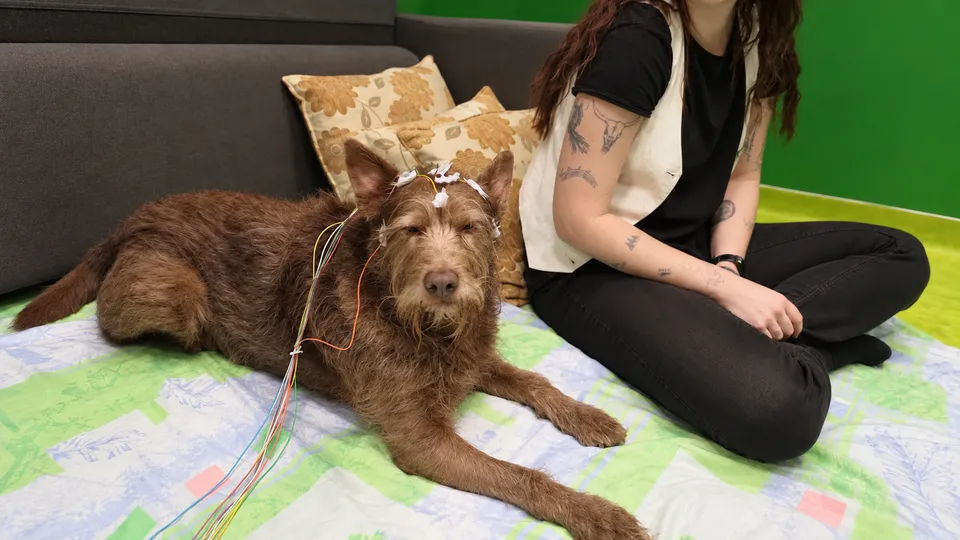
The team compared electroencephalographic responses in 20 human adults and 20 pet dogs as both listened to continuous streams of nonsensical three-syllable words. Some streams followed patterns built on consonants, others on vowels; a third set had no consistent pattern. “We found striking similarities in how both species processed these speech sequences,” says Dorottya Rácz, a co-author. “Like humans, dogs’ brains segmented the continuous speech stream into words more effectively when the recurring pattern—that is, the word’s skeleton—was made up of consonants.”
The implication goes well beyond dogs. It suggests that regular exposure to speech alone can reshape brain function, and that language-processing biases once seen only in humans can arise without any complex linguistic ability. “And that is what makes this study interesting,” says Juan Manuel Toro, a professor at the Center for Brain and Cognition at Pompeu Fabra University, who was not involved in the work. “Because it shows this bias is not exclusively human. Domestic dogs are exposed to human language from birth, and this study demonstrates that that experience is enough for them also to ‘focus’ on consonants to identify words.”
Mr Toro speaks with some authority on unexpected consonant-lovers. Last year he presented a study showing that ChatGPT had developed the very same bias—work that is cited as a reference in the new paper. Large language models, trained on enormous quantities of text, learn to detect its regularities; among those regularities is the fact that consonants do more work than vowels in identifying words. His team asked ChatGPT which of two pseudowords—one altered in a vowel, the other in a consonant—more closely resembled a target word. In both Spanish and English, the model leaned on consonants to judge similarity. “The results with dogs and with artificial intelligence language models point to the idea that experience with language allows this consonant bias to emerge,” he says.
The bias itself is an old acquaintance of developmental science. It was first studied in infants some 20 years ago, as the strategy they use to begin recognising words—one they keep into adulthood. Other work has named prosody, the rhythm of speech, as another of the infant’s early tools. Mr Toro has been there too, this time with rats. “What we showed is that rats displayed the same pattern of responses,” he says. “This suggested that the mechanism infants use to process the prosody of language comes from mechanisms we share with other animals and that evolved long ago.”
All of this bears on one of the deeper mysteries in biology. Before their first birthday, infants begin assembling a system that will let them express an infinite number of ideas from a small set of sounds. Whether language is an exclusively human gift, hardwired into the brain, or a cultural artefact assembled by learning remains unsettled. The new result does not settle it either. But it shifts the weight of the argument: if a dog’s brain, with no language of its own, can be bent into a human-shaped bias simply by living within earshot of chat, then some of what looked like human endowment may instead be human environment.
Animal studies, once a sideshow in the science of language, are increasingly doing the heavy lifting in working out how humans acquire and process it. The dog’s contribution is a neat one: it cannot speak, yet it has learned to listen. Which suggests that the first step towards language may not be having anything to say, but simply hearing a great deal of it said.