
Scientists using DNA from locks of hair authenticated as Thomas Jefferson’s have found the strongest evidence yet that the third U.S. president fathered children with Sally Hemings, an enslaved woman in his household.
Matches between genome sequences reconstructed for Jefferson and Hemings and DNA from 16 living people put the probability that Jefferson fathered at least one of Hemings’ children at 99.96%, according to a paper published on September 21 on the preprint platform bioRxiv. The paper, whose senior author is Richard Kurin, a distinguished scholar and ambassador-at-large at the Smithsonian, has not yet been peer-reviewed.
Kurin recounts the investigation in a book, History by a Hair: Thomas Jefferson, Sally Hemings & Solving a 200-Year-Old Mystery, published on September 22.
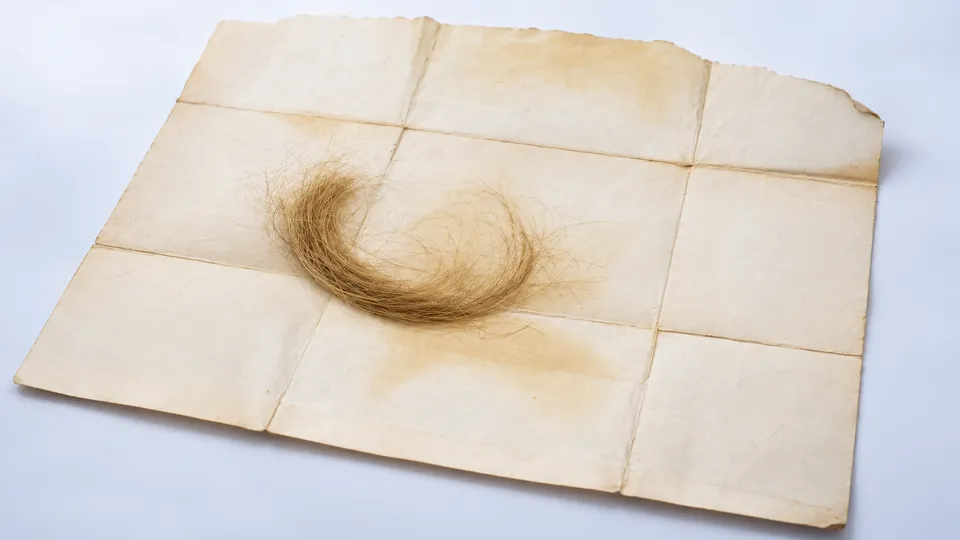
The inquiry began in 2011, when staff at the Smithsonian National Museum of American History opened a Bible that had belonged to Jefferson and found a reddish-blond hair pressed between its pages, CNN reported.
The research team had hoped the hair was Jefferson’s, but a comparison of its mitochondrial DNA with that of a living woman directly descended from Jefferson’s mother through the female line did not match, ruling him out.
The team instead used other hair samples attributed to Jefferson, including locks in the Smithsonian’s collection and a packet provided by the Thomas Jefferson Foundation at Monticello containing a lock clipped at his deathbed, which had not previously been available for analysis. The scientists compared the reconstructed genomes with DNA from living descendants of Jefferson and his wife Martha, of Jefferson’s brother Randolph, and of two of Hemings’ sons, Eston and Madison. Hemings had four children who lived to adulthood, but only Eston and Madison claimed Jefferson as their father.
A 1998 genetic study led by the late Eugene Foster, a retired pathology professor at Tufts University and the University of Virginia, had found a rare haplotype, or combination of genes, in the Y chromosomes of males descended from Jefferson’s uncle that also existed in descendants of Hemings. Critics said that tied Hemings’ descendants to a male in the Jefferson lineage, but not necessarily to the president himself. “He didn’t have Thomas Jefferson’s DNA,” Kurin told CNN, adding: “I thought, if we can get Thomas Jefferson’s DNA, we could use that as the source of comparison to various descendants, and really firmly solve the question.”
Éadaoin Harney, a senior population geneticist at the 23andMe Research Institute who was not involved in the research, said its strength lay in comparing multiple branches of the family tree. “By studying the patterns of DNA sharing across all of these individuals, it became possible to disambiguate exactly how the descendants of Sally Hemings were related to Thomas Jefferson,” she told CNN in an email.
Harney said the methods could also help recover the obscured histories of enslaved people. In a 2023 study of enslaved and free African Americans from Maryland, she used DNA analysis with other biomolecular and archaeological techniques to trace ancestry and links to people still living in the state. “Historical records are full of gaps, particularly when it comes to documenting the lives of people who occupied less privileged places in society,” she said, adding that the same tools could “help reconnect them with their descendants”.
Rumours of a relationship between Jefferson and Hemings, who was 30 years his junior and a half-sister of his wife, have persisted for more than 200 years. The accusation first appeared in print in 1802, when journalist James Callender alleged in the Richmond Recorder that Jefferson kept Hemings as a concubine, according to Encyclopedia Virginia. The Recorder wrote that “there is not an individual in the neighbourhood of Charlottesville who does not believe the story”, and later records aligned Hemings’ pregnancies with Jefferson’s presence at his Monticello plantation in Virginia.
In 2000, two years after Foster’s study, the Thomas Jefferson Foundation acknowledged “the strong likelihood that Thomas Jefferson and Sally Hemings had a relationship over time that led to the birth of one, and perhaps all, of the known children of Sally Hemings”. Kurin said the team pressed on despite the failure of the Bible hair. “We had hit a dead end, but scientists are always looking for alternatives,” he said. “I think we were propelled still by scientific and historical curiosity.”
One question remains open: whose hair was pressed into Jefferson’s Bible. Genetic fragments showed it belonged to a female member of the Jefferson family, Kurin said, but nothing more. “It’s like a partial fingerprint,” he said. “That is still a lingering mystery.”