
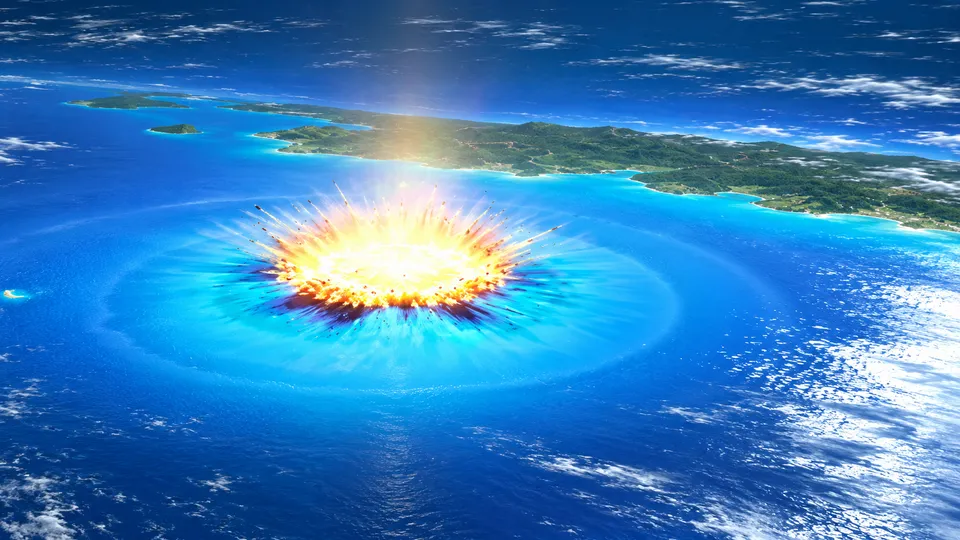
The asteroid that killed the dinosaurs 66 million years ago left behind an ecosystem where life could have taken root, with hot water circulating beneath the Chicxulub crater for eight million years, according to a study published this week.
The finding revises an earlier estimate that the hydrothermal system under what is now the Yucatán Peninsula lasted about two million years. Annemarie Pickersgill, a geologist and planetary scientist at the University of Glasgow’s SUERC Center for Isotope Sciences, and her colleagues drilled about a kilometer down and pulled samples of feldspar, a mineral whose potassium decays into argon at a known rate. The ratio of the two put the rocks’ history further back than thought. Lunar rocks and volcanic formations have long been dated the same way.
The team also ran computer simulations of the impact’s aftermath. Cooling to 90 degrees Celsius — 194 degrees Fahrenheit — at a depth of one kilometer took 1.5 million to 2.3 million years. Temperatures held above 50 degrees Celsius, warm enough for microbes, for as long as five million years. After about six million years, the flow of hot water weakened; by eight million it had stopped. The simulation lined up with the isotope dates from the rock samples.
Impact heating made the buried rock porous, and seawater then seeped through, carrying nutrients and warmth into an otherwise cold ocean floor. It was, in principle, a haven. “Longer periods of hydrothermal activity will generate extended windows of opportunity for prebiotic chemical reactions to occur, life to develop, and micro-organisms to thrive and propagate beyond their point of origin,” Dr. Pickersgill said in the study, published in the journal Communications Earth & Environment.
Whether anything actually lived there is another matter. The researchers did not test for signs of life, and life has been found at only eight of 70 underwater impact craters where hydrothermal activity has been detected. Matching an impact’s timing to the later flourishing of organisms is hard.
Dr. Pickersgill said the Chicxulub system was small next to the impact basins that battered the early Earth and the larger craters seen on other worlds. “It is therefore possible that these larger impacts could have created even longer-lived hydrothermal systems,” she said, adding they might have maintained habitable conditions “for a minimum of several million years.”