
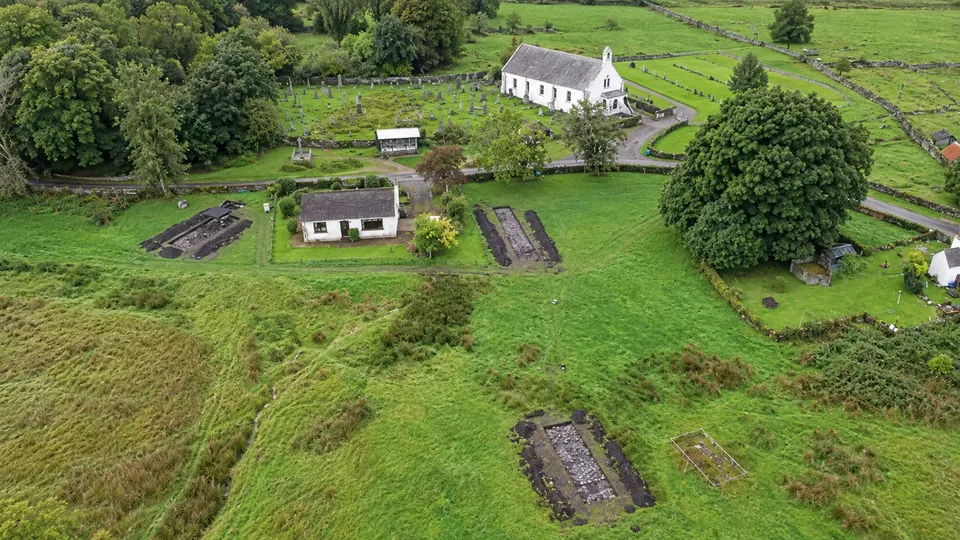
Archaeologists digging on the Scottish island of Lismore have found traces of gold and silver casting alongside an early medieval cemetery, evidence that its sixth-century monastery grew into a wealthy center of early medieval Britain, according to a study in the journal Antiquity.
Lismore, at the mouth of Loch Linnhe in Argyll, was known from chronicles as the seat of a monastery founded by Saint Mo Luóc, whose death Irish annals recorded in the late sixth century. The community belonged to Dál Riata, a Gaelic-speaking kingdom spanning Argyll, much of the Hebrides and territory in present-day Northern Ireland. Iona became the kingdom’s most famous monastery, though early records also pointed to important centers at Lismore, Applecross and St Blane’s on Bute.
Physical evidence for Mo Luóc’s foundation stayed scarce. Cross fragments and several seventh- or eighth-century dress pins offered clues, but excavations in the mid-2000s found no monastery. The Lismore Historical Society opened a new search in 2016, and geophysical surveys and targeted digging around the parish church began turning up a deeper early medieval landscape.
One telling spot was an oval stone structure roughly eight meters across. Inside, the team found pottery, cut antler, a crucible fragment and a possible metal punch. Charcoal-rich deposits just outside yielded hundreds of clay mold fragments, crucibles and carved wood. In all, more than 1,000 pieces of non-ferrous metalworking debris came from that one excavation area.
The molds show craftspeople cast at least two types of penannular brooch, along with rectangular objects that may have been buckles. X-ray fluorescence analysis identified copper alloys as the main metals worked, but several crucibles carried unusually high levels of gold and silver, rare evidence of precious-metal casting. The find gives new context to an early medieval touchstone for testing gold unearthed on Lismore in the 19th century. Radiocarbon dating places the craftworking deposits mainly between the seventh and ninth centuries, and the assemblage is the largest found in Scotland after Dunadd, a major Dál Riata power center.
The quality stood out as much as the quantity. Finely carved bone “motif pieces” bear intricate interlace designs that may have helped metalworkers develop patterns or shape gold foil for decorative objects. The researchers know of no comparable examples of this quality elsewhere in Scotland and only a handful in Ireland. Waterlogged ground preserved yew hoops from stave-built vessels, part of a possible yew box and a whetstone big enough to sharpen swords or sickles.
The monastery also buried generations of its people. Excavations confirmed an early medieval cemetery ringed by a limestone wall. The earliest tested burial dates to between A.D. 650 and 780, another to between 900 and 1040, with further graves grouped around a broken granite cross known as the Sanctuary Stone. The graves held adults, adolescents, children and infants, though every adult skeleton examined in that area was male. Pairs of infants appeared to have been laid together in single grave cuts, and one disarticulated femur carried sharp-force trauma possibly inflicted by a sword or axe.
Three newly recovered fragments of decorated cross-slabs widened the picture. Some carry ornament never before identified in early medieval Scotland. Others resemble sculpture from Applecross, Nigg and Rosemarkie, raising the possibility that artisans tied to the same wider tradition worked at Lismore.
Taken together, the authors argue, the cemetery, buildings, metalworking and sculpture point to a thriving community with regional, and possibly wider, influence between the seventh and 10th centuries. The island controls the entrance to Loch Linnhe and the Great Glen, the strategic corridor through the Highlands, sits on unusually productive farmland and lies near Dunollie, a fortified center named repeatedly in Irish chronicles. Iona’s later fame, the authors suggest, may have overshadowed other Christian establishments in Dál Riata — some perhaps rivals for prominence, though the written record is fragmentary.
The monastery’s earliest sixth-century church has still not been located, and the full boundaries of its enclosure remain unknown.