
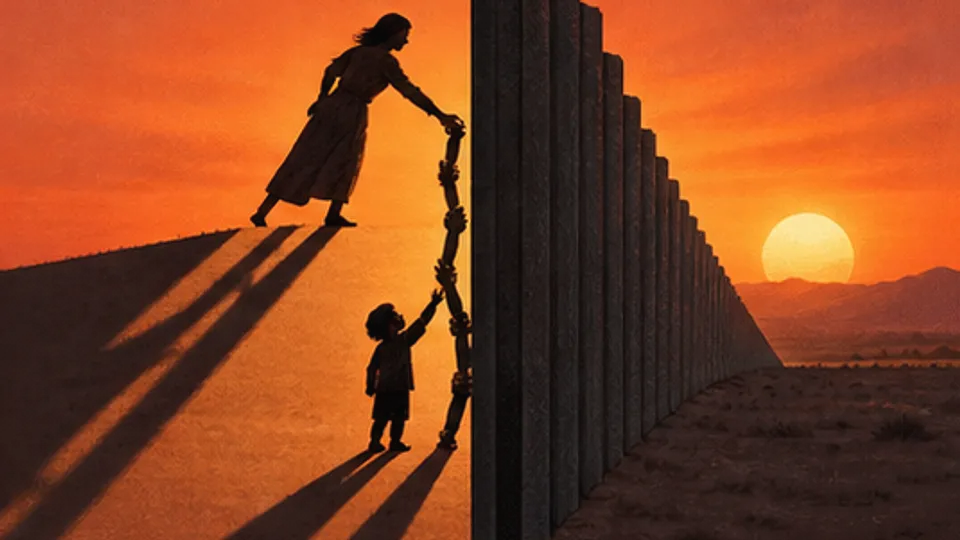
The ladder was made of people. This past June, near Tecate, a municipality about 50 kilometres east of Tijuana, smugglers lined up against the steel bars of the border wall and told Maria to climb — hands on their shoulders, then on the bars themselves. A young man from the group of about five went first and made it over. Then it was her turn. “Then I heard and saw that [U.S. Border Patrol] trucks started to arrive,” Maria told CBC News in an interview at the Instituto Madre Asunta shelter in Tijuana.
She fell back onto the Mexican side, landing among shrubs with thorns, and the group ran. She does not know what happened to the young man who made it over the wall. CBC is withholding her full name because she fears repercussions after two attempts to enter the U.S. in the past 10 months. She was trying to get back to her husband and her twin sons in California.
The migrant caravans that once made this city of about 2.3 million a waiting room for the U.S. have disappeared. But people are still crossing, and according to advocates many of them are deportees — mothers among them — trying to return to the families they were separated from. The routes these days are more clandestine, the margins of success narrow, and the price runs into the tens of thousands of dollars.
Vitalina Pietrobiassi, director of the Instituto Madre Asunta, run by the Catholic Scalabrinian Missionaries, calls the border a place of “pain” and “separation.” “The women who are deported come here to find a way out of their desperation,” she said. Next door, at the House of the Migrant shelter for men, executive director Raul Ochoa says the coyotes now charge between $15,000 and $25,000 US. At the low end, that buys a guide to a remote spot where surveillance is weak; at the top end, he says, it can buy guaranteed passage through a port of entry under an arrangement with a U.S. Customs and Border Protection agent. Either way, he says, the odds are poor: “The border is basically sealed, there is a lot of security, and the price to pay a coyote is extremely high.”
Down the hall from Maria, Dina Ramos is making the same calculation. A mother of six children, all born in the U.S., where she lived undocumented for more than 20 years, she was caught by U.S. authorities on Sept. 13 while trying to slip across. She had returned to Mexico in July to see her ailing parents. “My children are over there, on the other side, and that’s what hurts,” she said. She plans to try again. “One does many things for love.”
Ramos is one of more than 10,000 people intercepted since last October in the San Diego Sector, which covers roughly 96 km of land border from the Pacific Ocean west of Tijuana to the Tecate region. The year before, the sector recorded approximately 320,000 apprehensions between October 2023 and September 2024. On Sept. 16, the Department of Homeland Security and Customs and Border Protection said apprehensions along the whole U.S.-Mexico border have dropped by more than 90 per cent since December 2023. The funnel has narrowed; the desperation has not.
“It’s something that is still happening, most of all, yes, with deported mothers who left their families, their children,” said Soraya Vazquez, deputy director of Al Otro Lado, which gives legal and humanitarian support to migrants. “They will always have a yearning to return.” Maria is the yearning made specific. Originally from the state of Mexico, she lived undocumented in the U.S. for years and crossed irregularly twice. In December 2024 she got word that her oldest son had suffered a massive heart attack at age 29. She rushed back to Mexico; he died before she arrived. She stayed a year.
The family considered Canada, since her U.S.-born twins could enter without issue. A lawyer in Mexico City got her an appointment at the Canadian embassy in the fall of 2025, where an official photographed her, fingerprinted her and interviewed her. “The person who interviewed me told me, ‘Good luck,’ and that he believed I was a good person,” she said. Canada rejected her application. She was never told why.
So in December 2025 she put her life in the hands of smugglers and walked, with a group of about half a dozen, for three days through the desert and mountains of Sonora, which borders Arizona. At about 2 or 3 a.m. on the third day, they believed they had made it. “And then all these flashlights turned on,” she said. “It was immigration and they told us, ‘Stop walking, don’t advance, stand there.’ They had dogs.” She had been travelling with another mother and that woman’s 14-year-old son, a boy she was trying to pull away from people linked to crime. “She cried. All that effort, all those bruises, all those falls, it stays here, the dream ends here.” They were handcuffed, walked to a bus and taken to the Central Arizona Florence Correctional Center, about 100 km southeast of Phoenix. On a lawyer’s advice Maria pleaded guilty before a judge in Tucson. After about two weeks incarcerated, she was deported — roughly a week before Christmas.
She plans to try again. Her husband arranged the June attempt; of the cost, she says only, “The only thing I know is that we owe money.” One of her twins is set to join the U.S. Marines. “It’s tough. At first, it’s a nightmare, but that nightmare can turn into a dream,” she said. “A dream I want to reach in the future … to be with my family, to be united.”