
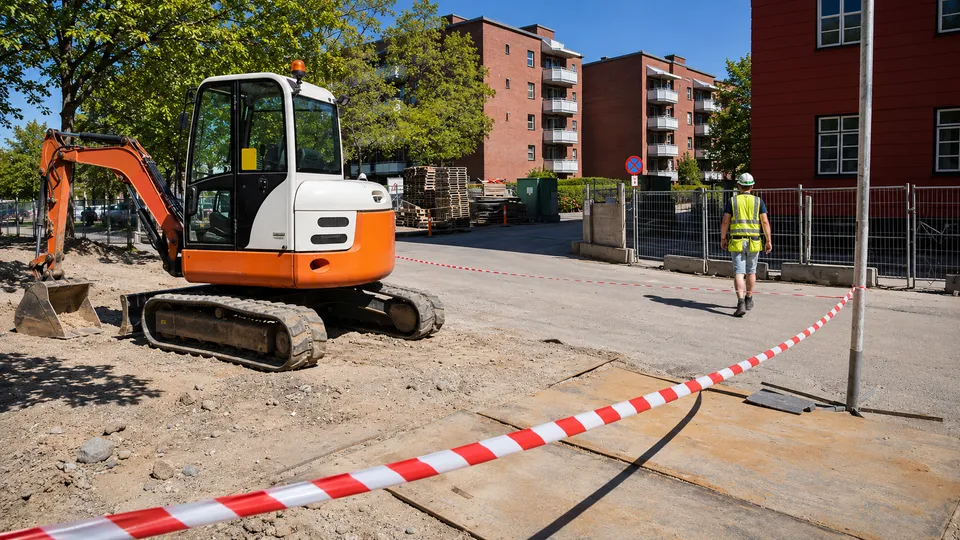
Seven families from Helsingør, a coastal city north of Copenhagen, are in Denmark’s Supreme Court arguing against their former landlord, the housing association Boliggården. Their claim, as Al Jazeera’s Nils Adler reported, is that they lost their homes because of where they or their parents come from. Their leases were terminated in 2022 under a 2018 law that used to be called, officially and with no apparent embarrassment, the “ghetto law.” The two-day hearing began on Friday and, according to a report carried by AOL, resumes on Monday.
The law runs on a formula, and the formula is the story, so here it is. Every December 1, the Danish government publishes a list of “parallel societies.” To make the list, a social housing area needs at least 1,000 residents, and more than 50% of them have to be immigrants or descendants of immigrants from “non-Western” countries. It also has to meet two of four social criteria: unemployment, crime, education and income. An area that stays on the list for five years becomes a “transformation area,” which used to be called a “hard ghetto,” and it must bring its share of public family housing down to 40% by 2030, by selling, demolishing or converting homes.
Notice which test does the real work. An estate with exactly the same unemployment, crime, education and income figures but fewer non-Western residents faces no such requirement. The social problems can be present without the origin test, and the area isn’t touched. The origin test is the gate.
So imagine, purely hypothetically, that you run a housing estate that is heading toward the list. You could try to lower unemployment, which is hard and slow and mostly outside your control. Or you could work on the other number in the formula, which is the share of residents born in particular places. A ratio is a fraction, and a fraction can come down because the top shrinks.
The families say that is what happened to them. In early 2020 Boliggården announced it would renovate 96 apartments at the Nøjsomhed estate and then terminated the leases. Most of those tenants had foreign backgrounds. One plaintiff, Riad, who is 33 and did not give his surname, said the landlord “didn’t want the estate to be labelled ‘hard ghetto’.” The residents argue the association pushed them out to cut its non-Western share so the area would stay outside the legislation. They lost in the lower courts.
Who counts as Western
“Non-Western” is a Statistics Denmark category. In 2020 the UN Human Rights Office described it as covering every country outside the EU except Andorra, Australia, Canada, Iceland, Liechtenstein, Monaco, New Zealand, Norway, San Marino, Switzerland, the US and the Vatican. So if you come from the Vatican, you are Western. The UN office said the label “disproportionately means Denmark’s non-white, non-European ethnic populations.” It also follows you down a generation: someone born in Denmark counts as non-Western if neither parent is a Danish-born citizen. A Danish citizen born in Copenhagen can be non-Western in Denmark.

The families’ lawyer, Eddie Khawaja, told AFP: “It’s about whether the criteria regarding the tenants’ origin is neutral or not.” The lower courts, and the Danish government, say it is neutral. Their reasoning is that “non-Western” is not an ethnic group. It lumps together people from dozens of countries, so it can’t be ethnic discrimination, so nothing in the Equal Treatment Act was broken.
That argument is clever. The broader you draw a category that excludes mostly non-white people, the harder it is to name the one ethnicity it targets.
The EU’s top court has already been asked about this. In December 2025, ruling on cases brought by tenants from Mjølnerparken in Copenhagen and Schackenborgvænge in Slagelse, the Court of Justice found that nationality or birthplace alone does not establish ethnic origin. But it also found that a criterion that looks neutral and spans many origins can still be tied to ethnicity. Before that, coverage of the case notes, one of the court’s advisers had concluded the law was direct discrimination. The judgment hands the decision back to Danish judges. They have to work out whether the criterion really rests on ethnic origin and whether it leads to less favourable treatment, which the court said could include “an increased risk of early termination of their leases.” That is an unusually specific description of what happened in Helsingør.
The politics
The government’s justification sits in a plan titled “One Denmark without Parallel Societies: No Ghettos in 2030.” In 2021, Kaare Dybvad Bek, interior minister at the time, said concentrations of non-Western foreigners raise the risk of “religious and cultural parallel societies.” Tenants’ associations estimate that about 11,000 people across the country will have to move by 2030.

The EU ruling has not changed the law. In January, Sophie Hæstorp Andersen, then housing minister, said it had to keep being applied until the Eastern High Court ruled, according to Danske Kommuner. A four-party coalition has governed since June, and it includes the Green Left (SF), which backed the law in 2018, according to DR. SF’s Jacob Mark is now minister for children, elderly affairs and housing, which puts him in charge of a law his party helped pass.
The case could matter well beyond seven families. It will probably produce a Danish ruling on whether a “non-Western” background is covered by racial discrimination law. Susheela Math, head of legal at the NGO Systemic Justice, said a ruling tying the label to racial discrimination would force the state to address the future of the whole classification system. If the Helsingør families win, they would likely be rehoused in comparable homes, and might be able to move back. The Mjølnerparken case is still before the Eastern High Court, and those tenants have a harder problem: their homes have already been sold. No verdict date has been set, though reports suggest a ruling could come later this month.
“No Ghettos in 2030” is a target for a list, and the list is built from a ratio. You can get a ratio down by improving the lives of the people in it, or by moving some of them somewhere else.