
There is a small kingdom on the edge of the North Sea where pigs outnumber people more than two to one. At any given moment Denmark keeps as many as 12 million breeding pigs, and each year it raises another 30 million for slaughter and live export. Pork and its relatives make up a quarter of the country’s food exports. As Nick Clark reported for Al Jazeera, these animals now do something their ancestors never did. They help heat the houses.
Every pig leaves something behind. According to the Danish Agriculture and Food Council, the pig sector produces more than 17 million tonnes of manure a year, most of it liquid slurry, and that slurry gives off methane and nitrous oxide, two powerful greenhouse gases. For generations this was a disposal problem, one more cost of doing business. Then the state found it could be fuel.
From the barn to the pipe
The change came quickly. In little more than ten years Denmark went from a handful of small biogas operations to about 150 plants on an industrial scale, and up to 70 percent of what they digest is pig and cattle manure. The gas goes into the national grid. It also fuels transport and homes, and what is left over becomes fertiliser.
Denmark now has the highest share of biogas in its gas grid of any country in Europe, at about 40 percent. A May 2026 country brief by the Institution of Gas Engineers and Managers puts the rise at roughly 10 percent in 2019 to around 40 percent of total gas consumption in 2025. The industry’s own Biogas Outlook 2025 projected a higher figure, 46 percent, but it measures something narrower: biogas as a share of the gas drawn from the grid, not of all gas consumed.
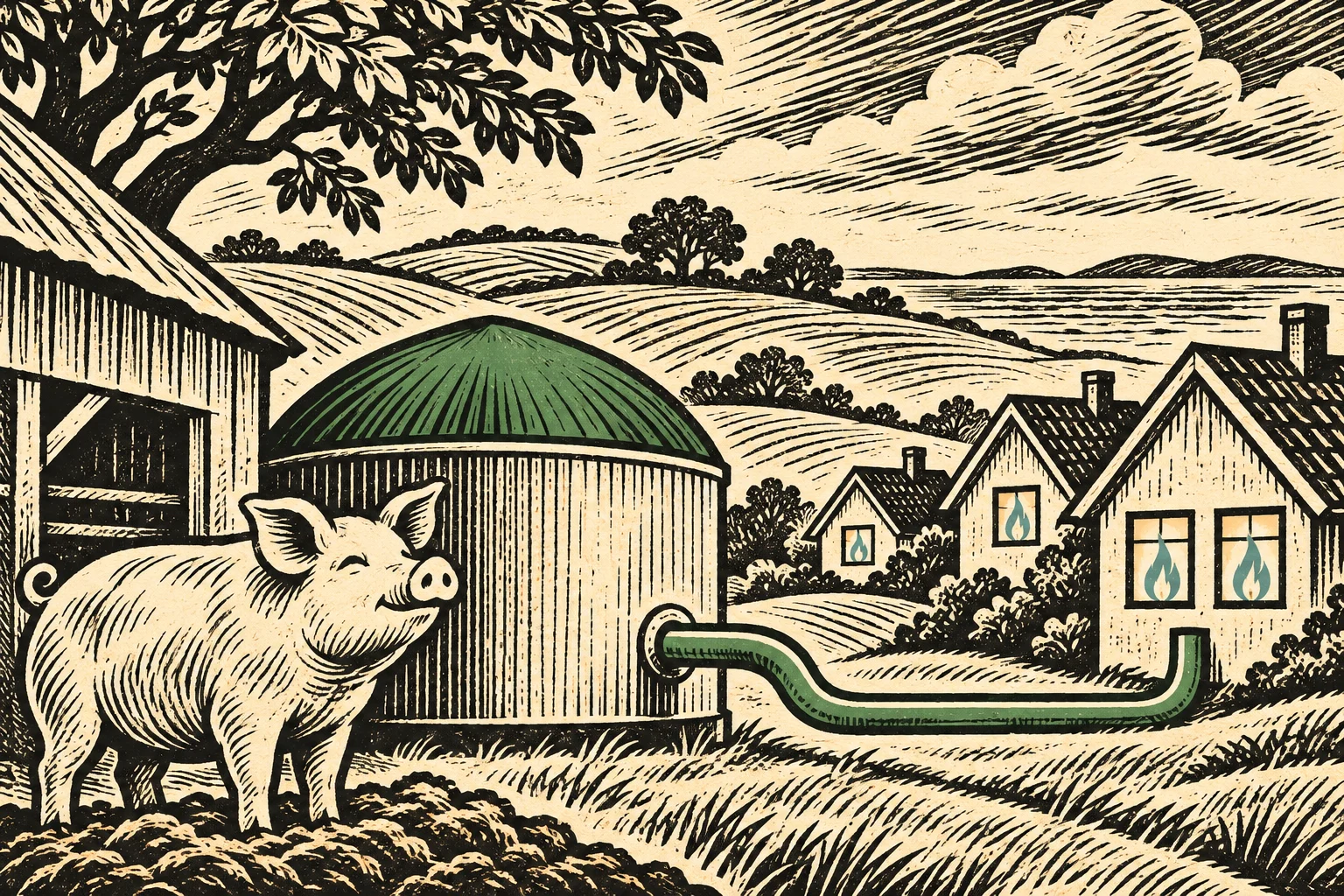
The timing has been kind to Denmark. The wars in Ukraine and Iran have made oil and gas markets volatile. A cubic metre of gas made from slurry on a Danish farm does not depend on any foreign pipeline or tanker route. Rulers who have watched energy used as a weapon tend to value that, whatever they say about the climate.
The town that set a deadline
Sønderborg is a coastal town in the south of Denmark, close to the German border. In 2007 it launched an initiative called ProjectZero, which promised a carbon-neutral energy system by the end of 2029. It is the same town where a Danish supercomputer’s waste heat has also been put to use. Renewables, industrial waste heat and biogas together have so far cut its energy-related carbon emissions by 79 percent.
“In a world marked by geopolitical uncertainty, energy has become an even more critical infrastructure. Societies need resilient, local energy solutions. ProjectZero is definitely about climate solutions, but it also helps give us energy independence.”
That was Allan Pilgaard-Jensen, ProjectZero’s chief executive, speaking to Al Jazeera. The independence he describes comes from two large plants, Glansager and Kværs. Each year they take in roughly 850,000 tonnes of organic material, mostly livestock slurry topped up with food waste and crop residues. Between them they produce enough biogas to meet the Sønderborg region’s entire annual gas demand.
The trap
Not everyone is celebrating. A report by NOAH Friends of the Earth Denmark and Foodrise argues that relying on pig and cow manure has built a “factory farm trap”, one that keeps livestock numbers high. NOAH’s Jacob Sørensen says Denmark has to cut its pig herd for the sake of the climate, public health and biodiversity.
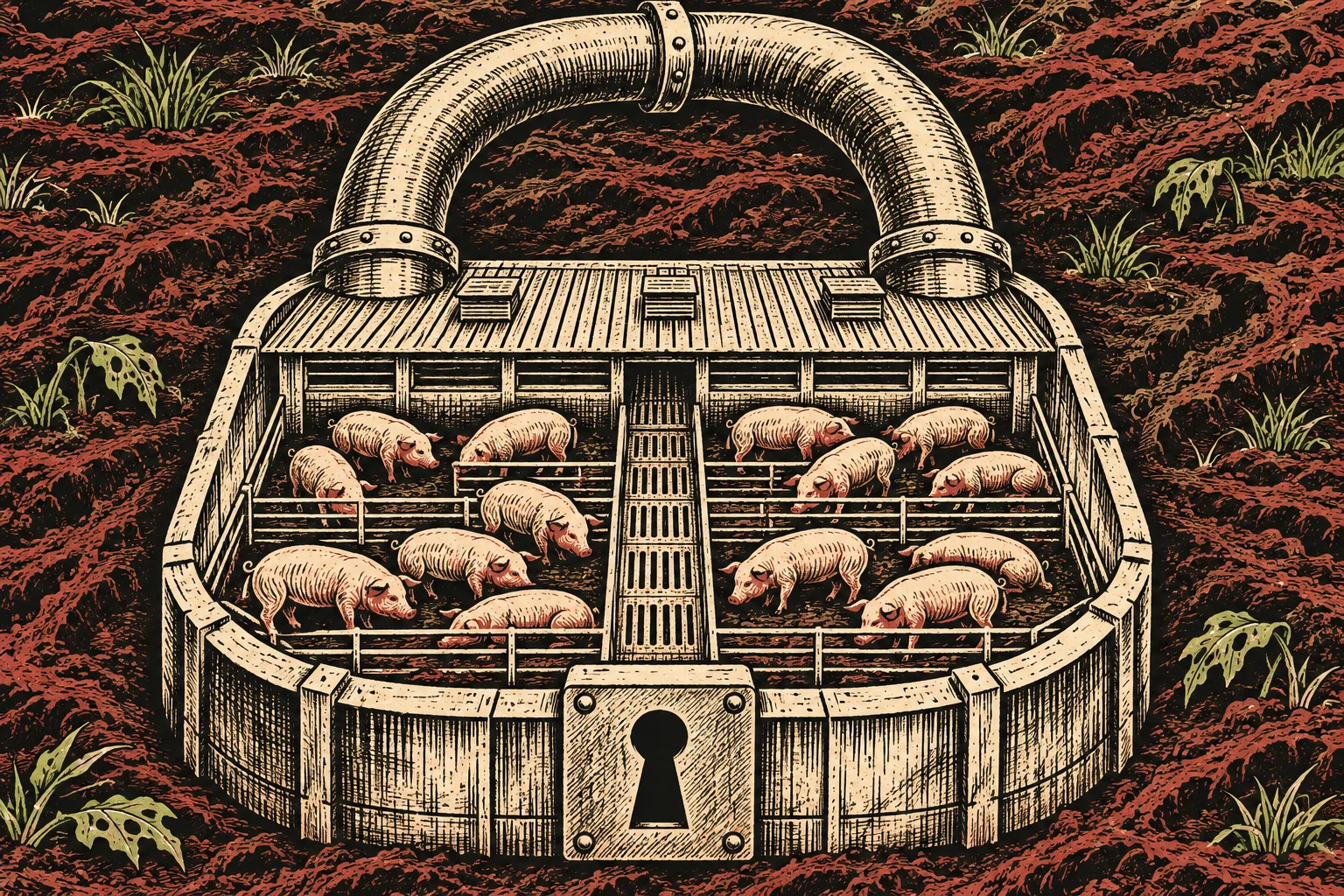
“Denmark claims climate leadership, but its current biogas strategy is moving in the wrong direction,” he said. “Biogas props up factory farming of pigs and locks in pollution rather than contributing to the necessary phasing out of the sector.” He argues the money spent on biogas would be better spent on emission-free energy, “such as wind turbines, solar panels, geothermal heat and energy-saving technologies.”
His warning is an old one. Any machine built to solve a problem soon comes to need the problem. A digester needs slurry, slurry needs pigs, and a plant built on borrowed money needs both for decades.
Industry groups such as Biogas Denmark see it differently. Biogas, they argue, tackles climate and energy security problems right now, and it reduces agricultural emissions that cannot be avoided, emissions that are about to start costing farmers money.
The bill of 2030
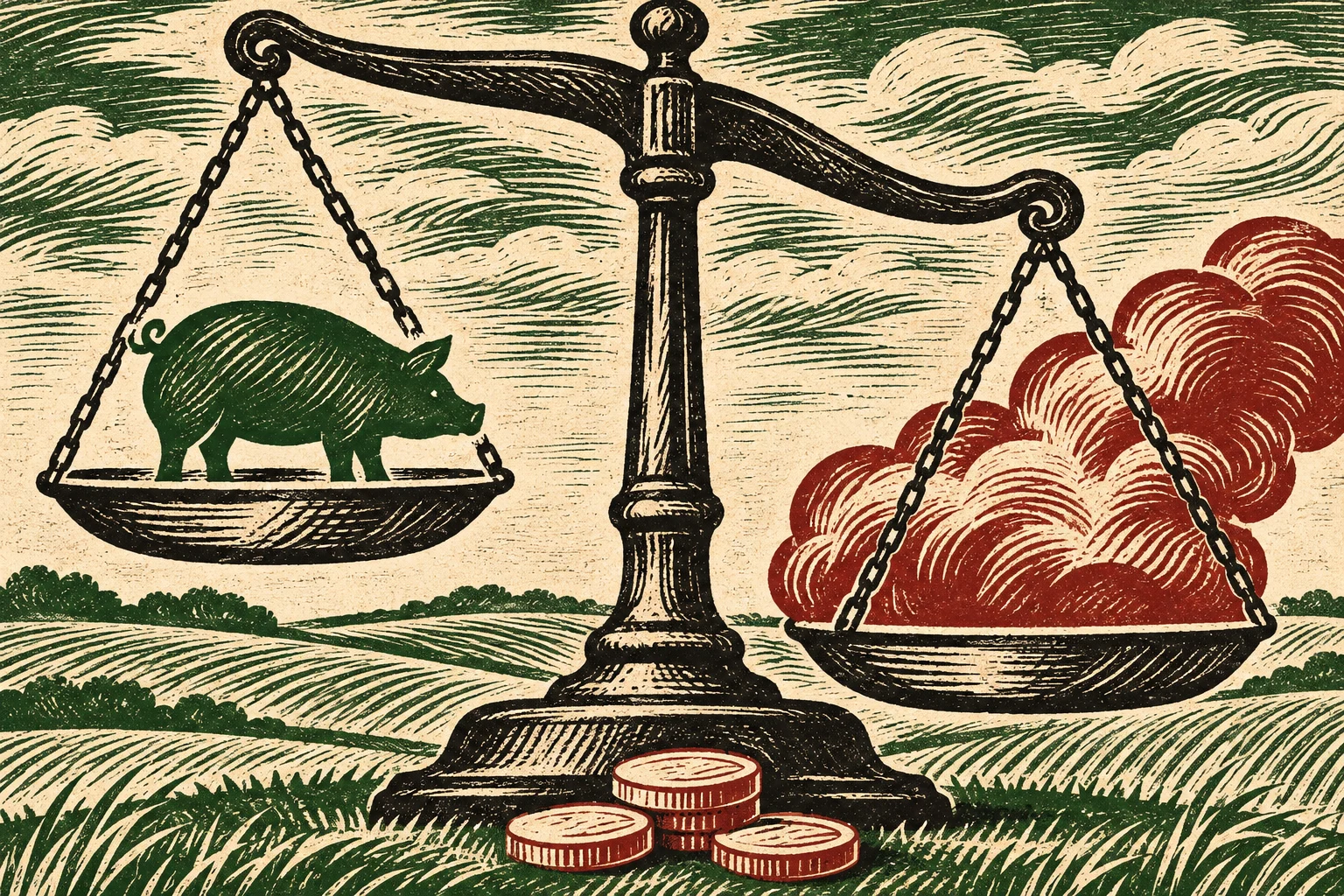
That bill is coming. In 2030 Denmark will become the first country to tax greenhouse gas emissions from farming. Al Jazeera puts the price at about 16 euros ($18) per tonne of carbon dioxide. The fuller arithmetic comes from the law itself. The green tripartite agreement of June 2024 brought together government, farmers, industry and environmental groups, and the parties fixed the details that November. As Agriland reported, the headline levy is 300 kroner per tonne of CO2 equivalent from livestock, rising to 750 kroner in 2035. A basic deduction of 60 percent brings the real rate down to 120 kroner in 2030, which is roughly the 16 euros, and to 300 kroner in 2035.
At Gråsten Agricultural College, near Sønderborg, some of the answers are being tested on a small scale. The campus looks like any farm, with livestock barns, tractor sheds and grain silos. Manure from its 200 cows and 400 sows goes into an on-site biogas plant, where bacteria break it down. The gas is burned in engines that make electricity for the farm, and the leftover heat warms the college buildings. Burning the gas releases carbon dioxide. A small capture unit pulls it out of the flue gas and pipes it into a storage tank, so it can be sold for drinks carbonation, refrigeration and food processing.
“For a long time, farming has been seen as part of the problem, and we would like to change that so that farming becomes part of the solution,” said the principal, Bjarne Ebbesen. He calls the college “a kind of living laboratory to test how agriculture can reduce emissions,” and he thinks the idea can grow: “Agricultural carbon capture can be scaled up across the country. And it then becomes a money-making opportunity.”
Critics point out that turning manure into fuel does nothing about farming’s wider ecological footprint. The pigs remain, all 12 million breeding sows and the 30 million that follow them each year. What has changed is what Danes call them. Once they were a source of pollution. Now they feed the energy supply.
“Carbon is being used in many different processes,” Ebbesen said, “so why shouldn’t farmers sell it as they sell milk, grain or meat?”