
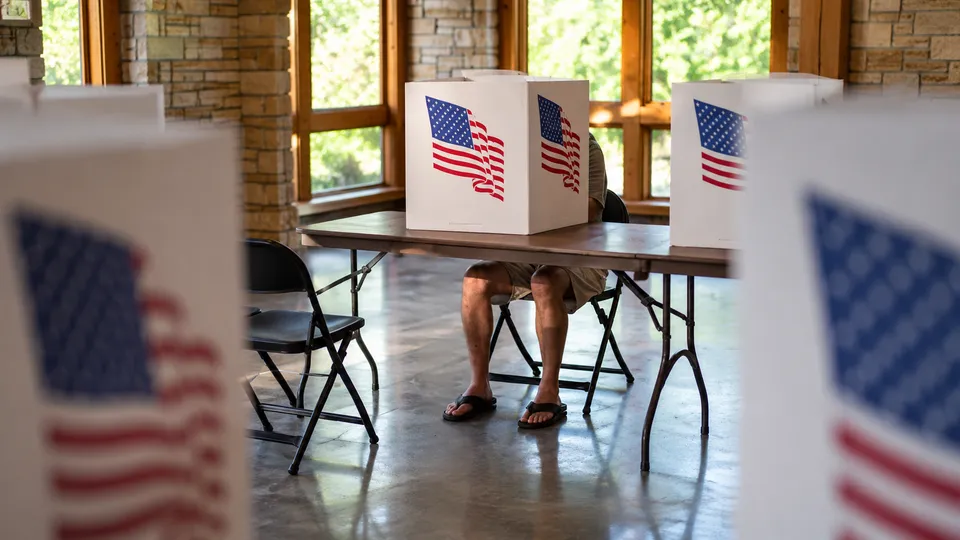
If you are the minority party in Congress and you are worried that the executive branch might try to interfere in a midterm election, your options are limited. You don’t run the Justice Department. You don’t command the National Guard. What you do have is lawyers, planning, and the ability to file things very quickly at 6 a.m. on a Wednesday. So that is the thing the Democratic Party has spent months building, and CNN’s account of it is a useful tour of what institutional opposition looks like when it’s done with org charts instead of press releases.
Senate Minority Leader Chuck Schumer has been running closed-door tabletop exercises with Democratic senators, legal experts and former officials, working through hypothetical scenarios that are not really hypothetical at all: Trump deploying Department of Homeland Security agents and the National Guard to polling places; federal officials seizing ballots after announcing that a foreign adversary compromised voting systems; AI-generated videos alleging election fraud being used to justify purging eligible voters from the rolls. Participants played stand-ins for the Homeland Security Secretary, the Director of National Intelligence and the Attorney General, which has a certain dramaturgical charm: someone in that room had to be the fake Attorney General and decide what the real one might do.
“These sessions didn’t just help us work out how we can thwart some of Trump’s egregious threats,” Schumer said in a statement to CNN. “They have been critical in helping us imagine the many twists and turns Trump and his cronies could throw at us, and where gaps in our preparation could potentially exist.”
On the House side, Rep. Joe Morelle has compiled a list of more than 150 possible Election Day threats — including ICE agents appearing at voting locations and influencers spreading word that polling sites have moved — and walked colleagues through them. House Minority Leader Hakeem Jeffries gave him the assignment this spring in the broadest possible terms: “I want you to go out and build the greatest election protection and election security program in American history,” Jeffries said, according to Morelle.
The whole apparatus, per CNN’s reporting, now includes a Senate election protection task force launched in April, the first-ever bipartisan Senate election observer program (built by Sen. Alex Padilla, a former California Secretary of State) to send staffers to watch polling places, vote counting and certification, pre-drafted legal pleadings asking judges to protect the chain of custody of ballots if federal agents try to seize them, and a preemptive lawsuit from Democratic leaders seeking to block ICE and other federal officers from polling and counting sites. It is scheduled to run through certification until the new Congress is seated on January 3, 2027.
Vanita Gupta, a former associate attorney general who has taken part in the exercises, called it “the largest mobilization of lawyers, organizers, communicators, and people working to support election administrators and secretaries of states and state AGs.” The lawyers’ logistics have acquired the flavor of disaster response: Elias Law Group, the largest firm representing the Democratic Party, is litigating 85 voting and election cases in 41 states, and partner Aria Branch told CNN, “We all basically are prepared to be deployed to a state at a moment’s notice if there is a threat or potential litigation that needs to be handled. We basically have go-bags prepared.” Go-bags. For electoral litigation.
Rep. Pramila Jayapal, who has worked on the threat assessment, framed the strategic shift plainly: “We just have to be ready to go to court immediately. There is no time to write briefs. So, I think a lot of those briefs are being at least preliminarily drafted, so we are ready.” This is the mechanism worth understanding. Election disputes are decided fast — recount deadlines, certification dates, inauguration dates do not move. The party that shows up with drafted briefs and standing plaintiffs wins the first forty-eight hours, and in election law the first forty-eight hours are frequently the whole game. Preparing in October for litigation you may file in November isn’t paranoia; it’s just docket management.
Is there anything to prepare against? The administration has kept the question open. Federal law already bars deploying federal “troops or armed men” at polling places except to repel “armed enemies of the United States,” but asked earlier this year whether he would send ICE officers or National Guard troops to the polls, Trump answered that he would do “anything necessary to make sure we have honest elections.” Asked back in February whether Trump was considering ICE at the polls, then-press secretary Karoline Leavitt said, “That’s not something I’ve ever heard the president consider. No” — which is a denial about what she’s heard, narrowly.
The White House’s position, via spokeswoman Lauren Bis, is that the suspicious party here is the other one: “Every American should be asking why the radical Left and Democrats refuse to pass the SAVE America Act which includes commonsense election integrity measures, like Voter ID, that are strongly supported by the vast majority of Americans. This legislation would make sure Americans, and Americans only, decide our elections.”
One of Schumer’s tabletop scenarios has, in a way, already run live. In June, Senate Democrats gamed out the FCC threatening broadcast licenses over disfavored political content; three months later, Jimmy Kimmel said the administration had pressured ABC not to air an interview with Texas Democratic Senate candidate James Talarico. “It was sobering for me,” a Senate Democratic aide involved in the exercise told CNN. The war game turned out to be a rehearsal.
Democrats also come in with some courtroom momentum. They blocked repeated Republican attempts to pass Trump’s elections overhaul bill, which divided the GOP; the Supreme Court rejected Trump’s plan to change how mail-in ballots are distributed and upheld state laws counting mail ballots that arrive after Election Day; and of the federal government’s lawsuits demanding election records from 30 states and Washington, D.C., 26 have been dismissed, according to the Brennan Center for Justice. Polls suggest real optimism in the party about taking the House and possibly the Senate — which is, of course, exactly why the planning exists. You build the biggest fortress when you think you have something worth defending.
The deeper structural point is that election administration in America is now contested terrain in a way it once wasn’t, and both parties have adjusted: one side by preparing to intervene, or so the other side believes; the other by building a private, party-run shadow election infrastructure from scratch because it doesn’t control the official one. “Our elections are safe and secure,” Padilla said, before noting that “we don’t put anything past Donald Trump.” Both halves of that sentence are load-bearing.