
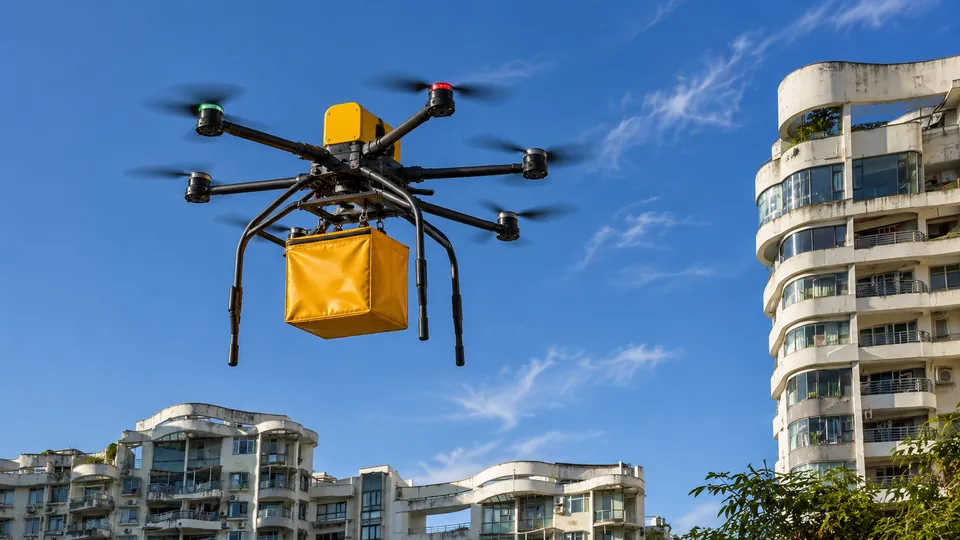
In August, Amazon said its Prime Air drones would reach “nearly 500 cities and towns by the end of 2026.” When it announced the plan on August 19, the service was running in eleven locations across seven states. That makes the plan roughly a sixfold expansion, squeezed into about four and a half months. Amazon has competition. On November 5 Zipline raised $1.5 billion at a $21.5 billion valuation, and on the same day Walmart signed up for 300 more Zipline drone sites, on top of the 21 already running. DoorDash and Uber are building their own versions. The business plan is pretty simple: a burrito or a phone charger, dropped onto your lawn from the sky, often within half an hour.
The thing holding this back is mostly regulatory. Under today’s rules, each delivery site generally needs its own FAA approval to fly beyond the operator’s line of sight. The FAA’s proposed Part 108 rule would make those flights permitted by rule, so a company would no longer have to collect a waiver for every site. If you are trying to cover 500 towns, that difference matters a lot. According to the industry tracker Drone Intelligence, the final rule has been sitting with White House reviewers since July 10. The FAA has said it hopes to publish it by the end of the year, and the deadline Congress set by statute falls on December 7, 2026. Once those last hurdles are cleared, the economics push toward volume: more sites, more flights, more drones in the air above more suburbs.
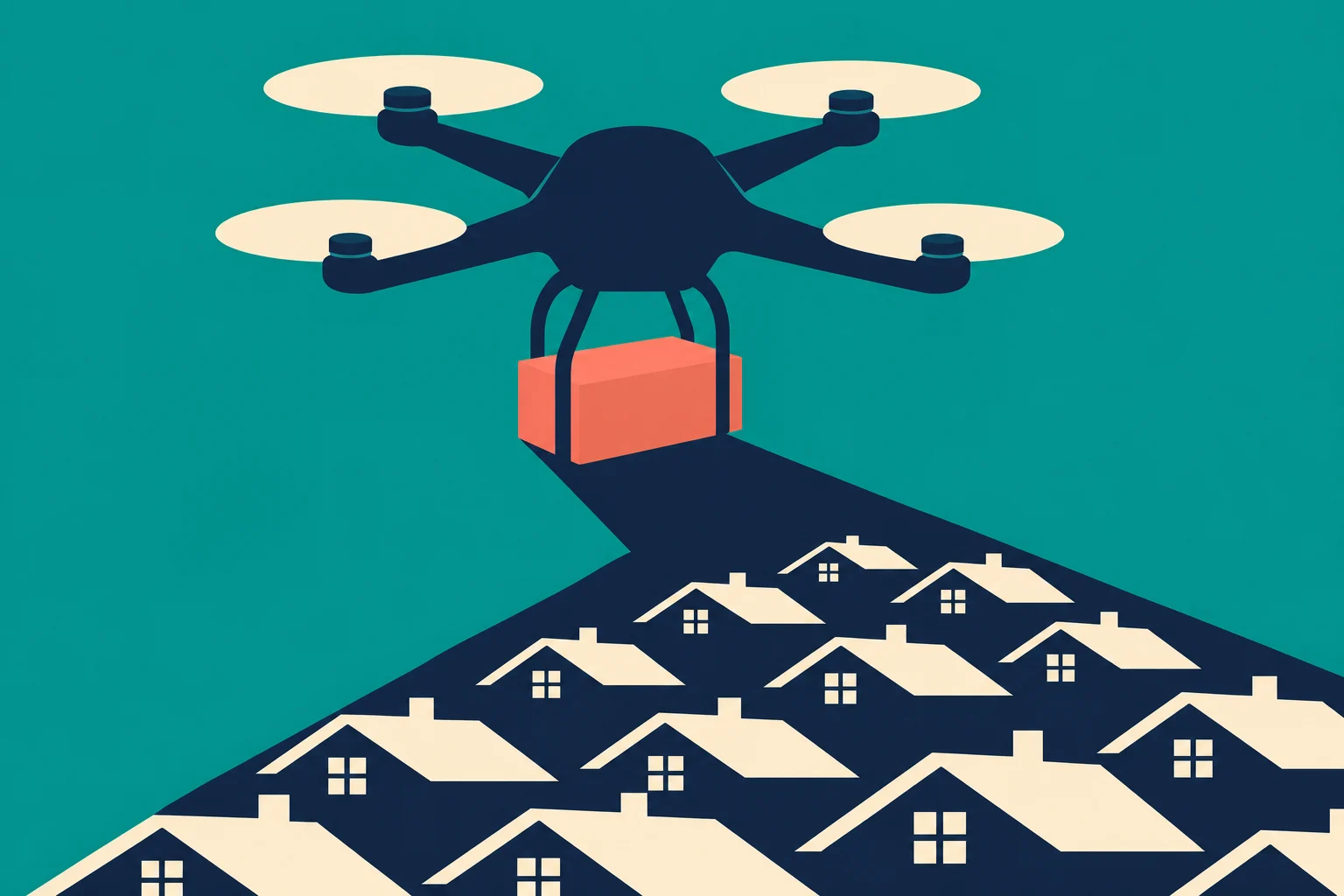
For most people this will be a curiosity, and occasionally a funny video when a drone does something dumb. But writing in Ars Technica, Sean Gallagher points to a cost that appears in nobody’s unit economics. A growing number of people around the world live with post-traumatic stress disorder or other anxiety disorders that drones set off, and for them the sound overhead means something else entirely.
What the sound means
Drones have been on battlefields since the late 1980s, when the Israel Defense Forces started using them. At first they watched and spotted targets, and the weapons came from somewhere else. Gallagher saw naval drone operations being developed aboard the USS Iowa in 1986 and 1987, when sailors mostly experienced them as a nuisance and spent hours waiting by a boat to fish crashed ones out of the water. A few years later, during the Gulf War, Iraqi troops on Faylaka Island surrendered to a Pioneer drone from the USS Wisconsin. They had linked the drone with the bombardment they had just taken from the USS Missouri, so when it came back to assess the damage, their morale collapsed. The drone fired nothing. What broke them was what it signalled.
Over southern Lebanon, the lawnmower-like drone of the engines became a constant reminder that someone was watching and that artillery or an air strike could follow. The fear grew once drones started carrying weapons themselves, and grew again with “loitering munitions,” one-way drones built to dive into a target and explode. A 2012 Stanford Law study of US drone strikes in Pakistan described what that does to a community:
Drones hover twenty-four hours a day over communities in northwest Pakistan, striking homes, vehicles, and public spaces without warning. Their presence terrorizes men, women, and children, giving rise to anxiety and psychological trauma among civilian communities.
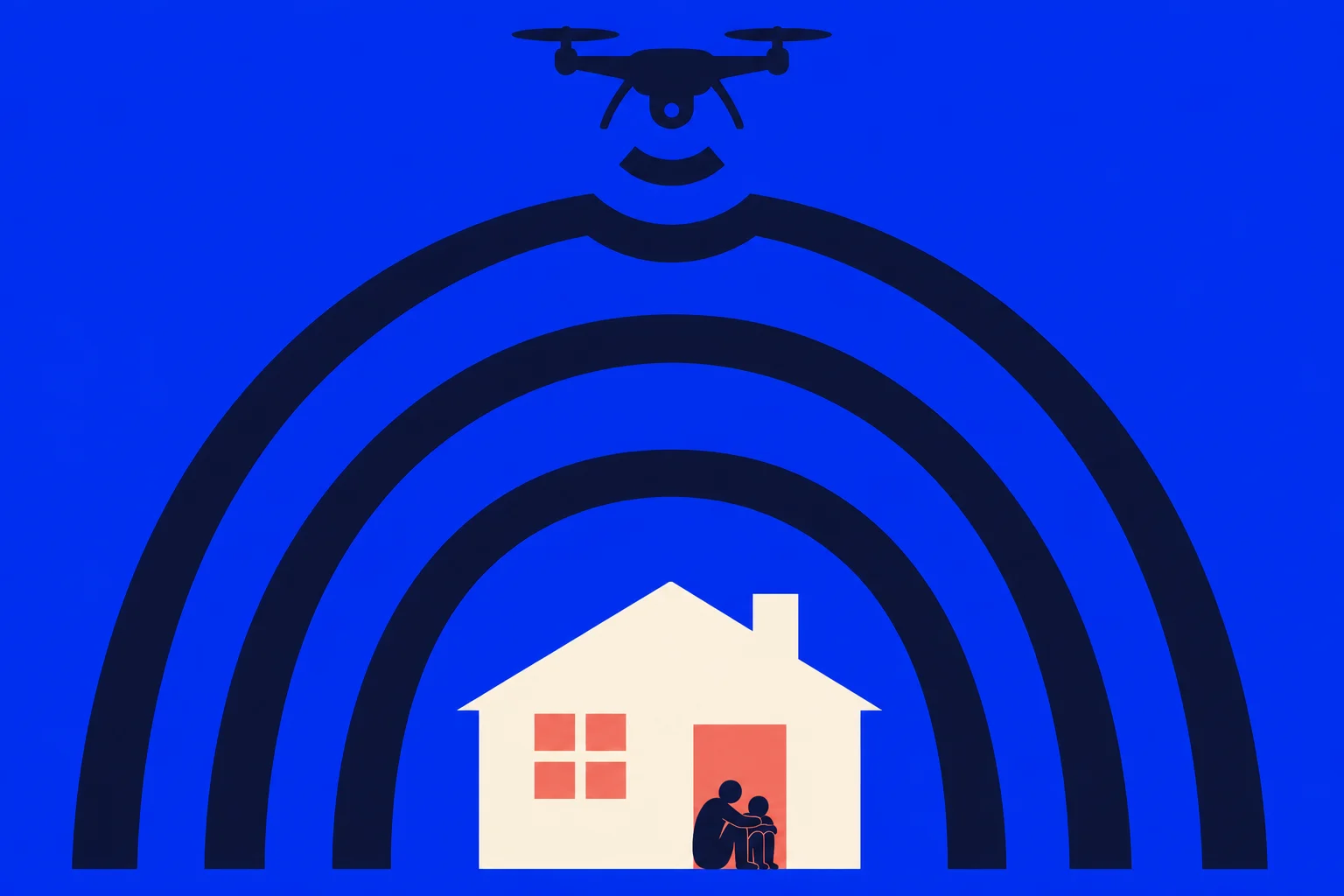
Ukraine, Gaza and Lebanon have repeated that experience on a larger scale. A team of US and Ukrainian psychiatrists led by Dr. Joseph L. Bonvie of Massachusetts General Hospital found that Ukrainian soldiers and civilians who have been through a drone attack, particularly those injured in one, “are at heightened risk for developing persistent psychological symptoms, a vulnerability intensified by the ongoing threat of repeated attacks.” Some Ukrainian doctors now call the resulting “unique hypervigilance behavior with corresponding hyperarousal and avoidance behaviors” by the name “dronophobia.” In the team’s words, “The distinct hum of an approaching drone, often likened to the swarming of hornets, has itself become a psychological weapon. The escalating pitch as a drone draws near elicits fear and helplessness even before an attack.”
In Gaza, the Jordanian psychiatrist Dr. Mohammad Abu Slaih wrote in European Psychiatry about consultations with 19 patients. “All patients reported an intense phobic reaction to the acoustic signature of drones (the ‘zannana’), associated with imminent bombing and death, manifesting as full-blown panic attacks,” he wrote. “Three children developed a specific fear of looking at the sky.” Iran’s drone attacks on Gulf states have been nothing like what Gaza has suffered, but they have still disrupted sleep, caused fatigue and fed anticipatory anxiety among civilians in the United Arab Emirates and elsewhere.
The US Army’s Training and Doctrine Command has compared drones’ capacity to cause PTSD to the “shell shock” of World War I and the “battle fatigue” of World War II. It wrote that the “fear and stress from (the sound of) near-persistent drone presence creates anticipatory anxiety… Fears can persist beyond the drone’s presence, enhancing a soldier’s anxiety even when out of harm’s way.” Not many American troops have actually been targeted by drones flown by Iran, ISIS or Iran-backed militias. But the footage spreads well beyond the people in it. Russian and Ukrainian units both post videos of drones chasing down individual soldiers, and Ukrainian units sometimes add horror-film soundtracks. Neda Gould, an associate professor of psychiatry at Johns Hopkins, told Psychiatry Online that this makes drone trauma different, because a soldier “may also relive the experience in a way that is completely out of their control.”

The other end of the joystick
Within the US military, the first signs of drone-related stress showed up among the operators. A 2014 study led by an Air Force psychologist found that 4.3 percent of Air Force drone operators showed “a pattern of symptoms of moderate to extreme level of severity” associated with PTSD. Later research found operators just as likely to have PTSD symptoms as aircrews deployed to war zones, and possibly more at risk. Operators often watch a target for days or weeks before a strike. They take in imagery and radio traffic continuously, they never get the transit home that a pilot does, and because they had all that time to study the target, mistakes are harder to put behind them.
None of this is an argument against the delivery industry, which is not dropping anything worse than toothpaste. It does mean the industry is scaling up a noise that, for a meaningful number of people, already has a meaning. The public has already pushed back against police drone programs in California, and those at least have a stated public purpose. A delivery drone mostly saves you a trip to the store.
Amazon’s pitch is that orders can arrive in as little as 30 minutes. The Army’s view is that the fear “can persist beyond the drone’s presence.” Both are claims about how long a drone stays with you, and only one of them appears in the marketing.