
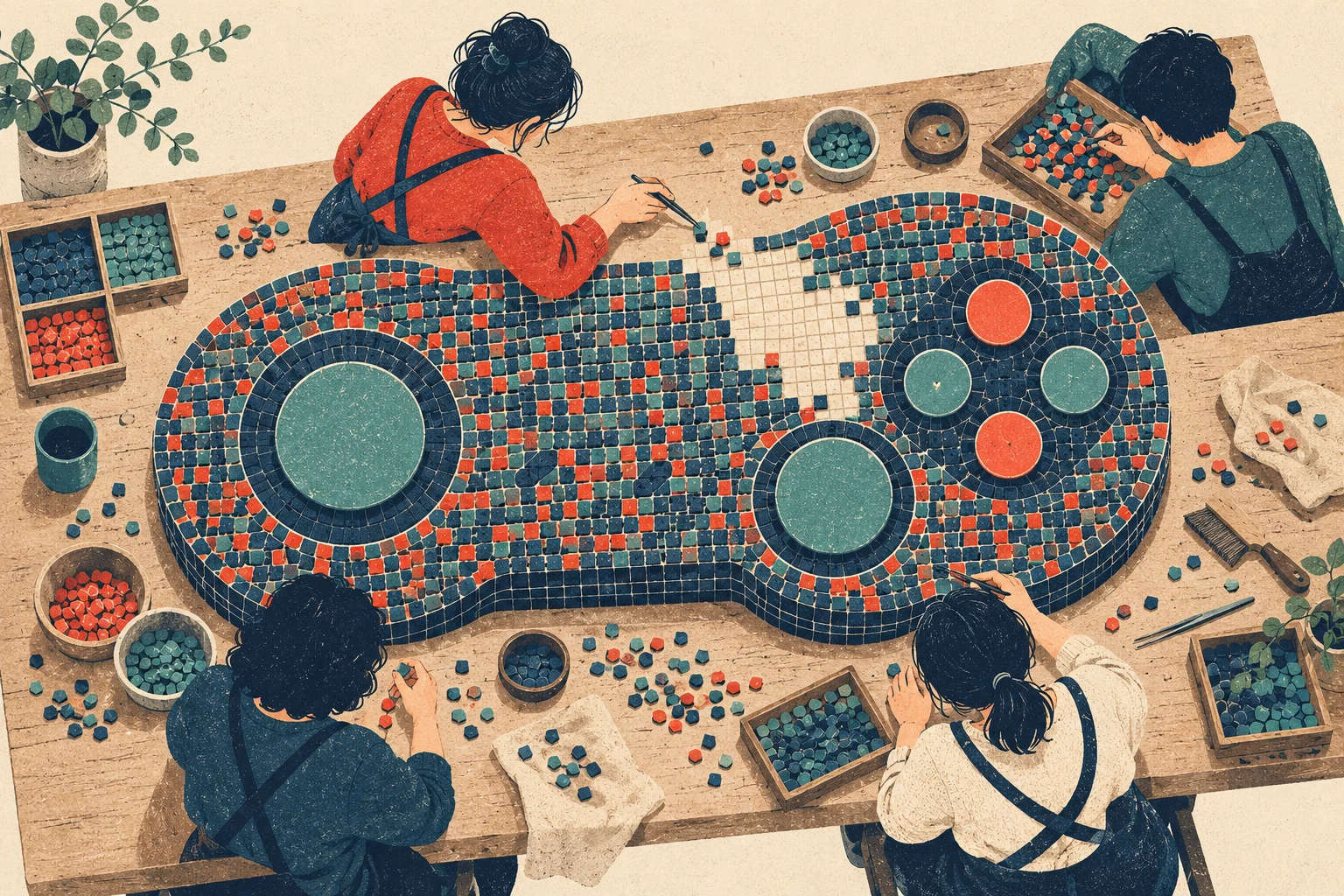
For several years a small, stubborn trade lived on the internet. Its members took video games that were already finished, sold and sealed by their makers into machine code, and worked backwards. Function by function, they rebuilt the source code that the studios never released, checking each piece against the original until it matched. They did it slowly and together, and they kept the score on a website called decomp.dev.
On Thursday the website announced that it was shutting down. As Jason Koebler reported for 404 Media, the reason is that people using AI to clone and decompile games have overrun the community and now produce far more than human engineers working alone ever could. The administrator writes under the name Encounter. GamesRadar identifies them as the developer Luke “encounter” Street. Their announcement reads like an obituary for a way of working.
Historically, matching decompilation has been a brutally difficult, time consuming task, on the scale of years for any moderately-sized game with a number of active contributors.
People did this for many reasons. Speedrunners went looking for glitches that would shave time off a run. Hobbyists ported old games to new machines, so that Super Mario 64, for instance, could run natively on a PC. Modders wanted code they could change, archivists wanted code that might otherwise be lost, and some people simply enjoyed the challenge. The site served all of them. It hosted file libraries and tools, and on each project a percentage meter crept towards 100 as matched functions piled up.
“decomp.dev was originally designed to gamify decompilation: watching the progress go up was a fun way to stay motivated when every fraction of a percent took real human effort,” Encounter wrote.
The machine arrives
According to 404 Media, recent frontier models such as GPT-6-Astra turned the work from years of labour into something trivial. The post on decomp.dev itself traces the change to model releases in early 2026. Encounter credits the machines plainly: “They are significantly better at following complex directions, cross-referencing resources for symbols or debug information, and writing natural code with enough guidance.”
Then comes the sentence on which everything turns: “It is now clear that, with the right guidance, human input, and code reviews, AI can expedite the decompilation process in a significant way. What is also now clear is that the community aspect of decompilation has been broken.”
So the tool works. The trouble is what the tool did to the people.
Hostile forks
Encounter describes a new type of visitor. This person takes open-source code that humans wrote over a long time, has an AI “finish” it, and releases the result. “These kinds of hostile forks put little to no effort into meaningfully contributing to existing projects, tearing apart our community fabric,” the administrator wrote. “While community members put in the effort to decompile a game, opportunists have frequently raced to release a half-baked, barely-functional port from it.” Today, Encounter added, “anyone with an AI subscription” can produce a port or static recompilation that works at a basic level.
It is now impossible, the administrator says, to tell which projects are mainly human-led and which are mostly machine-made. The meter that once measured endurance now measures spending: decompilation has become “a hollow numbers game, exacerbated by folks who just want to burn tokens to make number go up.”

Here is a reflection, not a finding. Every guild depends on its labour being scarce. Once the labour is free, all that remains to compete over is the scoreboard, and a scoreboard can be bought.
Encounter did not ban AI-assisted projects. The post explains that “slop” is hard to define and hard to police for one hobbyist working alone. Encounter also objects to “decomp” coming to mean little more than a PC port. The shutdown is partial. Existing projects will still be tracked, and their pages and historical data stay online, but the main index and the ability to add new projects are disabled. Nobody can host a copy, because the code never had an open-source license and the author keeps all rights to it.
Beyond the workshop
Outside the closed site, the AI decomps and recomps keep coming. People have used AI to put Mario into Elden Ring, to port games to platforms they were never built for, and to splice games together in every combination imaginable. In recent days tools built for the job have appeared. One of them, decomp.wtf, invites users to “point the AI agent you already use at a game you own,” and promises to turn it “back into C, one function at a time” while checking “every function byte for byte against the original.” Rights holders have their own front in this fight: Activision and Bethesda have already shut down AI-built Fallout and Call of Duty projects.
The same pressure is reaching software that people pay for. In recent days, mostly working AI-coded clones of Adobe’s Creative Cloud products and of Microsoft Office have circulated, and both suites normally cost hundreds of dollars a year. They sit in a grey zone of copyright. Developers and small firms who sell software as a service, the dominant model in Silicon Valley for the past decade, say job openings are drying up and describe a malaise as they watch AI advance. Small game developers say their projects are regularly taken by “clean room” AI clones, built without anyone ever looking at the original code.
“All I am hearing from software engineers is that software-as-a-service is dying as a business model,” Mike Nolan, who studies the politics of open-source software, told 404 Media. “It’s becoming so easy to recreate the functionality that you want.” Earlier this year Nolan launched Malus.sh, working software that “recreates” open-source programs from scratch without breaching copyright. He built it to expose gaps in copyright law and open-source licences that leave developers unprotected, and to satirise the people using AI to profit from those gaps.
On decomp.dev, the old project pages are still up. Their progress meters were filled in, a fraction of a percent at a time, by people who no longer have a place to gather.