
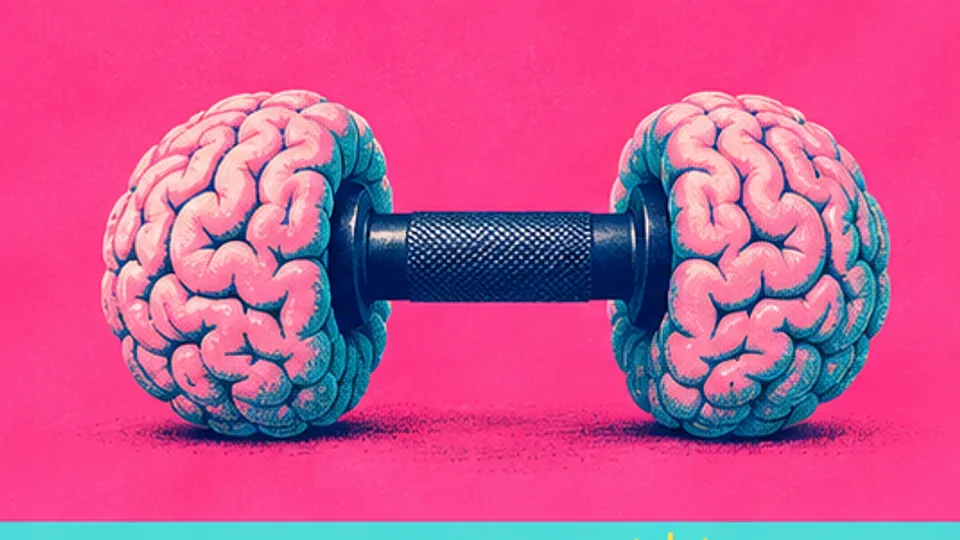
Professional cyclists and Olympic skiers are adding brain endurance training, a method that pairs rapid cognitive drills with physical exercise, to their routines to build resistance to mental fatigue, CNN reported.
Studies led by Christopher Ring, a professor of psychology at the University of Birmingham, on cyclists, soccer players, padel players and recreational weight-lifters found that participants who did the training could perform longer and better before becoming fatigued, according to CNN.
British professional cyclist Tom Portsmouth, 24, told CNN he turned to the method after breaking his hip in a crash at the under-23 Paris-Roubaix race in May 2023, when he found that rebuilding his body was not enough to win sponsors in an increasingly competitive field. “I felt my mental fatigue was blocking my performance, so I went looking for ways to unlock it,” he said.
The concept rests on an argument made by Samuele Marcora, now at the University of Bologna, that the final decision to keep going often comes from the brain rather than the body, Ring told CNN. “The idea is to put yourself into a state that’s both physically and mentally exhausting, by combining cognitive and physical training,” Ring said. In practice that means 15 to 20 minutes of cognitive exercises, delivered by an app that flashes numbers, letters and shapes and asks rapid-fire questions testing reaction time, decision making and memory, a few times per week.
Interest in the training has grown sharply, driven by a cultural push toward optimization, a rising focus on mental health in sport and a post-Covid boom in marathons and triathlons, CNN reported. “Most of the elite athletes train pretty similarly, fuel similarly, rest similarly,” Ring said. “There aren’t many things you can do to get a true advantage over your competition.”
Ring warned the method is no miracle solution. “The interest is growing, but very few actually stick to it,” he said. “BET is hard. We’ve had pro-athletes throw their phones at a wall.” He recommends working with a coach; for Portsmouth that is Scott Frey, an experimental psychologist who left academia after 30 years and now works with around 15 athletes, from ultra-runners to professional cyclists and Olympic skiers.
“Until recently, sport science has focused on everything from the shoulders down, but it has neglected everything from the neck up,” Frey told CNN. He adapts the training to each athlete’s cognitive profile, maintaining strengths and building weaker areas.
Portsmouth said the training let him reach a “flow state” at the Circuit Franco-Belge 2025 race, a little under a year after he began. “Usually, the peloton is really loud, and I’m hypersensitive to it,” he told CNN. “But this time ... It was entirely silent. I was just completely within myself, finding my way - flowing - through the peloton, and eventually off the front.” He attacked, won the first intermediate sprint and then the rest of the sprints.
The appeal has reached beyond endurance sport. Ali Nullmeyer, a Canadian two-time Olympic alpine skier whose slalom runs last about 60 seconds, told CNN she hurt her knee weeks before the 2022 Olympics and lost three weeks of on-snow training. She did brain endurance exercises before every training run in the three days before her event. “I was surprised with what I was able to do at the Olympics with the amount of training I had,” she said.
The most popular app in the field, Soma NPT, launched in 2018 and used by both Ring and Frey, now has more than 22,000 users, its chief executive, Grant Hayes, told CNN. He said its audience has expanded to include CEOs, government departments and previously the military, and that the company is in discussions with fire departments. “There is increasing recognition that cognitive performance, mental fatigue and the brain’s ability to adapt are important not only for athletes, but for anyone operating in demanding environments,” Hayes said.