
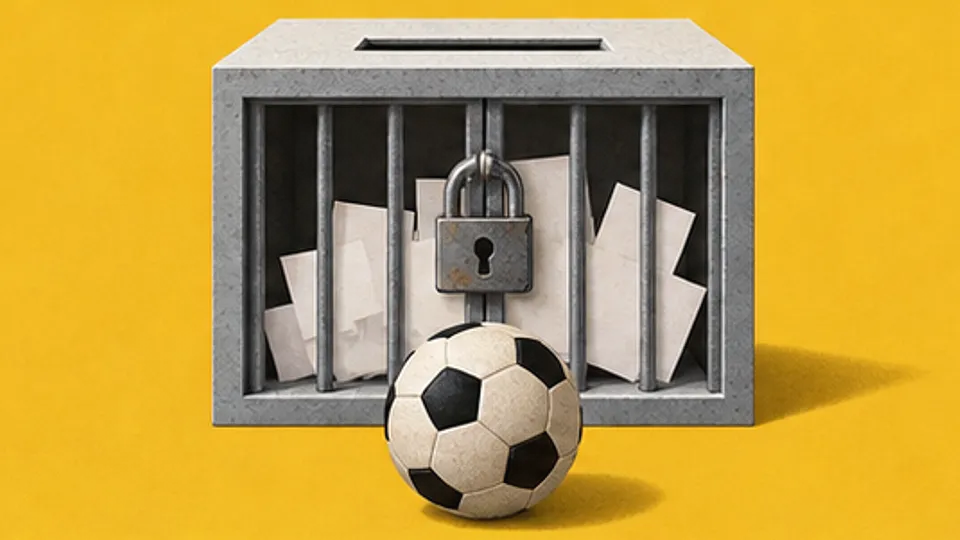
There is a door into politics, and every so often those who guard the door decide to close it. Israel’s Central Elections Committee has voted to bar the country’s two main Arab-majority political lists from next month’s parliamentary election — a decision that could leave Palestinian citizens of Israel without their principal representatives in the Knesset, according to Al Jazeera.
The committee also voted to disqualify two individual candidates: Ofer Cassif, a Jewish politician from the Arab–Jewish Hadash party, and Sami Abu Shehadeh, the leader of the Palestinian nationalist Balad party. The arithmetic of exclusion is plain. The lists through which Arab citizens have mainly spoken in parliament are struck from the ballot; the men who crossed the lines of ethnicity and party to speak alongside them are struck too. Al Jazeera notes the contrast in the rules as they fall: politicians facing arrest warrants from the International Criminal Court, or international sanctions, remain eligible to run.
What remains of a democracy when a fifth of its citizens lose their parties a month before the vote is a question the committee has answered with a shrug and a show of hands. The election is next month. The door, for now, is closed.
A fixture in search of a refusal
In another arena, under different lights, the same republic’s name has become a word athletes weigh in their mouths. Ireland are due to play Israel in the Nations League on Sunday in Debrecen, Hungary, where Israel’s “home” game is being held far from home. But on Saturday the machinery of matchday began to stall, the Associated Press reports.
Journalists in Debrecen were told, 15 minutes before the scheduled start, that the team’s news conference was being pushed back until after training. Training itself was significantly delayed. Irish broadcaster RTE reported the players were still in their hotel more than two hours after the session was supposed to begin — and that some players had decided they did not want to play the games.
“And if they stay to their stated ambition that they have to be all in it together, if one or more want to be out, maybe they will all be out,” RTE reporter Tony O’Donoghue told Radio 1.
Two fixtures stand in question: Sunday’s in Debrecen, and the return on October 4 — Ireland’s “home” game — in Backa Topola, Serbia. The pressure to boycott them has been building for months in a country where affinity with Palestinians runs deep. After Thursday’s 1-0 loss in Kosovo, midfielder Jason Knight said the players were in a difficult situation and that he did not think the matches should be going ahead.
The coach, the Icelander Heimir Hallgrimsson, had earlier put the dilemma in his own stark grammar: “we’re not playing with genocide, we’re playing against genocide. We’re playing against Israel, we’re not playing with Israel.” The Israeli football federation answered with fury, accusing him of “stupidity, ignorance and hypocrisy”.
The association’s cold arithmetic
The Football Association of Ireland has refused the boycott calls, arguing that the team could face punishing sanctions from UEFA — and Ireland is due to cohost the 2028 European Championship with England, Wales and Scotland. Institutions, it must be said, keep their faith in tournaments and spreadsheets; sanctions are measurable, conscience is not.
Yet the association’s own record carries an irony it cannot file away. Former Ireland coach Brian Kerr pointed out that back in November the FAI itself went to UEFA and requested that Israel be expelled from the tournament on principle. “And yet they went against that principle,” Kerr said. The FAI, he added, had “lost the respect of the Irish people.” “The Irish people and the soccer-going public don’t want the games to be played. I think they’ve made their opinions clear over the last year.”
More than 160 Irish sportspeople signed an open letter urging the association to reconsider. Protesters gathered outside the team hotel in Dublin last week. The SIPTU trade union raised a huge poster in central Dublin beside the River Liffey — “Go with your conscience!”, “Don’t play with genocide” — beside an image of a blood-splattered ball.
On Saturday in Debrecen the players stayed in their hotel and the clocks kept running. Somewhere between the ballot committee in Jerusalem and the hotel corridor in Hungary, ordinary people — voters without lists, footballers without a training session — are being asked to pretend that the structures above them are untouched by the war. The structures insist. The people, increasingly, decline.